9 Effective Async Communication Norms to Combat Meeting Fatigue
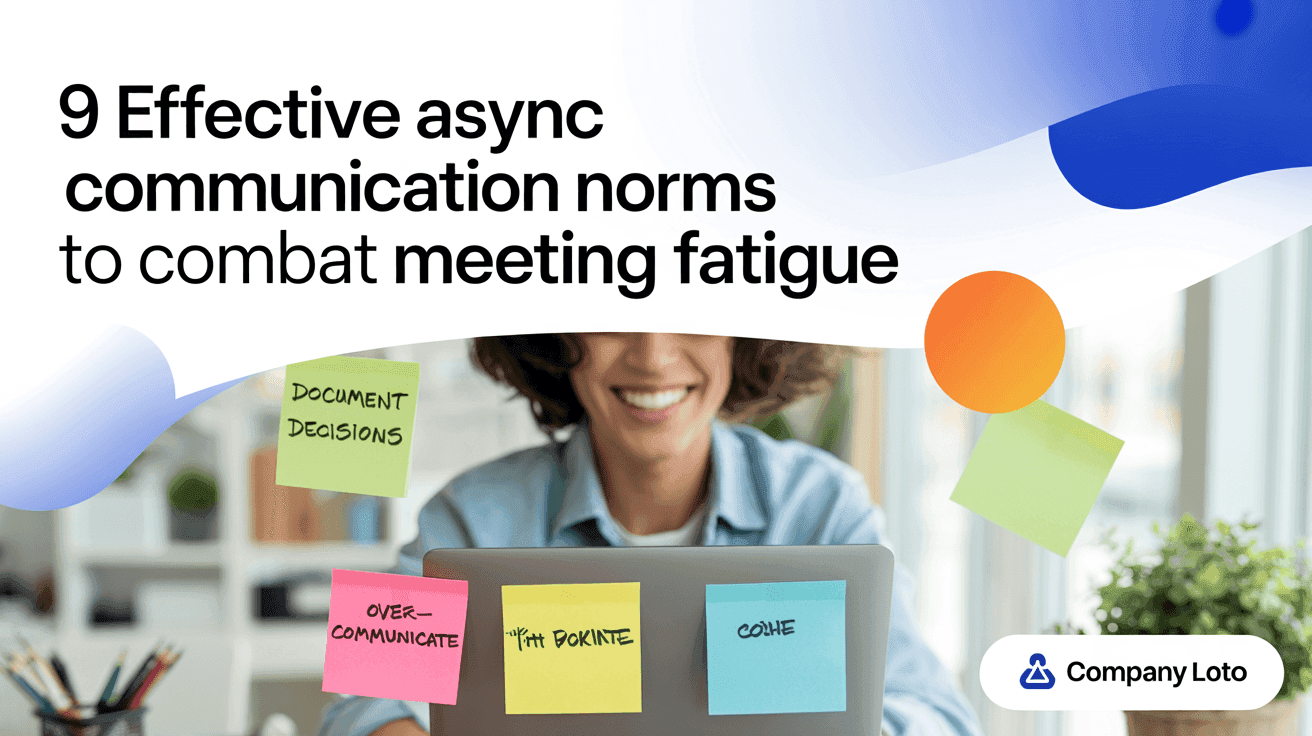
Table Of Contents
- Understanding Meeting Fatigue in the Modern Workplace
- The Psychology Behind Meeting Overload
- Benefits of Asynchronous Communication
- Effective Async Communication Norms
- 1. Establish Clear Documentation Protocols
- 2. Define Response Time Expectations
- 3. Implement Thoughtful Channel Selection
- 4. Create Detailed Async Updates
- 5. Develop Decision-Making Frameworks
- 6. Use Asynchronous Brainstorming Tools
- 7. Practice Clear Communication Hygiene
- 8. Schedule Focused Deep Work Time
- 9. Conduct Regular Communication Audits
- Implementation: Creating Your Async Communication Strategy
- Overcoming Common Challenges
- Measuring Success: KPIs for Async Communication
- Conclusion
Meeting fatigue has emerged as one of the most significant workplace challenges in recent years, particularly as remote and hybrid work arrangements have become commonplace. According to research by Microsoft, the average Teams user now experiences 252% more weekly meeting time compared to pre-pandemic levels, with the average workday expanding by 46 minutes. This digital overwhelm isn't just an inconvenience—it directly impacts employee wellbeing, productivity, and ultimately, your organization's bottom line.
At iGrowFit, we've worked with hundreds of Fortune 500 companies and observed firsthand how unmanaged meeting cultures create psychological strain on employees, leading to decreased engagement, higher stress levels, and diminished cognitive performance. The solution isn't simply to cancel all meetings but rather to develop thoughtful asynchronous communication norms that complement necessary synchronous interactions.
This article explores nine evidence-based asynchronous communication strategies that can significantly reduce meeting fatigue while maintaining or improving team collaboration, alignment, and productivity. Drawing from our experience with over 75,000 employees across diverse industries, we'll share practical implementation advice that aligns with both organizational goals and individual wellbeing needs.
Understanding Meeting Fatigue in the Modern Workplace
Meeting fatigue—often referred to as "Zoom fatigue" in remote contexts—describes the mental exhaustion that results from excessive or ineffective meetings. This phenomenon extends beyond simple tiredness; it represents a state of cognitive and emotional depletion that impacts productivity, creativity, and overall workplace satisfaction.
The symptoms often manifest as difficulty concentrating, decreased engagement, irritability, and a sense of time wasted. In our consultancy work at iGrowFit, we've documented how these symptoms directly correlate with decreased psychological capital—the mental resources employees need to perform at their peak.
Meeting fatigue particularly intensified during the pandemic as organizations overcompensated for physical distance with calendar-crushing meeting schedules. Many companies have yet to recalibrate their collaboration models, continuing patterns that research shows are unsustainable for long-term performance and employee wellbeing.
The Psychology Behind Meeting Overload
Understanding the psychological mechanisms behind meeting fatigue helps explain why simple calendar management isn't enough to solve the problem. Several cognitive factors contribute to meeting exhaustion:
-
Attention residue: When employees jump between meetings without adequate transitions, they carry cognitive remnants from previous discussions, reducing their effectiveness in subsequent interactions.
-
Decision fatigue: Each meeting typically requires multiple decisions, depleting the finite mental resources available for high-quality decision-making throughout the day.
-
Context switching costs: Research indicates that frequent context switching between different projects, teams, or topics can reduce productivity by up to 40%.
-
Self-presentation strain: The constant awareness of being observed in video meetings creates additional psychological load as employees manage their on-screen presence.
These psychological factors help explain why many workers report feeling exhausted despite seemingly doing "less" physical work than in pre-digital environments. The mental toll is substantial but often underrecognized in traditional productivity metrics.
Benefits of Asynchronous Communication
Asynchronous communication—where information is exchanged without requiring participants to engage simultaneously—offers a powerful alternative to meeting overreliance. The benefits extend beyond simply reducing calendar clutter:
Enhanced productivity: Asynchronous communication allows employees to respond at optimal times, aligning with their personal productivity rhythms rather than arbitrary meeting schedules.
Deeper thinking: By providing time for reflection before responding, async communication often yields more thoughtful, comprehensive responses than spontaneous meeting discussions.
Improved documentation: Async methods naturally create records of decisions and discussions, reducing the need for detailed meeting notes and minimizing information loss.
Global accessibility: For distributed teams across time zones, async communication eliminates the need to schedule meetings at inconvenient hours, promoting work-life balance.
Inclusion advantages: Thoughtful async practices give equal voice to team members who may be less comfortable speaking up in traditional meetings, especially those from different cultural backgrounds or communication styles.
While synchronous meetings will always have their place for relationship building, complex problem-solving, and sensitive discussions, strategic async implementation can dramatically reduce unnecessary meeting load.
Effective Async Communication Norms
1. Establish Clear Documentation Protocols
Effective asynchronous communication begins with robust documentation systems. When information is easily discoverable, teams naturally require fewer clarification meetings. We recommend implementing:
- A centralized knowledge base organized by project, department, and topic
- Standardized templates for different types of documentation (project briefs, status updates, decision logs)
- Clear ownership designation for maintaining and updating key documents
- Regular audits to remove outdated information and reduce information overload
Consistent documentation protocols reduce the "I must have missed that email" syndrome that drives unnecessary catch-up meetings. By creating a single source of truth for important information, teams can operate with greater autonomy and confidence.
2. Define Response Time Expectations
One common concern with asynchronous communication is uncertainty about when responses will arrive. This anxiety often drives teams back to meetings where immediate feedback is guaranteed. Counter this by establishing clear response time norms:
- Define expected response windows for different communication channels (e.g., 24 hours for email, 4 hours for chat during working hours)
- Create urgency indicators that team members respect (differentiating between "need feedback by EOD" versus "FYI only")
- Establish escalation pathways for truly time-sensitive matters
- Encourage batch processing of communications at designated times rather than constant reactivity
These expectations allow team members to plan their work confidently while respecting each other's focus time. In our consulting engagements, we've found that teams with clear response expectations typically reduce meeting time by 30-40% while maintaining or improving coordination quality.
3. Implement Thoughtful Channel Selection
Communication channel proliferation can be as problematic as meeting overload. Effective async communication requires intentional channel selection based on the nature of the information being shared:
- Document-based collaboration tools for complex information requiring context and nuance
- Chat platforms for quick questions and informal updates
- Project management systems for task-related communications and progress tracking
- Email for formal communications with external stakeholders or when a record is needed
Part of establishing healthy async norms is training teams to match the message to the medium. This prevents the "we need a meeting to sort through all these scattered communications" problem that many organizations face.
4. Create Detailed Async Updates
Many status update meetings can be eliminated by implementing structured asynchronous reporting. These updates should:
- Follow consistent formats that make information easy to scan and absorb
- Include progress highlights, blockers, upcoming priorities, and specific questions requiring input
- Link to relevant documents, data, or resources that provide context
- Clearly indicate what actions are needed from recipients, if any
We've helped teams transition from weekly 60-minute status meetings to 15-minute focused discussions by moving updates to an async format. The key is ensuring the updates are substantial enough to truly replace the informational component of meetings.
5. Develop Decision-Making Frameworks
Many meetings occur because teams lack clear processes for making decisions asynchronously. Implement frameworks that specify:
- Which decisions can be made unilaterally, consultatively, or by consensus
- How proposals should be documented and shared for consideration
- Timeframes for providing input on different types of decisions
- Methods for registering agreement, concerns, or alternative suggestions
Tools like decision matrices, RAPID frameworks (Recommend, Agree, Perform, Input, Decide), or simple approval workflows can dramatically reduce decision bottlenecks that drive meeting scheduling.
6. Use Asynchronous Brainstorming Tools
Creative collaboration doesn't always require real-time meetings. Asynchronous brainstorming often produces more diverse ideas and allows for deeper consideration:
- Digital whiteboard tools that allow team members to build on each other's ideas over time
- Structured ideation templates that prompt different thinking angles
- Comment and voting features that help refine and prioritize concepts
- Time-boxed ideation periods followed by synthesis of key themes
While initial kickoffs and final synthesis may benefit from synchronous discussion, the core ideation work often yields better results when done asynchronously, particularly for diverse teams with varying thinking styles.
7. Practice Clear Communication Hygiene
Ambiguous communication quickly drives teams back to meetings for clarification. Async communication requires particular attention to clarity:
- Using descriptive subject lines and headers that convey the main point
- Front-loading key information and requests rather than burying them in context
- Breaking complex information into digestible sections with clear headings
- Reviewing communications for potential misinterpretations before sending
In our experience at iGrowFit, communication clarity directly correlates with meeting reduction. Teams that invest in communication quality training typically see a 20-25% decrease in clarification meetings within three months.
8. Schedule Focused Deep Work Time
Asynchronous communication works best when teams have protected time to engage thoughtfully with content and requests. Encourage:
- Blocked calendar time designated for deep work and async communication processing
- Team-wide "meeting-free" days or half-days to create shared focus periods
- Notification management practices that prevent constant interruptions
- Respect for colleagues' focus time by avoiding expectation of immediate responses
These practices create the conditions for high-quality asynchronous engagement, preventing the cycle where poor async communication drives more meetings.
9. Conduct Regular Communication Audits
Communication patterns should evolve based on team needs and effectiveness data. Implement regular audits to evaluate:
- Which meetings consistently deliver value versus those that could be handled asynchronously
- Communication bottlenecks or friction points where information flow breaks down
- Team satisfaction with current communication methods and workload
- Alignment between communication practices and key performance indicators
These reviews prevent communication debt—the accumulation of inefficient practices that gradually erode productivity and wellbeing.
Implementation: Creating Your Async Communication Strategy
Transitioning to more asynchronous communication requires intentional change management. Follow these implementation steps:
Start with a baseline assessment: Measure current meeting loads, communication satisfaction, and identify specific pain points.
Pilot with receptive teams: Begin implementing async norms with groups that are motivated to reduce meeting fatigue.
Provide skill development: Many async communication challenges stem from insufficient training in written communication, documentation, and digital tool usage.
Lead by example: Leadership must model appropriate async behaviors, particularly respecting focus time and not expecting immediate responses.
Gather continuous feedback: Create regular check-in mechanisms to identify what's working and what needs refinement.
Remember that the goal isn't to eliminate all synchronous communication but to be more intentional about when real-time interaction adds genuine value.
Overcoming Common Challenges
Even with careful planning, organizations typically encounter several challenges when shifting toward async communication:
Cultural resistance: Some team members may perceive async communication as less engaging or feel disconnected without frequent face time.
Solution: Balance async work with meaningful synchronous connection opportunities focused on relationship building rather than status updates.
Tool overwhelm: The proliferation of digital tools can create fragmentation and confusion about where to find information.
Solution: Consolidate tools where possible and create clear guidance on which platforms serve which purposes.
Accountability concerns: Managers sometimes worry that less visibility will lead to reduced accountability.
Solution: Focus on outcomes rather than activity, implementing clear deliverable tracking that doesn't depend on synchronous check-ins.
Communication skill gaps: Async communication requires strong writing skills that not all team members may possess.
Solution: Provide training and templates that support clear written communication, with extra coaching for those who struggle.
Measuring Success: KPIs for Async Communication
To ensure your async communication strategy is delivering results, track these key indicators:
- Total meeting hours per employee (aim for reduction of non-essential meetings)
- Employee satisfaction with communication load and effectiveness
- Time to decision on key initiatives
- Quality of documentation and information accessibility
- Project completion rates and deadline adherence
- Employee wellbeing metrics like stress levels and work-life balance satisfaction
Effective async communication should improve both productivity metrics and employee experience measures. If you're seeing improvement in one area but not the other, your implementation may need adjustment.
Conclusion
Meeting fatigue represents a significant threat to workplace productivity, innovation, and employee wellbeing. By implementing thoughtful asynchronous communication norms, organizations can create more sustainable work patterns that respect cognitive limitations while maintaining effective collaboration.
The nine strategies outlined in this article—from documentation protocols to communication audits—offer a comprehensive framework for reducing meeting overload. However, successful implementation requires ongoing attention to team needs, communication quality, and continuous improvement.
At iGrowFit, we've observed that organizations that successfully balance synchronous and asynchronous communication typically see improvements not just in meeting reduction but in overall employee engagement, retention, and business outcomes. The investment in developing these norms pays dividends across multiple dimensions of organizational health.
Reducing meeting fatigue through effective asynchronous communication norms isn't simply about having fewer meetings—it's about fundamentally rethinking how teams share information, make decisions, and collaborate. The psychological benefits extend beyond time savings to include reduced stress, improved focus, and greater autonomy—all critical components of the psychological capital that drives sustainable high performance.
While the transition requires intentional effort and skill development, the long-term benefits make this a worthwhile investment for organizations committed to both business excellence and employee wellbeing. As work continues to evolve, the ability to communicate effectively across time and space will only become more valuable.
The most successful organizations will be those that thoughtfully design their communication practices rather than defaulting to calendar-filling meeting habits. By implementing these nine async communication norms, you can create a more productive, engaged, and sustainable workplace where teams can truly hit goals and finish tasks consistently—without the drain of meeting overload.
Ready to transform your organization's communication culture and reduce meeting fatigue? Contact iGrowFit today for a customized assessment of your team's communication patterns and a tailored implementation plan for effective async communication norms. Our team of management consultants, psychologists, and workplace wellbeing experts can help you design communication practices that enhance both productivity and employee experience.