Autism Workplace Accommodations: 12 Practical Adjustments That Work
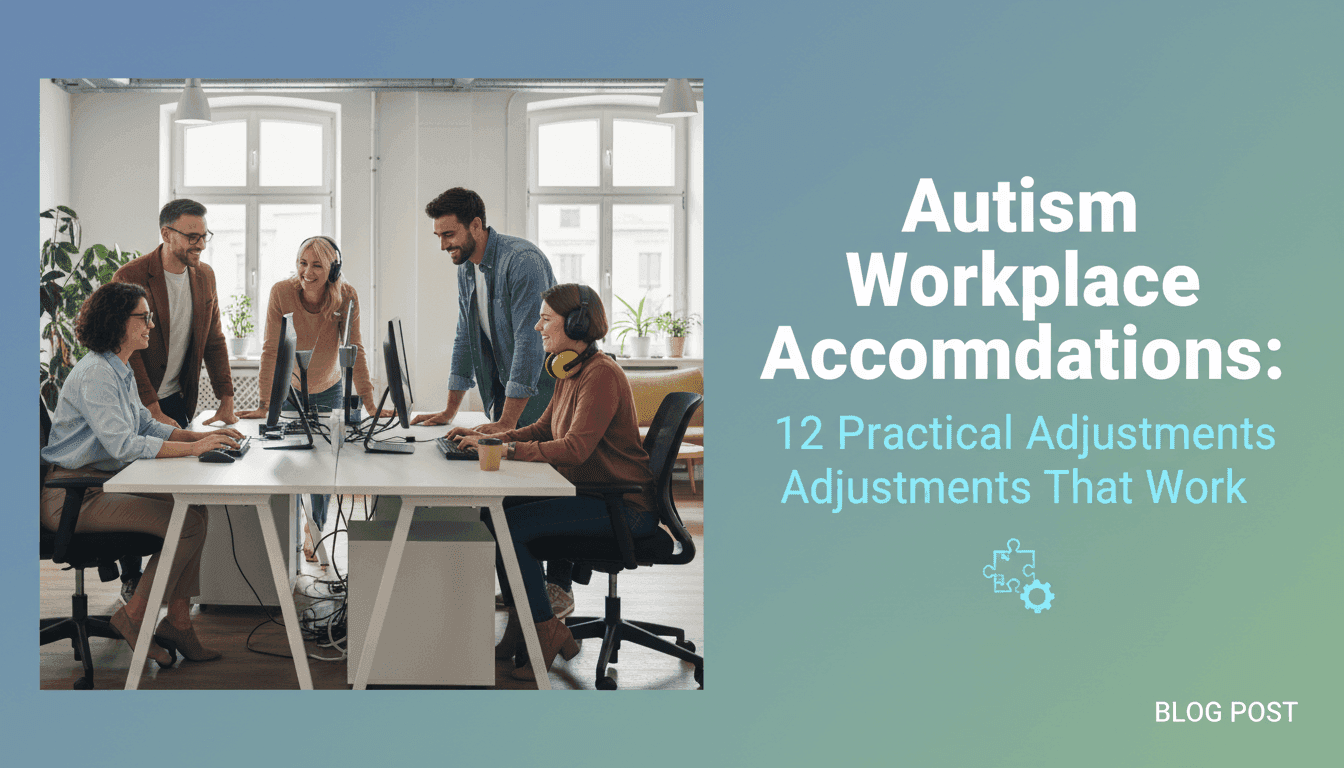
Table Of Contents
- Why Autism Workplace Accommodations Matter More Than Ever
- Understanding What Autistic Employees Actually Need
- 12 Practical Autism Workplace Accommodations
- 1. Sensory-Friendly Workspaces
- 2. Clear, Written Communication
- 3. Structured Routines and Predictable Schedules
- 4. Flexible Working Arrangements
- 5. Noise-Reduction Tools
- 6. Dedicated Quiet Spaces
- 7. Explicit Social and Meeting Norms
- 8. Regular One-on-One Check-Ins
- 9. Task Management and Visual Aids
- 10. Adjusted Performance Review Processes
- 11. Neurodiversity Awareness Training for Teams
- 12. Access to EAP and Mental Health Support
- How to Implement Accommodations Without Singling Anyone Out
- The Business Case for Getting This Right
- Final Thoughts
Autism Workplace Accommodations: 12 Practical Adjustments That Work
Most workplaces are not designed with autistic employees in mind — and the performance gap this creates is entirely preventable. Research consistently shows that autistic individuals bring exceptional strengths to the workplace, including heightened attention to detail, strong pattern recognition, deep focus, and remarkable reliability. Yet without the right autism workplace accommodations, these strengths are often buried under environments that overwhelm, confuse, or exclude.
For HR professionals, team leaders, and business owners, implementing thoughtful accommodations is not simply about compliance or optics. It is about unlocking human potential that might otherwise remain hidden. At iGrowFit, we have spent over 15 years partnering with organisations across Singapore and beyond to build psychologically healthy workplaces where every employee can perform at their best. In that work, we have seen firsthand how small, targeted adjustments can produce profound results for autistic employees and for entire teams.
This guide walks you through 12 practical autism workplace accommodations that are grounded in evidence, straightforward to implement, and genuinely effective. Whether you are supporting a newly disclosed employee or building a proactively inclusive workplace culture, these strategies give you a concrete starting point.
Why Autism Workplace Accommodations Matter More Than Ever {#why-accommodations-matter}
Autism Spectrum Disorder (ASD) is more prevalent in the workforce than many organisations realise. Global estimates suggest that approximately 1 in 100 people are autistic, and a significant proportion of those individuals are either employed or actively seeking employment. However, unemployment and underemployment rates among autistic adults remain disproportionately high, not because autistic individuals lack capability, but because workplaces frequently lack flexibility.
The social, sensory, and communicative demands of conventional office environments can create unnecessary friction for autistic employees. Open-plan offices, ambiguous verbal instructions, unpredictable schedules, and neurotypical social norms can all compound into barriers that have nothing to do with job performance. When organisations address these barriers through autism workplace accommodations, the results are compelling: lower absenteeism, higher retention, improved team morale, and access to a pool of talent that competitors overlook.
Understanding What Autistic Employees Actually Need {#understanding-needs}
Before diving into specific adjustments, it is important to recognise that autism is a spectrum. No two autistic individuals experience the world in exactly the same way. Some may have heightened sensory sensitivities; others may find social ambiguity particularly challenging. Some will thrive with minimal supervision once given clear instructions; others may benefit from more frequent structured feedback.
The most effective approach begins with a genuine, confidential conversation. Ask the employee what specific challenges they experience and what has worked well for them in the past. Avoid assumptions based on stereotypes, and frame the discussion around performance enablement rather than deficit correction. This person-centred approach aligns with the evidence-based methodology that underpins iGrowFit's EAP and coaching frameworks, which prioritise understanding the individual before prescribing solutions.
12 Practical Autism Workplace Accommodations {#12-accommodations}
1. Sensory-Friendly Workspaces {#sensory-friendly}
Many autistic individuals have heightened sensitivity to sensory input, including lighting, sound, smell, and physical texture. Fluorescent lighting that flickers, strong fragrances from colleagues, or the constant hum of HVAC systems can create genuine cognitive overload that makes sustained concentration extremely difficult. Simple adjustments, such as allowing the use of warm-toned desk lamps, offering unscented workplace policies, or providing ergonomic seating options, can significantly reduce sensory burden without requiring major infrastructure changes.
2. Clear, Written Communication {#written-communication}
Verbal instructions that are vague, rapid, or delivered in group settings can be difficult for autistic employees to process accurately. Supplementing spoken communication with written summaries, email follow-ups, or detailed written briefs gives autistic employees the time and clarity they need to process information without the added pressure of real-time decoding. This practice, incidentally, benefits the entire team by reducing miscommunication across the board.
3. Structured Routines and Predictable Schedules {#structured-routines}
Unpredictability is one of the most consistently reported stressors for autistic employees. Last-minute meeting changes, shifting deadlines, and unclear role expectations can trigger significant anxiety that disrupts productivity. Wherever possible, provide advance notice of schedule changes, share meeting agendas beforehand, and maintain consistency in daily workflow structures. When changes are unavoidable, communicate them as early as possible with clear explanations of what will be different and why.
4. Flexible Working Arrangements {#flexible-working}
Remote or hybrid working options have proven particularly beneficial for many autistic employees, offering greater control over their sensory environment, social interactions, and daily structure. Flexibility around start and finish times can also help employees who may need additional time to transition between home and work contexts. The key is not unlimited flexibility, which can itself be anxiety-inducing, but rather a clearly agreed-upon and consistent flexible structure.
5. Noise-Reduction Tools {#noise-reduction}
Providing noise-cancelling headphones or earbuds is one of the lowest-cost, highest-impact accommodations available. For autistic employees who are sensitive to sound, the ability to filter out background noise can mean the difference between a productive workday and one spent in a state of constant overstimulation. Normalising the use of headphones in the workplace removes the social stigma that sometimes prevents employees from using tools that would genuinely help them.
6. Dedicated Quiet Spaces {#quiet-spaces}
Beyond individual tools, having access to a designated quiet room or low-stimulation zone gives autistic employees a place to decompress during overwhelming moments or to concentrate on complex tasks. These spaces benefit the wider workforce too, providing a resource for anyone who needs to work without distraction. Framing quiet spaces as a general productivity resource rather than a disability accommodation helps normalise their use.
7. Explicit Social and Meeting Norms {#social-norms}
The unwritten social rules of workplace interactions, such as when to speak up in meetings, how to handle disagreement professionally, or how much small talk is expected, are invisible to many neurotypical employees but can be genuinely confusing for autistic individuals. Making these norms explicit removes the guesswork. Sharing a simple guide to meeting etiquette, clarifying how feedback is typically delivered, or explaining the purpose of informal team social events can dramatically reduce social anxiety and help autistic employees participate more confidently.
8. Regular One-on-One Check-Ins {#one-on-ones}
Frequent, structured check-ins with a direct manager provide autistic employees with reliable opportunities to ask questions, clarify expectations, and raise concerns in a low-pressure setting. These conversations work best when they follow a consistent format, happen at a predictable time, and include a written summary of any actions agreed upon. Rather than waiting for performance reviews to surface issues, regular check-ins catch small misalignments before they become significant problems.
9. Task Management and Visual Aids {#task-management}
Project management tools, visual timelines, and structured task lists give autistic employees a concrete framework for organising their work. Tools such as Trello, Asana, or even a well-structured shared document can make priorities explicit and reduce the cognitive load of figuring out what to do next. When possible, break larger projects into clearly defined smaller tasks with specific deadlines, and confirm priorities in writing rather than leaving them open to interpretation.
10. Adjusted Performance Review Processes {#performance-reviews}
Traditional performance reviews often rely heavily on subjective social assessments, such as 'teamwork', 'communication style', or 'executive presence', which may not accurately reflect the contributions of autistic employees whose strengths show up differently. Reviewing performance against objective, agreed-upon criteria; sharing review questions in advance; and separating feedback about work output from feedback about social style creates a fairer and more accurate evaluation process. This approach also tends to produce more actionable feedback for all employees.
11. Neurodiversity Awareness Training for Teams {#awareness-training}
Accommodations for individual employees are significantly more effective when the surrounding team understands and supports neurodiversity. Providing education about autism and neurodivergence reduces stigma, builds empathy, and helps colleagues understand why certain accommodations are in place without requiring the autistic employee to constantly explain themselves. iGrowFit's training programmes can be tailored to equip teams with the psychological literacy needed to build genuinely inclusive cultures rather than simply compliant ones.
12. Access to EAP and Mental Health Support {#eap-support}
Many autistic employees experience co-occurring mental health challenges such as anxiety, depression, or burnout, often as a direct result of the effort required to navigate neurotypical environments day after day. This phenomenon, known as autistic masking or camouflaging, is exhausting and has long-term wellbeing consequences. Providing access to a comprehensive Employee Assistance Programme that includes psychologists, counsellors, and coaches who understand neurodivergence gives autistic employees a confidential, professional space to process these experiences and build sustainable coping strategies.
How to Implement Accommodations Without Singling Anyone Out {#implementation}
One of the most common concerns employers raise is how to implement autism-specific accommodations without making the individual employee feel stigmatised or singled out. The most effective answer is universal design: building flexibility, clarity, and sensory awareness into the workplace for everyone, so that autistic employees are simply using features that happen to exist across the organisation.
For example, offering all employees the option to receive written meeting summaries, providing quiet zones available to the whole team, or making noise-cancelling headphones part of standard office equipment removes the need for any individual to declare a disability in order to access support. Where individual accommodations are genuinely needed, keep the conversation confidential, frame it as a performance partnership discussion, and document agreed adjustments in writing so that both parties have clarity and accountability.
The Business Case for Getting This Right {#business-case}
Organisations that invest in autism workplace accommodations are not simply being altruistic. They are making a sound strategic investment. Studies in organisational psychology consistently show that inclusive workplaces report higher employee engagement, lower turnover, and stronger innovation outcomes. Autistic employees who are properly supported often demonstrate exceptional depth of expertise, meticulous quality standards, and loyalty that translates into long-term institutional knowledge.
Furthermore, the accommodations described in this article are overwhelmingly low-cost or no-cost. The greater investment is in cultural willingness, managerial capability, and the right support infrastructure. That is precisely where a strategic EAP partner adds the most value, by equipping leaders with the tools, frameworks, and psychological expertise to make inclusion a lived experience rather than a policy document.
Final Thoughts {#final-thoughts}
Creating a workplace where autistic employees can genuinely thrive is neither complicated nor expensive. It requires clarity, consistency, empathy, and a willingness to move beyond one-size-fits-all assumptions about how work gets done. The 12 autism workplace accommodations outlined in this guide are practical entry points, each one grounded in evidence, endorsed by lived experience, and implementable without disrupting broader team operations.
The organisations that get this right do not just benefit their autistic employees — they build stronger, more adaptive, more human workplaces for everyone. At iGrowFit, we believe that developing people's psychological capital is the most sustainable competitive advantage any business can build. Supporting neurodivergent employees with the right accommodations is a powerful expression of that belief in action.
Ready to build a more inclusive, high-performing workplace?
If you are looking to implement autism-friendly workplace practices or strengthen your organisation's broader Employee Assistance Programme, our team at iGrowFit is here to help. We offer evidence-based EAP services, neurodiversity awareness training, and bespoke organisational consulting tailored to your specific workforce needs.
Chat with us on WhatsApp today and let's talk about how we can help your people hit goals and finish tasks — every single one of them.