Corporate Counselling vs EAP: Which Model Fits Your Organisation?
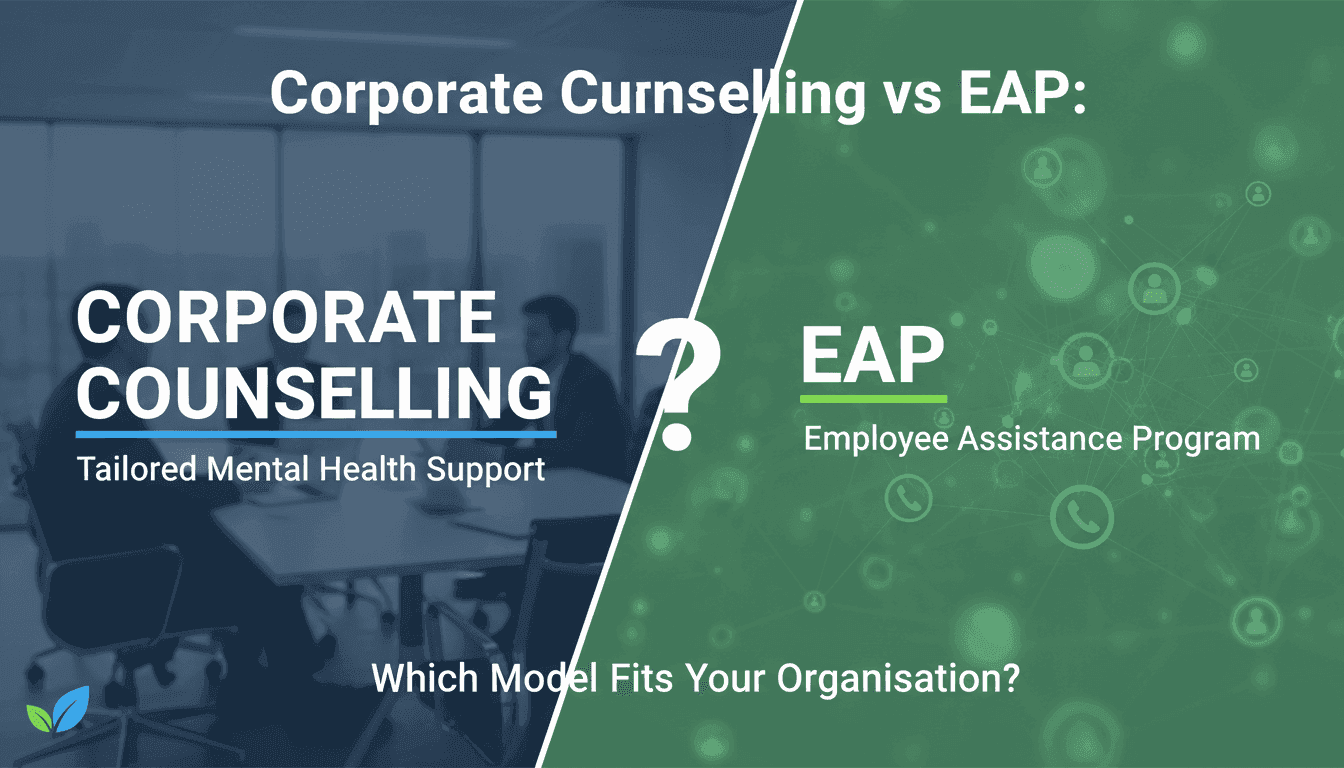
Table Of Contents
- What Is Corporate Counselling?
- What Is an Employee Assistance Program (EAP)?
- Key Differences Between Corporate Counselling and EAP
- When Corporate Counselling Is the Right Fit
- When an EAP Is the Right Fit
- Can Both Models Work Together?
- How to Choose the Right Model for Your Organisation
- Why iGrowFit's EAP Approach Stands Apart
Corporate Counselling vs EAP: Which Model Fits Your Organisation?
Mental health at work is no longer a discretionary benefit — it is a strategic business priority. Yet many HR leaders and business owners find themselves stuck at a familiar crossroads: should we bring in a corporate counsellor, or invest in a full Employee Assistance Program? The two models are often used interchangeably in conversation, but they serve very different purposes, operate at different scales, and deliver different outcomes for your people and your organisation.
This article breaks down the core differences between corporate counselling and EAPs, examines the strengths and limitations of each, and gives you a practical framework for deciding which approach — or which combination — is the right fit for where your organisation stands today.
What Is Corporate Counselling? {#what-is-corporate-counselling}
Corporate counselling refers to the provision of professional psychological support delivered directly within or through an organisation, typically by a qualified counsellor or psychologist engaged on a retainer or project basis. The focus is predominantly clinical: helping individual employees work through personal or work-related issues such as stress, grief, relationship difficulties, or performance anxiety. Sessions are usually confidential, often held on-site or via video, and are either self-referred by the employee or recommended by a line manager or HR partner.
At its core, corporate counselling is a targeted, one-to-one intervention. It treats the individual as the unit of change. While this makes it highly personalised, it also means the impact is limited to those who actively seek help — which, given the persistent stigma around mental health in many workplaces, is often a minority of those who actually need it. Corporate counselling can be enormously valuable in a crisis moment, but it rarely addresses the systemic or cultural factors that created the stress in the first place.
What Is an Employee Assistance Program (EAP)? {#what-is-an-eap}
An Employee Assistance Program is a structured, organisation-wide support system that combines psychological services with a broader ecosystem of resources — including counselling, coaching, training, assessments, crisis intervention, and often management consultation. Where corporate counselling focuses on the individual, an EAP is designed to strengthen the entire workforce by addressing mental health at multiple levels simultaneously: the individual, the team, and the organisation.
A well-designed EAP goes beyond reactive support. It includes proactive elements such as psychoeducation workshops, resilience training, leadership development, and data-driven insights that help organisations understand workforce wellbeing trends before they escalate into absenteeism, turnover, or burnout crises. EAPs are typically offered through a third-party provider with a multi-disciplinary team, giving employees and managers access to a wider range of expertise than a single counsellor could provide. They are confidential, accessible, and scalable — qualities that make them particularly well-suited to organisations with diverse, geographically distributed, or fast-growing teams.
Key Differences Between Corporate Counselling and EAP {#key-differences}
Understanding the distinction between these two models requires looking at more than just price or headcount. Here are the most important dimensions to consider:
Scope of intervention: Corporate counselling addresses the individual. An EAP addresses the individual, the team, and the organisation's culture and systems.
Range of services: Counselling focuses on therapeutic conversations. EAPs typically include counselling, coaching, crisis support, workshops, leadership training, psychometric assessments, and manager consultation.
Accessibility: Counselling usually requires the employee to actively seek help. EAPs often include proactive outreach, digital resources, and training programmes that reach employees who would never walk into a counsellor's office.
Data and measurement: Corporate counselling rarely generates organisational-level data. EAPs can provide aggregated, anonymised insights that help HR leaders and management make evidence-based decisions about workforce wellbeing.
Cultural impact: Counselling treats symptoms. EAPs — when implemented well — help shift organisational culture toward psychological safety, openness, and sustainable performance.
Cost structure: Corporate counselling is typically charged per session or on a retainer. EAPs are usually priced per employee per year, making costs predictable and scalable.
When Corporate Counselling Is the Right Fit {#when-corporate-counselling}
Corporate counselling makes the most sense in specific, well-defined situations. If your organisation is a small team of fewer than 30 people, the overhead of a full EAP infrastructure may exceed your immediate needs. In these cases, engaging a trusted counsellor who understands your workplace context can be a practical and cost-effective starting point.
Corporate counselling is also appropriate as a crisis-response measure — for example, following a traumatic incident, a sudden bereavement, or a period of acute organisational disruption such as a restructure or retrenchment. Having a counsellor on-call or on-site during these moments provides immediate, compassionate support to affected employees.
Finally, some organisations choose corporate counselling as a complement to a broader wellbeing strategy, not as a standalone solution. In this configuration, the counsellor works alongside HR and occupational health teams to provide specialist psychological input on complex individual cases, while other elements of the wellbeing programme address team-level and organisational-level needs.
When an EAP Is the Right Fit {#when-eap}
For most organisations with 50 or more employees — and certainly for those operating across multiple sites, industries, or demographics — an EAP offers significantly greater value and reach than counselling alone. The reasons are both strategic and practical.
If your organisation is experiencing elevated levels of presenteeism, stress-related absenteeism, high turnover, or declining engagement scores, these are signals that the issue is systemic, not just individual. An EAP's ability to work at the organisational level — through leadership coaching, manager training, and cultural assessment — means it can address root causes rather than only treating symptoms after the fact.
EAPs are also the right fit when confidentiality and accessibility need to be guaranteed at scale. Employees are more likely to reach out for help when support is offered through a neutral third party rather than through an internal resource they associate with management or performance evaluation. The psychological safety created by this separation is one of the most important — and underappreciated — advantages of a well-structured EAP.
Organisations committed to employee wellbeing as a business strategy rather than a compliance checkbox will also find that EAPs deliver measurable return on investment. Research consistently shows that every dollar invested in mental health support at work generates significant returns through reduced absenteeism, improved productivity, and lower recruitment and training costs associated with turnover.
Can Both Models Work Together? {#can-both-work-together}
The corporate counselling versus EAP framing can sometimes create a false binary. In practice, many high-performing organisations use elements of both, with the EAP providing the structural backbone and individual counselling serving as a specialised resource for complex or high-acuity cases.
For example, an EAP might handle the majority of employee referrals through a network of counsellors and coaches, while the organisation also retains a dedicated psychologist for executive-level coaching or to support employees navigating particularly severe mental health challenges. This layered approach ensures broad coverage at the population level while also meeting the intensive needs of individuals who require more specialist input.
The key is intentional integration — understanding what each element of your wellbeing strategy is designed to achieve, who it is designed to reach, and how the different components reinforce one another. Without this intentionality, organisations risk duplicating efforts, confusing employees about where to turn for help, or creating gaps that leave high-risk individuals without appropriate support.
How to Choose the Right Model for Your Organisation {#how-to-choose}
Deciding between corporate counselling and an EAP — or a combination of both — comes down to four practical questions:
-
What is the scale of need? Consider your headcount, geographic spread, and the diversity of challenges your workforce faces. Larger, more complex organisations generally benefit most from the breadth of an EAP.
-
What are your current pain points? If you are responding to individual crises, counselling may be sufficient. If you are trying to shift culture, develop leaders, or reduce systemic stress, an EAP is better equipped.
-
How proactive do you want to be? Corporate counselling is inherently reactive. If your organisation values prevention and early intervention — which the evidence strongly supports — an EAP is the more appropriate vehicle.
-
What outcomes will you measure? Define what success looks like before you invest. If your goal is to reduce absenteeism rates, improve engagement scores, or demonstrate wellbeing ROI to senior leadership, choose a model that generates the data to prove impact.
It is also worth engaging your employees in this decision. Anonymous surveys or focus groups can reveal what kinds of support your people actually want and would use — insights that are often more valuable than any benchmark comparison.
Why iGrowFit's EAP Approach Stands Apart {#igrowfit-approach}
Not all EAPs are created equal. Many off-the-shelf programmes offer little more than a counsellor hotline and a library of self-help articles — a level of support that rarely moves the needle on organisational wellbeing in any meaningful way.
iGrowFit takes a fundamentally different approach. Built on more than 15 years of experience working with over 450 Fortune 500 companies, MNCs, and SMEs across the region, iGrowFit's EAP is designed around the belief that sustainable performance comes from psychological capital — the internal resources of confidence, hope, resilience, and optimism that allow people to do their best work even under pressure.
The iGrowFit model is delivered through the ConPACT framework — an integrated system of Consultancy, Profiling, Assessments, Coaching, and Training — that gives organisations a truly holistic approach to workforce wellbeing. Rather than treating mental health as a separate HR function, iGrowFit aligns wellbeing strategy directly with business goals, ensuring that every intervention contributes to measurable performance outcomes. With a multi-disciplinary team of psychologists, coaches, management consultants, and researchers, iGrowFit can address challenges at every level — from the individual employee seeking support to the executive team designing an organisational culture that enables people to consistently hit goals and finish tasks.
For organisations in Singapore and across the region, iGrowFit also brings the credibility of national-level partnerships, including work with Singapore's Health Promotion Board on psychological wellbeing initiatives — a testament to the evidence-based rigour that underpins every programme they deliver.
Making the Right Choice for Your People
The question of corporate counselling versus EAP is ultimately a question about what kind of organisation you want to be. If you are looking for a safety net for individuals in crisis, corporate counselling may be enough to start. But if you are building an organisation where wellbeing is woven into the culture, where leaders are equipped to support their teams, and where mental health is treated as a driver of performance rather than a cost centre, an EAP is the stronger, more future-ready investment.
The best time to put the right support in place is before your people need it most. Start the conversation now — your workforce will thank you for it.
Ready to find the right fit for your organisation?
Talk to the iGrowFit team today to explore which EAP model best matches your organisation's size, culture, and wellbeing goals. Our specialists will help you design a programme that moves beyond tick-box compliance and delivers real, measurable impact for your people.