Corporate Mental Health Program: A Step-by-Step Build Guide for HR
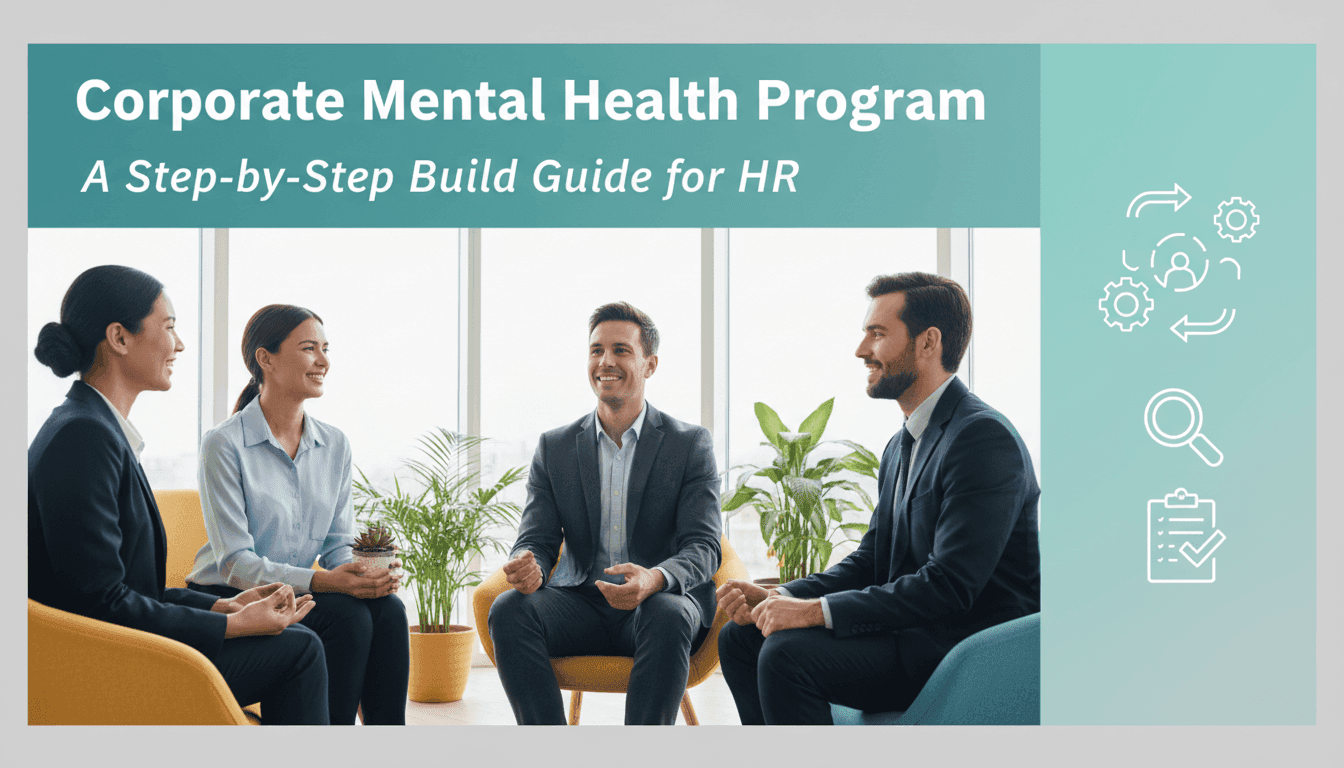
Table Of Contents
- Why Corporate Mental Health Programs Are No Longer Optional
- The Business Case: What the Data Actually Shows
- Step 1: Conduct a Baseline Needs Assessment
- Step 2: Secure Leadership Buy-In Before You Build Anything
- Step 3: Design Your Program Around Psychological Capital, Not Just Crisis Response
- Step 4: Build a Multi-Layered Support Structure
- Step 5: Train Managers to Be the First Line of Support
- Step 6: Communicate, Destigmatize, and Drive Utilization
- Step 7: Measure, Iterate, and Sustain
- Common Pitfalls HR Leaders Must Avoid
- Conclusion: From Checkbox to Culture
Corporate Mental Health Program: A Step-by-Step Build Guide for HR
Your employees are showing up — but are they truly present? Across industries and organization sizes, HR leaders are grappling with a workforce quietly carrying enormous mental strain. Burnout, disengagement, anxiety, and the fear of being judged for speaking up have become normalized features of modern work, and the cost of inaction has never been higher.
The good news is that building a corporate mental health program is one of the highest-leverage investments an HR team can make. Done well, it reduces absenteeism, lifts productivity, strengthens retention, and — perhaps most importantly — creates the kind of psychologically safe culture where people can consistently hit their goals and finish what they start.
This guide is built specifically for HR professionals who are ready to move beyond wellness perks and build something structurally sound. Whether you are starting from zero or upgrading an existing initiative, the seven steps ahead will give you a clear, evidence-backed framework to design, launch, and sustain a corporate mental health program that actually works.
Why Corporate Mental Health Programs Are No Longer Optional {#why-corporate-mental-health-programs-are-no-longer-optional}
Mental health at work has moved from a fringe conversation to a boardroom priority — and the shift is irreversible. Mental health is no longer a secondary consideration; it has become a cornerstone of effective workforce strategy. For HR leaders, this means the question is no longer whether to invest in a mental health program, but how to build one that delivers real outcomes.
The scale of the challenge is significant. Over three-quarters of workers report experiencing work-related stress in the past month, and about 52% of employees say they have felt burned out in the last year due to their job. These aren't abstract statistics — they represent the people on your team managing deadlines, client pressures, and personal challenges simultaneously. Today's workforce faces unprecedented levels of stress, burnout, and competing personal and professional pressures, and without support, these challenges drive absenteeism, presenteeism, and turnover, eroding business performance.
For companies operating across Asia-Pacific — including Singapore, where workplace wellbeing has increasingly become a strategic imperative — the urgency is equally real. Organizations that treat mental health as a genuine priority are building a tangible competitive advantage in talent attraction, engagement, and long-term resilience.
The Business Case: What the Data Actually Shows {#the-business-case-what-the-data-actually-shows}
Before walking into a leadership meeting to propose budget for a corporate mental health program, HR leaders need more than good intentions — they need compelling numbers. The data is on your side.
Every $1 invested in promoting mental health has a $3 to $5 return. That figure comes from research cited by the SHRM Foundation, and it is supported by findings from multiple directions. Investments in wellbeing programs typically return four to five times their value, according to Dr. Wolfgang Seidl, Leader of Workplace Health Consulting at Mercer. The returns are not hypothetical — they are measurable through reduced healthcare costs, lower absenteeism, and stronger retention.
Retention alone is a powerful argument. SHRM data shows that workers who are burned out from work are nearly three times more likely to be actively searching for another job. Pair that with the productivity impact: employees struggling with depression demonstrate 35% lower productivity, while presenteeism — working while unwell — costs employers three times more than absenteeism. The cost of doing nothing, in other words, far exceeds the cost of building a program.
In a 2022 report by SHRM, SHRM Foundation, and Otsuka, 94% of HR professionals believed that offering mental health resources can improve the overall health of employees, 88% said these benefits can increase productivity, and 86% opined that these resources can improve employee retention. These numbers make the business case for a corporate mental health program as straightforward as any other strategic investment.
Step 1: Conduct a Baseline Needs Assessment {#step-1-conduct-a-baseline-needs-assessment}
Every effective corporate mental health program begins with listening before acting. Too many organizations skip this step and launch programs that miss the mark — offering solutions to problems their employees don't actually have, while overlooking the real pain points.
A needs assessment should answer three core questions: What are the primary sources of mental strain in your organization? Which employee groups are most affected? And what gaps exist in your current support structure? Start by reviewing your current employee benefits to identify gaps in access, communication, and utilization. Supplement this with confidential employee surveys, focus groups, and an analysis of existing data such as absenteeism rates, healthcare claims, and turnover trends.
Conducting a baseline psychosocial risk assessment and establishing the organization's specific risk profile before drafting begins is an essential first step. This data-driven foundation ensures your program addresses real needs rather than assumed ones. It also gives you a benchmark against which you can later measure impact — a critical step for demonstrating ROI to leadership.
Individual assessments help organizations understand the unique mental wellness needs of each staff member, and based on these assessments, customized support plans can be created that cater to individual needs. At an organizational level, this same principle applies: the more precisely you understand your workforce's profile, the more bespoke and effective your program will be.
Step 2: Secure Leadership Buy-In Before You Build Anything {#step-2-secure-leadership-buy-in-before-you-build-anything}
A mental health program that lives only inside the HR department is a program that will struggle to survive. Leadership visibility is not a nice-to-have — it is a structural requirement for any initiative that aims to shift culture.
Securing leadership buy-in and appointing a policy owner from the start is critical. Identifying a named senior leader who will sponsor the policy publicly sends a clear organizational signal. When leadership champions mental health openly — whether through town halls, written communications, or sharing their own experiences with stress and recovery — it creates permission for the rest of the organization to engage.
Management and leadership buy-in are critical to these transformations. When leaders model and champion support for mental health programs and initiatives, they help reinforce the organization's goals. This is particularly important for destigmatization. Research shows that when executives openly discuss their own use of mental health support, program utilization rates rise significantly across the organization.
Finding strategic partners within the organization to implement mental health initiatives is essential, rather than putting all of this on HR teams alone. Currently, 77% of HR professionals often feel caught in the middle of the strategic vision set by leadership and the practical realities employees face. Co-creating the program with leaders across functions — not just HR — ensures it carries organizational weight and stays funded.
Step 3: Design Your Program Around Psychological Capital, Not Just Crisis Response {#step-3-design-your-program-around-psychological-capital-not-just-crisis-response}
One of the most common mistakes organizations make is designing a mental health program that only activates when something goes wrong. Crisis support is necessary, but it is not sufficient. The most resilient, high-performing organizations build programs that proactively develop mental strength — not just manage distress.
This is where the concept of psychological capital (PsyCap) becomes a transformative lens for HR. Psychological capital, often abbreviated as PsyCap, represents an individual's positive psychological state of development. It encompasses four key components: hope, self-efficacy, resilience, and optimism, and has gained significant attention in both academic and professional circles due to its potential to enhance employee performance, job satisfaction, and overall well-being.
There is now substantial evidence that positive psychological interventions, and particularly PsyCap interventions, are effective in increasing positivity and producing a wide range of desirable work outcomes. For HR professionals, this means designing programs that go beyond access to therapy — they should include coaching, resilience training, strengths-based development, and initiatives that build an employee's belief in their own capacity to succeed.
At iGrowFit, this philosophy underpins every engagement. Rather than simply managing mental health symptoms, our approach focuses on building psychological capital for peak performance — developing the hope, efficacy, resilience, and optimism that allow employees to consistently perform at their best. PsyCap interventions are associated with enhanced wellbeing, improved performance, increased resilience, boosted optimism and hope, higher self-efficacy, and improved workplace attitudes. Designing your program with this proactive, developmental lens is what separates a truly transformative initiative from a reactive safety net.
Step 4: Build a Multi-Layered Support Structure {#step-4-build-a-multi-layered-support-structure}
No single intervention can address the full spectrum of employee mental health needs. Effective corporate mental health programs operate across multiple layers — from organization-wide culture initiatives down to individual access to professional support.
Here is a practical structure to guide your program design:
- Culture and awareness layer: Regular communication about mental health, destigmatization campaigns, mental health observance events, and leader storytelling that normalizes wellbeing conversations.
- Policy and flexibility layer: Policies should reflect your commitment to mental health support, including flexible work arrangements that acknowledge different life demands and generous leave policies that recognize the importance of rest and recovery.
- Professional support layer: A robust Employee Assistance Program (EAP) offering confidential counseling, psychological assessments, and referral pathways. EAP services may include assessments of employees' needs and referrals for diagnosis and treatment of mental health, substance use, or other issues. Educational and wellness programs — such as programs on stress management — are also staples of many EAPs.
- Developmental and coaching layer: Workshops, resilience coaching, strengths profiling, and team-level wellbeing interventions that build long-term psychological capital.
- Peer support layer: Introducing a peer-led support group or mental health ambassador program with volunteers who are naturally inclined to promote mental health creates community-level support that sustains engagement between formal interventions.
Mental health is not confined to workplace stress — it intersects with every dimension of a person's life. From family responsibilities and financial concerns to navigating major life changes, a holistic approach is essential for meaningful support. The most effective programs acknowledge this whole-person reality and build support structures that reflect it.
Step 5: Train Managers to Be the First Line of Support {#step-5-train-managers-to-be-the-first-line-of-support}
Managers sit at the most important intersection in any mental health program. They are often the first to notice when something is wrong with a team member, and they have the greatest daily influence over whether employees feel psychologically safe or silently struggling.
Yet many managers are underprepared for this role. A significant number of managers don't know what benefits are available to their team, and many aren't sure how to help their teams access support. A policy exists on paper; implementation exists in behavior. The gap between the two is where most workplace mental health strategies fail, and this failure almost always occurs at the line-manager layer. Organizations invest in policy text and EAP contracts but skip the training that would equip managers to have a supportive conversation when someone discloses distress.
Manager training for mental health support should cover:
- Recognizing early warning signs of burnout, anxiety, and disengagement
- How to initiate supportive, private conversations without overstepping professional boundaries
- Navigating disclosure appropriately and connecting employees to resources
- Equipping managers to recognize signs of distress, have empathetic conversations, and guide their team members to the right resources — because managers are often the first line of support, and their training is crucial for a successful program
- Workload management practices that prevent burnout before it escalates
Data shows that workers whose managers have a negative impact on their mental health are two times less likely to believe in the mission of their organization. Conversely, a well-trained manager who acts with empathy and clarity can become one of the most powerful assets in your entire mental health program.
Step 6: Communicate, Destigmatize, and Drive Utilization {#step-6-communicate-destigmatize-and-drive-utilization}
You can build the most comprehensive program in your industry and still fail if employees don't know it exists or don't feel safe using it. Communication and stigma reduction are not soft additions to a mental health program — they are structural requirements.
According to SHRM's Employee Mental Health research, 67% of workers are unaware or only somewhat aware of the mental health resources their organization offers. When workers are aware, they are significantly more likely to say they would not leave their current job for a new one with better mental health benefits. Awareness drives both utilization and retention.
Destigmatization requires consistent effort across multiple channels. Organizations must remove logistical and cultural barriers to accessing mental health benefits. Such benefits need to be a part of employees' daily lives, and people must feel safe using them. Practical tactics include:
- Regular multi-channel communications reminding staff of available resources
- Senior leaders visibly using and endorsing mental health benefits
- Normalizing mental health conversations in team meetings, newsletters, and onboarding
- Empowering employees as wellness ambassadors who help spread wellness practices throughout the organization
- Scheduling awareness activities around key dates such as World Mental Health Day
"You can offer the most glamorous resources in the world, but if people don't feel psychologically safe, it won't work," as one expert pointedly notes. Destigmatization is the foundation on which utilization is built — and utilization is ultimately what determines whether your program delivers its intended impact.
Step 7: Measure, Iterate, and Sustain {#step-7-measure-iterate-and-sustain}
A mental health program without measurement is a program without accountability. Sustainable programs are built on a continuous feedback loop — tracking what is working, identifying gaps, and making evidence-based adjustments over time.
As workplace trends evolve and employee needs shift, it is important for business leaders to adopt a systematic approach to evaluating the effectiveness of their mental health programs and policies to ensure continuous improvement and alignment with priorities. Key metrics to track include:
- EAP and resource utilization rates — are employees actually accessing what you have built?
- Absenteeism and presenteeism trends — are employees missing fewer days or showing up more engaged?
- Employee pulse surveys and engagement scores — how is psychological safety and overall wellbeing trending?
- Turnover and retention data — is the program contributing to people staying longer?
- Manager confidence scores — are people leaders feeling equipped to support their teams?
Research tracking real-world mental health program data found a median yearly return on investment that grew significantly for companies whose programs had been in place for three or more years. This underscores one of the most important truths about corporate mental health programs: the compounding return increases with time. Sustained investment outperforms one-off initiatives at every measure.
Surveying your people using an employee engagement survey before and after implementing your mental health program gives you a clearer grasp of just how impactful it can be — and provides the documented evidence you need to secure continued leadership support and budget.
Common Pitfalls HR Leaders Must Avoid {#common-pitfalls-hr-leaders-must-avoid}
Even well-intentioned programs can fail if they fall into predictable traps. Knowing these pitfalls in advance is one of the most valuable things an HR leader can do before launch.
Treating the EAP as the entire strategy. Most failed mental health policies treat an Employee Assistance Program as the whole strategy while ignoring workload design, management practices, and job control. An EAP is a critical component, but it should sit within a broader, multi-layered framework — not stand alone as the complete solution.
One-size-fits-all program design. Supporting the mental health of five generations that comprise today's workforce requires more than a one-size-fits-all approach. Different employee demographics, roles, and cultural backgrounds call for tailored programming and communication strategies.
Launching without continuous communication. Communication should not be limited to new benefits. Reaching out periodically to re-educate employees about existing benefits is equally important. A one-time announcement at launch is never enough.
Keeping it siloed in HR. When a mental health policy is owned solely by HR and invisible to senior leadership, it carries no operational weight. Organizational commitment requires visible cross-functional ownership.
Skipping measurement. Without baseline data and regular tracking, you cannot demonstrate impact, course-correct, or make the case for continued investment. Measurement is not an afterthought — it is part of the program architecture.
Conclusion: From Checkbox to Culture {#conclusion-from-checkbox-to-culture}
Building a corporate mental health program is one of the most meaningful investments an HR leader can shepherd — but only when it is built with intention, structure, and a genuine commitment to going beyond the checkbox.
The seven steps in this guide — needs assessment, leadership buy-in, proactive PsyCap-driven design, multi-layered support, manager training, destigmatization, and continuous measurement — are not a linear checklist to complete once. They form a living framework that evolves with your workforce. Workplace mental health is not a challenge that organizations can solve all at once. It takes continuous, iterative work from HR leaders to build a safe, supportive culture where employees can truly thrive.
The organizations that get this right don't just see fewer sick days or lower turnover. They build cultures where people bring their whole, capable selves to work — where hitting goals and finishing tasks consistently becomes the natural outcome of a workforce that feels genuinely supported. That is the kind of workplace worth building.
Ready to build a corporate mental health program that truly moves the needle?
At iGrowFit, our multi-disciplinary team of psychologists, coaches, counselors, and management consultants has partnered with over 450 Fortune 500 companies, MNCs, and SMEs to design evidence-based EAP and wellbeing programs that develop psychological capital and drive peak performance. We don't believe in off-the-shelf solutions — every program we build is bespoke to your people, your culture, and your goals.
Let's start the conversation. Reach out to our team on WhatsApp today and let us help you design a mental health program your employees will actually use — and one that your leadership will be proud to champion.