Global EAP Utilisation Benchmarks by Industry: What the Data Reveals About Workforce Mental Health
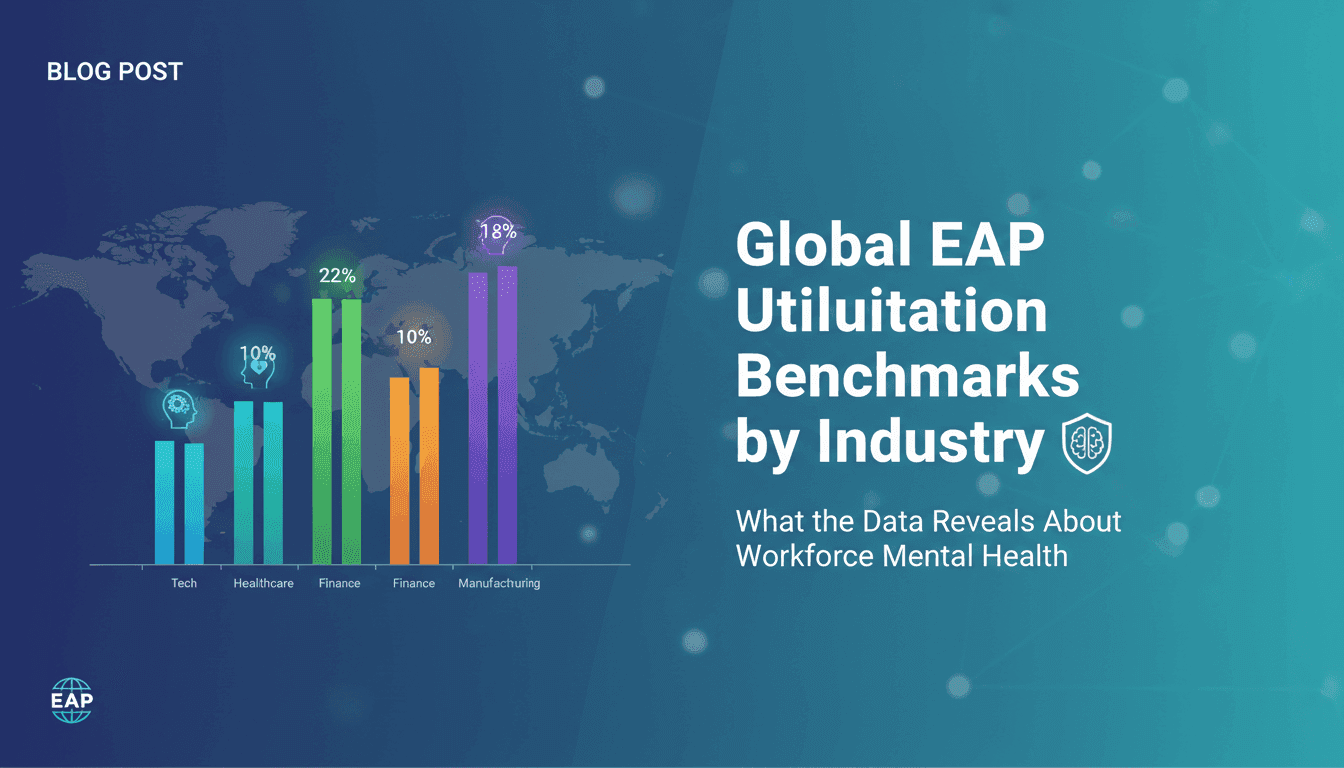
Table Of Contents
- What Is EAP Utilisation and Why Does It Matter?
- Global EAP Utilisation Benchmarks: The Big Picture
- EAP Utilisation Rates by Industry
- Key Factors Driving High and Low Utilisation
- What Low Utilisation Really Signals
- How to Improve EAP Utilisation in Your Organisation
- Benchmarking Your EAP: Questions Every HR Leader Should Ask
- Conclusion
Global EAP Utilisation Benchmarks by Industry: What the Data Reveals About Workforce Mental Health
An Employee Assistance Program is only as powerful as the number of employees who actually use it. Yet across industries worldwide, EAP utilisation remains one of the most misunderstood metrics in workforce wellbeing strategy. Organisations invest significantly in EAP services — counselling, mental health support, financial guidance, and more — only to find that utilisation rates hover between 3% and 10% on average globally. But averages, as any data-savvy HR leader knows, can be deeply misleading.
When you break down EAP utilisation benchmarks by industry, a far more nuanced and actionable picture emerges. Healthcare workers utilise EAPs at rates nearly double the global average. Technology companies, despite high investment in wellbeing perks, often struggle with stigma-driven underutilisation. Manufacturing and logistics sectors face access and awareness gaps that suppress engagement. Understanding where your organisation sits relative to these benchmarks is the first step toward building a truly effective mental health support ecosystem.
This article unpacks the latest global EAP utilisation benchmarks across major industries, explores the structural and cultural drivers behind the numbers, and offers evidence-based strategies to help HR professionals and business leaders close the gap between EAP investment and real employee impact.
What Is EAP Utilisation and Why Does It Matter? {#what-is-eap-utilisation}
EAP utilisation rate refers to the percentage of eligible employees who access EAP services within a given period, typically measured annually. It is the primary metric used by organisations and EAP providers to evaluate programme effectiveness, but it tells only part of the story. A utilisation rate of 6% in a high-stress industry like emergency services may represent remarkable reach, while the same rate in a white-collar professional services firm may signal a serious engagement failure.
Beyond the headline number, HR professionals increasingly track engagement depth (how many sessions employees complete), presenting issues (the types of concerns employees bring to EAP counsellors), and post-EAP outcomes (whether employees report improved functioning). These metrics together provide a more complete picture of programme value and help organisations make smarter decisions about EAP design, communication, and investment.
For companies serious about people development, EAP data is not just a wellness metric — it is a leading indicator of organisational health. High utilisation correlates with lower absenteeism, reduced presenteeism, stronger retention, and a culture where psychological safety is genuinely practised, not just stated in values documents.
Global EAP Utilisation Benchmarks: The Big Picture {#global-benchmarks}
Globally, EAP utilisation rates have been rising steadily since 2020, driven by increased mental health awareness post-pandemic, greater investment in digital EAP platforms, and a generational shift in how employees talk about psychological wellbeing at work. Current global benchmarks suggest the following ranges:
- Overall global average: 4.5% to 9% per year
- High-performing programmes: 15% to 25% or above
- Underperforming programmes: Below 3%
It is important to note that these figures vary significantly depending on how utilisation is defined. Some providers count a single information call as utilisation; others require at least one completed counselling session. When comparing your organisation's data to industry benchmarks, always clarify the methodology used by your EAP provider.
Asia-Pacific markets, including Singapore, Malaysia, and Australia, have seen notable upticks in EAP utilisation since 2022. Increased government-backed mental health awareness campaigns — including initiatives like those iGrowFit has partnered on with Singapore's Health Promotion Board — have helped normalise help-seeking behaviour in workplaces that were historically more reserved about mental health discussions.
EAP Utilisation Rates by Industry {#utilisation-by-industry}
Industry context shapes EAP utilisation more than almost any other variable. Below is a breakdown of benchmark utilisation rates and the key dynamics at play across major sectors.
Healthcare and Social Services
Healthcare workers consistently show the highest EAP utilisation rates globally, often ranging from 12% to 20%. This sector carries extraordinarily high occupational stress loads — secondary traumatic stress, moral injury, burnout, and irregular shift work are common. Paradoxically, healthcare environments have also become more psychologically literate, making it easier for employees to recognise when they need support and act on it without shame. Organisational mandates and proactive manager referrals also play a strong role in healthcare EAP uptake.
Financial Services and Banking
Financial services organisations typically report utilisation rates between 8% and 14%. High-pressure performance cultures, long hours, and significant job insecurity during market volatility create persistent mental health risk factors. However, many financial firms have invested heavily in EAP promotion and destigmatisation campaigns over recent years, and the sector has seen meaningful utilisation growth. The challenge remains at senior levels, where leadership stigma continues to suppress help-seeking among executives and high-performers who associate vulnerability with professional risk.
Technology and Software
Despite tech companies often offering generous wellbeing perks and progressive people policies, EAP utilisation rates in the sector cluster around 6% to 11% — moderate but with high variance. Remote and hybrid work models, which dominate the sector, reduce visibility of distress signals that managers in traditional offices might catch earlier. Younger workforces in tech tend to prefer app-based or digital mental health tools over traditional EAP counselling, suggesting EAP providers need to offer more flexible, digitally integrated access points to serve this demographic effectively.
Manufacturing, Logistics, and Supply Chain
This sector consistently records some of the lowest EAP utilisation rates, typically between 2% and 6%. Access barriers are significant: shift work makes standard business-hours counselling difficult to access, and blue-collar workplace cultures in many markets still carry meaningful stigma around mental health help-seeking. Language diversity in manufacturing workforces can also create communication barriers that reduce awareness of EAP services. Organisations in this sector that achieve above-benchmark utilisation typically invest heavily in multilingual EAP communications, on-site programme promotion, and manager training to normalise referrals.
Education
Schools, universities, and educational institutions show utilisation rates of 7% to 13% on average. Teacher burnout, student-related stress, and administrative pressure create substantial mental health risk. The relatively community-oriented culture of many educational institutions supports normalised conversations about wellbeing, though workload and time constraints can prevent employees from actually accessing services even when they know they exist.
Professional Services (Legal, Consulting, Accounting)
Professional services firms report utilisation rates between 5% and 10%, with significant variation based on firm culture and leadership tone. High-billing-hour expectations, perfectionism, and competitive environments create risk, but also foster reluctance to be seen as struggling. Firms with senior leadership who actively champion EAP — including sharing personal testimonials — consistently outperform sector averages by a significant margin.
Retail and Hospitality
Retail and hospitality sectors typically see utilisation rates of 3% to 7%, held back by high workforce turnover, part-time employment structures, and the practical challenge of reaching dispersed, front-line teams. Engagement is often episodic, spiking during high-stress seasonal periods. EAP programmes in these sectors benefit from QR-code-based access points, mobile-first platforms, and brief communication campaigns timed to peak stress windows.
Key Factors Driving High and Low Utilisation {#key-factors}
Benchmark data reveals that industry type alone does not determine utilisation outcomes. Across all sectors, several organisational factors consistently predict whether an EAP will achieve meaningful engagement.
Leadership championing is the single strongest predictor of above-average EAP utilisation. When senior leaders visibly endorse the EAP, share their own experiences with help-seeking, and actively encourage employees to use services, utilisation rates can increase by 30% to 50% compared to organisations where EAP promotion is left entirely to HR communications.
Awareness and accessibility remain persistent barriers. Studies consistently show that a significant proportion of employees either do not know their organisation has an EAP or do not know how to access it. Regular, multi-channel communications — not just an annual email — are necessary to maintain top-of-mind awareness.
Programme breadth also matters. EAPs that offer services beyond mental health counselling — including financial coaching, legal guidance, nutrition support, and family assistance — attract a wider range of users and reduce the stigma associated with accessing a programme that is perceived as exclusively for people who are struggling psychologically.
What Low Utilisation Really Signals {#low-utilisation-signals}
A low EAP utilisation rate does not automatically mean your employees are thriving. In most cases, it means one or more of the following conditions exist within your organisation:
- Employees are unaware the programme exists or do not know how to access it
- Workplace culture carries sufficient stigma around mental health to deter help-seeking
- Employees do not trust that the programme is confidential
- The programme does not feel relevant to their actual concerns
- Access barriers (timing, language, format) make utilisation impractical
Organisations that treat low utilisation as a signal requiring investigation — rather than evidence that employees are fine — consistently build stronger, more resilient workforces over time. At iGrowFit, this diagnostic mindset is built into how we approach EAP design and review. We don't just deliver programmes — we measure, interpret, and continuously optimise them to ensure real impact for both employees and the organisation.
How to Improve EAP Utilisation in Your Organisation {#improve-utilisation}
Moving from benchmark awareness to meaningful improvement requires a structured, evidence-based approach. The following strategies are drawn from high-utilisation organisations across multiple industries.
-
Conduct an EAP communications audit – Review how, when, and where your EAP is communicated to employees. If EAP information exists only in an onboarding document no one reads, utilisation will reflect that. Develop a 12-month communications calendar that keeps the programme visible year-round.
-
Train managers as EAP champions – Managers are the most credible source of EAP referrals. Invest in brief, practical training that helps managers recognise distress signals and make warm referrals to EAP services without crossing professional boundaries.
-
Review your access model – Is your EAP available after hours? Can employees access it digitally without needing to make a phone call during business hours? Reducing friction in the access journey directly increases utilisation.
-
Address confidentiality concerns proactively – Many employees fear that accessing EAP services will be reported to their manager or HR. Communicate clearly and repeatedly about the confidentiality protections in place, and ensure your EAP provider can substantiate those assurances.
-
Align EAP promotion with high-stress periods – Data from your HR calendar (performance review cycles, restructuring announcements, year-end crunch periods) can help you time EAP communications to moments when employees are most likely to benefit from and respond to them.
Benchmarking Your EAP: Questions Every HR Leader Should Ask {#benchmarking-questions}
Before you can improve EAP utilisation, you need a clear baseline. When reviewing your current programme, ensure you can answer the following:
- What is our current utilisation rate, and how is it being calculated? Understand the exact methodology your provider uses before drawing conclusions.
- How does our rate compare to industry benchmarks for our sector? A 5% utilisation rate means something very different in logistics versus financial services.
- What are the most common presenting issues among our employees? This data reveals workforce stress patterns and can inform upstream prevention and wellbeing initiatives.
- What percentage of users complete their recommended sessions? Completion rates indicate whether the programme is meeting employee needs once they engage.
- What is our EAP's average response and appointment time? Long wait times are a leading driver of drop-off after first contact.
For organisations looking to conduct a thorough EAP audit and benchmarking exercise, iGrowFit's team of psychologists, coaches, and organisational consultants brings over 15 years of cross-industry experience to help you interpret your data, identify gaps, and design a programme that genuinely serves your people.
Conclusion {#conclusion}
EAP utilisation benchmarks are not just numbers — they are a window into the psychological health of your workforce and the effectiveness of your investment in people. Across industries, the gap between available support and actual help-seeking remains one of the most consequential challenges in modern HR. Organisations that treat this gap as a solvable problem, informed by data and addressed through deliberate culture and programme design, consistently see returns in the form of lower absenteeism, stronger engagement, and more resilient teams.
Whether you are in healthcare, financial services, technology, or manufacturing, the benchmarks are clear: above-average EAP utilisation does not happen by accident. It is the result of leadership commitment, accessible programme design, consistent communication, and a workplace culture where seeking support is normalised rather than stigmatised.
If your organisation's EAP utilisation is below your industry benchmark — or if you are simply unsure where you stand — now is the right time to act. The data, the strategies, and the expertise to build a high-impact EAP exist. The question is whether your organisation is ready to use them.
Ready to Benchmark and Strengthen Your EAP?
iGrowFit's multidisciplinary team of psychologists, coaches, and organisational consultants has helped over 450 Fortune 500 companies, MNCs, and SMEs build evidence-based EAP programmes that deliver real, measurable impact. Whether you want to review your current utilisation data, redesign your EAP communications strategy, or build a comprehensive workforce mental health programme from the ground up, we are here to help.
Chat with our team on WhatsApp and let's talk about what a high-utilisation EAP looks like for your organisation.