
Having Difficult Conversations at Work: Scripts & Frameworks for Managers
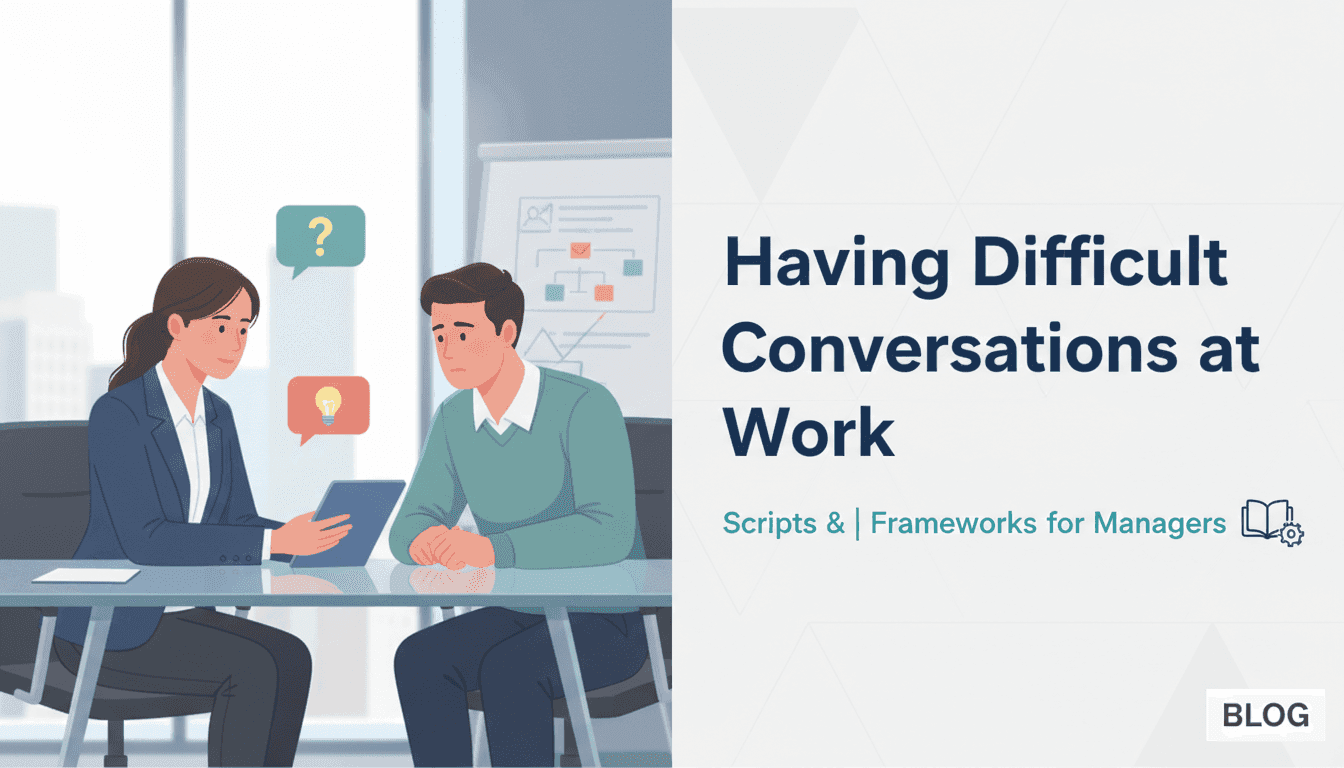
Table Of Contents
- Why Difficult Conversations Matter More Than Ever
- The Psychology Behind Conversational Avoidance
- The CLEAR Framework for Difficult Conversations
- Preparing for Difficult Conversations: The Pre-Work
- Conversation Scripts for Common Scenarios
- The DESC Framework: A Universal Approach
- Managing Emotional Reactions During Conversations
- Common Mistakes That Derail Difficult Conversations
- Following Up: Making Conversations Count
- Building Your Conversational Confidence
Every manager knows that sinking feeling when they realize they need to have "that conversation." Whether it's addressing underperformance, delivering critical feedback, or navigating interpersonal conflicts, difficult conversations represent some of the most challenging aspects of leadership. Yet, they're also among the most important.
When handled well, difficult conversations can transform workplace dynamics, strengthen relationships, and accelerate both individual and organizational growth. When avoided or mishandled, they create festering problems that undermine team morale, productivity, and psychological safety. Research shows that managers who effectively navigate challenging conversations see 40% higher team engagement and 35% better performance outcomes compared to those who avoid them.
In over a decade of working with more than 450 Fortune 500 companies and impacting 75,000+ employees, we've seen firsthand how mastering difficult conversations directly correlates with leadership effectiveness and organizational success. The good news? Like any leadership skill, conducting difficult conversations can be learned, practiced, and refined through evidence-based frameworks and proven scripts.
This comprehensive guide provides you with practical frameworks, word-for-word scripts, and psychological insights to approach even your most dreaded workplace conversations with confidence and competence. Let's transform difficult conversations from something you avoid into a powerful tool for developing your people and driving results.
Why Difficult Conversations Matter More Than Ever {#why-difficult-conversations-matter}
In today's complex work environment, the ability to navigate difficult conversations isn't just a nice-to-have skill for managers. It's a fundamental requirement for effective leadership. The modern workplace brings together diverse perspectives, remote work dynamics, generational differences, and heightened expectations for psychological safety and transparency. All of these factors increase both the frequency and complexity of challenging conversations.
When managers avoid difficult conversations, the costs compound quickly. Unaddressed performance issues don't resolve themselves; they typically worsen while other team members grow resentful of carrying extra weight. Interpersonal conflicts left to simmer create toxic team dynamics that drive away top talent. Even well-intentioned silence around sensitive topics can be interpreted as indifference or approval, perpetuating problematic behaviors.
Conversely, organizations that cultivate cultures of constructive dialogue see measurable benefits. Teams with high levels of psychological safety (where difficult conversations happen regularly and respectfully) demonstrate 27% higher profitability, according to extensive workplace research. Employees in these environments report greater trust in leadership, higher engagement scores, and increased willingness to innovate and take calculated risks.
The challenge isn't whether to have difficult conversations, but how to have them effectively. That's where evidence-based frameworks and preparation make all the difference.
The Psychology Behind Conversational Avoidance {#psychology-behind-avoidance}
Understanding why we avoid difficult conversations is the first step toward overcoming that avoidance. From a neurological perspective, our brains are wired to perceive potential conflict as a threat, triggering the same fight-or-flight response that kept our ancestors safe from predators. When we anticipate a difficult conversation, our amygdala activates, flooding our system with cortisol and reducing activity in our prefrontal cortex, the region responsible for rational thinking and emotional regulation.
This physiological response explains why even seasoned managers sometimes procrastinate on conversations they know they need to have. You're not weak or incompetent; you're human. However, recognizing this pattern allows you to develop strategies to work with your neurology rather than against it.
Managers typically avoid difficult conversations for several predictable reasons. First, there's the empathy trap: you genuinely care about your team members and don't want to hurt their feelings or damage the relationship. Second, there's outcome uncertainty: you can't control how the other person will react, and that unpredictability feels uncomfortable. Third, there's competency concern: you may worry about saying the wrong thing, escalating emotions, or mishandling the situation.
Additionally, many managers carry unhelpful beliefs about difficult conversations, such as "If I were a better leader, these problems wouldn't exist" or "Having this conversation means I've already failed." These cognitive distortions increase avoidance and undermine confidence. Reframing difficult conversations as opportunities for growth and clarity, rather than failures or confrontations, shifts your mindset from threat to challenge, a psychological state much more conducive to effective communication.
The CLEAR Framework for Difficult Conversations {#clear-framework}
The CLEAR framework provides a structured approach to planning and conducting difficult conversations. Developed through organizational psychology research and tested across thousands of workplace scenarios, CLEAR stands for Context, Listen, Empathize, Action, and Review. This framework ensures you address the issue thoroughly while maintaining the relationship and moving toward productive outcomes.
Context involves setting the stage appropriately. Choose a private, neutral location where you won't be interrupted. Schedule adequate time so neither party feels rushed. Begin by clearly stating the purpose of the conversation and the specific issue you need to address. Avoid starting with small talk that creates false expectations; instead, be direct yet respectful about why you're meeting.
Listen actively and genuinely. After presenting your observations or concerns, create space for the other person to share their perspective. Use open-ended questions that invite dialogue rather than defensiveness. Resist the urge to interrupt, explain, or justify while they're speaking. Your goal in this phase is understanding, not agreement. Take notes if appropriate, and use reflective listening techniques to demonstrate you're truly hearing what they're saying.
Empathize by acknowledging the other person's feelings and perspective, even if you don't agree with their actions or conclusions. Empathy doesn't mean condoning problematic behavior; it means recognizing the human being in front of you. Phrases like "I can understand why you might see it that way" or "That sounds frustrating" help maintain connection even during difficult exchanges.
Action focuses on the path forward. Collaboratively develop specific, measurable steps to address the issue. Clarify expectations, timelines, and consequences. This phase transforms a difficult conversation from merely airing concerns into a constructive plan for improvement. Document agreed-upon actions and ensure both parties leave with clarity about next steps.
Review involves scheduling a follow-up conversation to assess progress and provide support. This demonstrates your commitment to the employee's success and ensures accountability. The review phase also allows you to acknowledge improvements and recalibrate if initial strategies aren't working.
Preparing for Difficult Conversations: The Pre-Work {#preparing-conversations}
The quality of a difficult conversation is largely determined before it begins. Thorough preparation reduces anxiety, increases confidence, and dramatically improves outcomes. Investing time in pre-work isn't overthinking; it's professional diligence that respects both your time and the other person's.
Start by clarifying your objective. What specific outcome do you need from this conversation? Are you seeking behavior change, providing information, resolving a conflict, or making a decision? Write down your primary goal in one sentence. This clarity prevents conversations from wandering into unproductive territory or getting derailed by secondary issues.
Next, gather your evidence. Difficult conversations grounded in specific examples are far more effective than those based on vague impressions or generalizations. Document concrete instances of the behavior or performance issue, including dates, contexts, and impacts. If you're addressing performance concerns, have relevant data, metrics, or work samples ready to reference. This preparation isn't about building a prosecution case; it's about replacing subjective opinions with objective observations.
Anticipate responses and reactions. Put yourself in the other person's shoes and consider how they might respond to your feedback. What objections might they raise? What explanations might they offer? What emotional reactions are possible? By mentally rehearsing various scenarios, you prepare yourself to respond thoughtfully rather than reactively in the moment.
Check your emotional state before the conversation. If you're feeling angry, frustrated, or particularly anxious, consider whether you need to postpone until you can approach the conversation from a calmer, more centered place. Use grounding techniques like deep breathing or brief meditation to regulate your nervous system. Remember, your emotional state is contagious and will significantly influence the conversation's tone.
Finally, script your opening. Write out the first few sentences you'll use to begin the conversation. This doesn't mean reading from a script robotically, but having prepared language reduces the cognitive load of starting and helps you set the right tone immediately. Your opening should be clear, direct, and respectful.
Conversation Scripts for Common Scenarios {#conversation-scripts}
While every difficult conversation is unique, certain scenarios occur frequently in management contexts. Having frameworks and language patterns for these common situations provides a starting point you can adapt to your specific circumstances and personal communication style.
Addressing Poor Performance {#poor-performance}
Performance conversations require balancing accountability with support. The goal is to create clarity about gaps between current and expected performance while collaboratively developing an improvement plan.
Opening Script:
"Thank you for making time to meet with me. I want to discuss some concerns about your performance in [specific area]. Over the past [timeframe], I've observed [specific examples with dates and impacts]. This is below the standard we've established for this role, and I need to understand what's happening and work with you on a plan to improve. Can you help me understand your perspective on this?"
Middle Conversation:
After listening to their perspective: "I appreciate you sharing that context. [Acknowledge any valid points they've raised]. Moving forward, here's what I need to see: [specific, measurable performance standards]. What support or resources do you need from me to meet these expectations? What obstacles do we need to address together?"
Closing Script:
"Let me summarize what we've agreed to. You'll [specific actions and timelines], and I'll [specific support you're committing to provide]. We'll meet again on [specific date] to review your progress. I want to be clear: I'm committed to your success here, and I believe you can meet these standards. However, if we don't see significant improvement by [timeframe], we may need to consider whether this role is the right fit. Do you have any questions about what we've discussed?"
Giving Critical Feedback {#critical-feedback}
Critical feedback conversations focus on specific behaviors or outcomes that need adjustment. These differ from performance conversations in that they address discrete issues rather than patterns of underperformance.
Opening Script:
"I'd like to talk with you about [specific situation]. In [context], I observed that [specific behavior or outcome]. This had an impact on [team/project/client] because [specific consequences]. I don't think this was your intention, but I need us to address it. What was happening from your perspective?"
Middle Conversation:
After understanding their viewpoint: "I understand [acknowledge their perspective]. Here's what concerns me: [explain the impact or why the behavior is problematic]. Going forward, what I need to see instead is [describe desired behavior]. How does that land with you?"
Closing Script:
"I'm confident you can handle this differently in the future. To recap, when [situation] occurs, the approach I need you to take is [specific behavior]. I value your contributions to the team, and addressing this will help you be even more effective. Let's check in next [timeframe] to see how things are going."
Managing Interpersonal Conflict {#interpersonal-conflict}
When team members have conflicts affecting work quality or team dynamics, managers must intervene thoughtfully. These conversations require carefully maintaining neutrality while still addressing the business impact.
Opening Script (meeting with individuals separately first):
"I've noticed some tension between you and [colleague] that seems to be affecting [specific work impact]. I'm not interested in assigning blame or taking sides, but I do need to understand what's happening from your perspective so we can find a constructive path forward. Can you tell me about the situation as you see it?"
Opening Script (joint meeting after individual conversations):
"Thank you both for meeting with me. I've spoken with each of you individually, and I appreciate your willingness to address this situation. Here's what I know: we have a conflict that's impacting [specific work consequences]. My role isn't to determine who's right or wrong, but to help us find a way to work together effectively. I need both of your commitment to having a professional working relationship. Let's start by each of you sharing one thing you could do differently to improve this situation."
Closing Script:
"Here's what we've agreed: [summarize commitments from each party]. I expect you both to honor these commitments, and I'll be observing how things progress. If you're unable to work together professionally, it will affect performance evaluations for both of you. I'm optimistic we can resolve this, and I'm available if either of you needs support. Let's meet again in [timeframe] to assess how things are going."
Discussing Personal Hygiene or Appearance {#personal-hygiene}
Personal topics like hygiene or inappropriate appearance are among the most uncomfortable conversations managers must navigate. These require extra sensitivity while still addressing legitimate workplace concerns.
Opening Script:
"I need to discuss something sensitive with you, and I want to approach it respectfully. I've become aware of a concern about [personal hygiene/appearance issue], and it's something we need to address because [impact on workplace, if applicable, or simply because it's a professional standard]. I recognize this is an awkward conversation, but I'd be doing you a disservice by not bringing it to your attention. Is there anything you'd like to share with me about this?"
Middle Conversation:
Listening for potential medical or personal issues: "I appreciate you being open with me. [If medical issues are mentioned: 'If there's a medical situation, we can certainly discuss accommodations through HR.'] What I need going forward is [specific expectations regarding hygiene/appearance standards]. Can you commit to addressing this?"
Closing Script:
"I know this wasn't an easy conversation, and I appreciate your professionalism in discussing it. I'm confident we can move past this quickly. If you need any support or resources, please let me know. Otherwise, I'll consider this matter resolved as long as the issue doesn't recur."
Delivering Disappointing News {#disappointing-news}
Whether it's a denied promotion, salary increase rejection, or project reassignment, delivering disappointing news requires managing emotions while maintaining the relationship.
Opening Script:
"I wanted to meet with you personally to discuss [topic]. I know you were hoping for [desired outcome], and I need to let you know that [decision]. I want to explain the reasoning and answer any questions you have."
Middle Conversation:
After explaining rationale: "I understand this isn't the news you wanted to hear, and I recognize you're probably feeling [disappointed/frustrated]. Those feelings are completely valid. I want you to know that [affirm their value/contributions]. Here's what I can offer in terms of [alternative options or future possibilities, if any]."
Closing Script:
"I know you may need some time to process this. If you have additional questions after you've had time to think, my door is open. I value your contributions to the team, and I'm committed to supporting your continued growth here. [If applicable: 'Let's schedule time in the coming weeks to discuss your development goals and how we can work toward [promotion/raise/opportunity] in the future.']"
The DESC Framework: A Universal Approach {#desc-framework}
The DESC framework (Describe, Express, Specify, Consequences) provides another powerful structure for difficult conversations, particularly when you need to address specific behaviors or situations. This approach, rooted in assertiveness training and conflict resolution research, works across virtually any challenging scenario.
Describe the situation objectively, focusing on observable facts rather than interpretations or judgments. Use "when" statements: "When you arrived 30 minutes late to the client meeting" rather than "You're always late" or "You don't take this job seriously." This factual approach reduces defensiveness and creates a shared understanding of what you're addressing.
Express your feelings or concerns about the situation using "I" statements. This acknowledges the subjective impact without attacking the other person. For example: "I felt concerned about how this reflected on our team" or "I'm worried about the impact on project timelines." Expressing your reaction makes the conversation more human and authentic while maintaining professional boundaries.
Specify what you'd like to see happen differently. Be concrete and actionable: "I need you to notify me at least two hours in advance if you can't make a scheduled meeting" rather than "I need you to be more responsible." Vague requests lead to vague results; specific requests enable clear accountability.
Consequences involves explaining what will happen (both positive and negative) depending on whether the situation improves. "If we can resolve this attendance issue, we'll be able to move forward productively, and I can consider you for the upcoming project lead opportunity. However, if the pattern continues, we'll need to implement a formal performance improvement plan." This phase creates clarity about stakes and motivations.
The DESC framework's strength lies in its balance. It addresses problems directly while respecting the other person's dignity, creates clear expectations while leaving room for dialogue, and establishes accountability while maintaining the relationship. Practice this framework with lower-stakes conversations to build fluency before applying it to your most challenging scenarios.
Managing Emotional Reactions During Conversations {#managing-emotions}
Even with perfect preparation and scripting, difficult conversations can become emotionally charged. The other person might cry, become defensive, shut down, or react with anger. Your ability to navigate these emotional moments often determines whether the conversation succeeds or derails.
First, recognize that emotional reactions are information, not obstacles. When someone becomes emotional, they're signaling that something important is at stake for them. Curiosity about the emotion, rather than discomfort with it, shifts your response from reactive to responsive. Instead of trying to make the emotion go away, acknowledge it: "I can see this is bringing up strong feelings" or "Take the time you need."
Tears often trigger the most discomfort for managers. If someone begins crying, resist the urge to immediately comfort them or back away from your message. Offer a tissue and a brief pause: "Take a moment. I know this is difficult." Allow them to regain composure naturally. Continuing to talk while they're crying usually compounds their embarrassment. Once they've recovered, you can acknowledge their feelings ("I can see this matters a great deal to you") before continuing the conversation.
Defensiveness typically manifests as justifications, excuses, or counter-accusations. When you encounter defensiveness, avoid getting pulled into debate or feeling the need to prove your point. Instead, use reflective listening: "So from your perspective, the project delays were primarily due to dependencies on other teams. Help me understand what you think could have been done differently." This approach validates their need to be heard while gradually redirecting toward problem-solving.
Anger requires staying calm yourself. Remember that anger is often a secondary emotion covering fear, shame, or hurt. Don't match their emotional intensity or become defensive yourself. Use a calm, steady tone: "I understand you're upset, and I want to hear your concerns. I need you to lower your voice so we can have a productive conversation." If anger escalates to yelling or aggression, pause the conversation: "I can see we're both escalating. Let's take a break and resume this conversation tomorrow morning when we can discuss it more calmly."
Shutdown (silence, minimal responses, checked-out body language) can be harder to navigate than overt emotions. You can't force someone to engage, but you can name what you're observing: "You've become pretty quiet. What are you thinking right now?" If they remain withdrawn, you might say: "I sense you need time to process this. I want to hear your perspective. Would it help to continue this conversation tomorrow?" Sometimes allowing space for reflection is more productive than pushing through in the moment.
Throughout any emotional response, maintain your own regulation. Use grounding techniques like feeling your feet on the floor, taking slow breaths, or silently counting to five before responding. Your calm presence provides a co-regulating influence that helps the other person return to baseline. Remember, managing difficult conversations is a skill that involves managing yourself first and foremost.
Common Mistakes That Derail Difficult Conversations {#common-mistakes}
Even well-intentioned managers make predictable mistakes that undermine difficult conversations. Awareness of these pitfalls helps you avoid them and course-correct when you notice yourself falling into problematic patterns.
The Sandwich Approach (positive-negative-positive feedback) has fallen out of favor for good reasons. While the intention is to soften criticism, the result is often confusion about the message's importance. Recipients learn to distrust praise as merely the wrapper for criticism, and the critical message itself gets diluted. Instead, deliver feedback directly and respectfully without burying it between compliments.
Talking Too Much is a common anxiety response. When uncomfortable, many managers fill silence with explanations, justifications, and repetitions of their point. This prevents genuine dialogue and can make you sound defensive or uncertain. Practice delivering your key message concisely, then creating space for the other person to respond. Silence is productive; it gives both parties time to think.
Avoiding Specifics makes feedback impossible to act on. Telling someone they need to "be more professional" or "improve their attitude" provides no clear direction. Always ground difficult conversations in specific, observable behaviors and concrete examples. If you can't articulate specific instances, you're not ready to have the conversation yet.
Making It Personal crosses the line from addressing behavior to attacking character. "You're lazy" is personal; "You've missed the last four deadlines" addresses behavior. "You're a terrible team player" is personal; "In the last three team meetings, you've dismissed others' ideas without offering alternatives" describes observable actions. This distinction matters tremendously in how your message is received.
Rushing to Solutions before fully understanding the situation is a problem-solving trap. While it's tempting to quickly propose fixes and move on, premature solutions often miss the real issue and reduce buy-in. Invest adequate time in the listening and understanding phases before moving to action planning.
Forgetting to Document leaves you without records if situations escalate or require formal processes. After any significant difficult conversation, document the date, key points discussed, agreed-upon actions, and timelines. Send a follow-up email summarizing the conversation. This isn't about creating a "gotcha" file; it's about clarity, accountability, and protecting both you and the employee.
Avoiding Follow-Through perhaps undermines difficult conversations most significantly. If you outline consequences or expectations but then don't follow up, you've taught your team that these conversations don't actually matter. Your credibility as a leader depends on consistently following through on commitments made during difficult conversations.
Following Up: Making Conversations Count {#following-up}
The difficult conversation itself is only the beginning. What happens afterward determines whether the conversation creates meaningful change or becomes another forgotten interaction. Strategic follow-up transforms conversations from momentary discomfort into catalysts for development.
Within 24 hours of a difficult conversation, send a written summary. This email should briefly recap the key points discussed, agreed-upon actions from both parties, specific timelines, and the date of your next check-in. Keep the tone professional and forward-looking. This document serves multiple purposes: it ensures shared understanding, creates accountability, provides documentation, and demonstrates your commitment to the process.
Schedule specific follow-up conversations rather than leaving them vague. "Let's check in soon" too easily becomes never. Instead, before ending the initial conversation, pull out your calendar and schedule the follow-up meeting right then. For performance issues, weekly or bi-weekly check-ins might be appropriate initially. For other situations, a follow-up in two to four weeks might suffice.
During follow-up meetings, acknowledge progress before addressing remaining gaps. This isn't false praise; it's recognition of effort and improvement. "I've noticed you've been arriving on time consistently for the past two weeks. That's exactly what we discussed, and I appreciate your commitment to it" reinforces positive change. Then address any continuing concerns: "I still have some questions about the quality of the reports you've been submitting. Let's look at specific examples together."
Provide ongoing support between formal check-ins. If you committed to removing obstacles, securing resources, or providing coaching, follow through promptly. Your actions demonstrate whether you're genuinely invested in their success or simply checking boxes. Support might include connecting them with training resources, adjusting workflows, providing more frequent feedback, or problem-solving obstacles together.
Adjust course when necessary. If your initial approach isn't generating the desired results, acknowledge that and collaborate on modifications: "We agreed you'd focus on X, but I'm noticing Y is still an issue. What's getting in the way? What do we need to change about our approach?" This flexibility demonstrates that you're partners in problem-solving rather than adversaries.
Know when to escalate. If you've had multiple conversations with clear expectations and adequate support, but behavior or performance hasn't improved, it may be time to involve HR or move to formal performance management processes. This isn't failure; it's appropriate progression when informal approaches have been exhausted.
Building Your Conversational Confidence {#building-confidence}
Mastering difficult conversations is a developmental journey, not a destination. Even experienced leaders continue refining their approach and occasionally struggle with particularly challenging situations. Building your confidence and competence requires intentional practice and self-reflection.
Start by practicing with lower-stakes conversations. You don't need to wait for a crisis to use these frameworks. Apply the CLEAR or DESC structure to routine feedback conversations. Script your opening for everyday coaching moments. This regular practice builds neural pathways and muscle memory, making the skills more accessible when you face truly difficult situations.
Seek feedback on your approach from trusted colleagues, mentors, or a coach. After difficult conversations, reflect on what went well and what you'd do differently. Consider asking HR partners or senior leaders to role-play scenarios with you and provide feedback on your technique. This meta-level learning accelerates development far faster than trial-and-error alone.
Invest in your own psychological capital. Your ability to navigate difficult conversations directly correlates with your overall emotional intelligence, self-awareness, stress management, and resilience. Practices like mindfulness, regular supervision or coaching, and continuous learning about human behavior and communication all contribute to conversational confidence. At iGrowFit, we've seen how developing leaders' psychological capital transforms not just their conversation skills, but their entire leadership presence and effectiveness.
Build a support system within your organization. Connect with other managers facing similar challenges. Share experiences, strategies, and lessons learned. Knowing you're not alone in finding these conversations difficult normalizes the struggle and provides valuable peer learning.
Reframe difficulty as importance. The conversations you find most challenging are often the ones that matter most to your team's success and individuals' development. Each time you lean into discomfort rather than avoiding it, you're demonstrating the courage and integrity that define authentic leadership. Over time, you may never find difficult conversations easy, but you'll find them increasingly manageable and, eventually, rewarding.
Remember that having difficult conversations skillfully is an act of service to your team members. When you address issues directly, provide clear feedback, and hold people accountable with compassion, you're helping them grow, protecting the team's culture, and ultimately enabling everyone to perform at their highest level. That's not confrontation; it's leadership.
Difficult conversations are inevitable in management, but suffering through them poorly is not. With the frameworks, scripts, and strategies outlined in this guide, you have concrete tools to approach even your most challenging workplace conversations with greater confidence and competence.
The CLEAR framework provides a comprehensive structure for navigating the entire conversation arc, while DESC offers a quick, versatile approach for addressing specific behaviors. The conversation scripts give you language patterns to adapt for common scenarios, removing the paralysis of not knowing where to start. Understanding the psychology behind avoidance and emotional reactions equips you to manage both your own responses and others' with greater skill.
Most importantly, remember that mastering difficult conversations is fundamentally about developing people to reach their potential. When you address performance gaps, provide critical feedback, or navigate conflicts, you're not just solving problems; you're creating clarity, building accountability, and demonstrating that you care enough to have the hard conversations that lesser leaders avoid.
Your willingness to engage in these challenging moments, guided by evidence-based frameworks and genuine concern for your team members' success, distinguishes you as a leader who helps people hit goals and finish tasks consistently. With practice, preparation, and patience with yourself, you'll transform difficult conversations from dreaded obligations into powerful tools for leadership impact.
Start with one conversation you've been avoiding. Use the frameworks in this guide to prepare thoroughly. Trust the process, trust yourself, and take that first step. Your team's success depends on it, and you're more ready than you think.
Ready to Develop Your Leadership Capabilities?
Mastering difficult conversations is just one aspect of effective leadership development. At iGrowFit, we've spent over a decade helping leaders at more than 450 Fortune 500 companies, MNCs, and SMEs build the psychological capital and practical skills needed to lead with confidence and drive sustainable results.
Our evidence-based approach combines organizational psychology, leadership coaching, and practical frameworks tailored to your specific challenges. Whether you need individual executive coaching, team development programs, or comprehensive organizational solutions, our multi-disciplinary team of psychologists, coaches, and consultants is ready to support your growth.
Don't navigate your leadership challenges alone. Connect with our team today to discover how we can help you and your organization develop the capabilities to consistently hit goals and finish tasks.
Let's transform your leadership potential into measurable performance.