
Micromanagement: How It Damages Mental Health and How to Stop
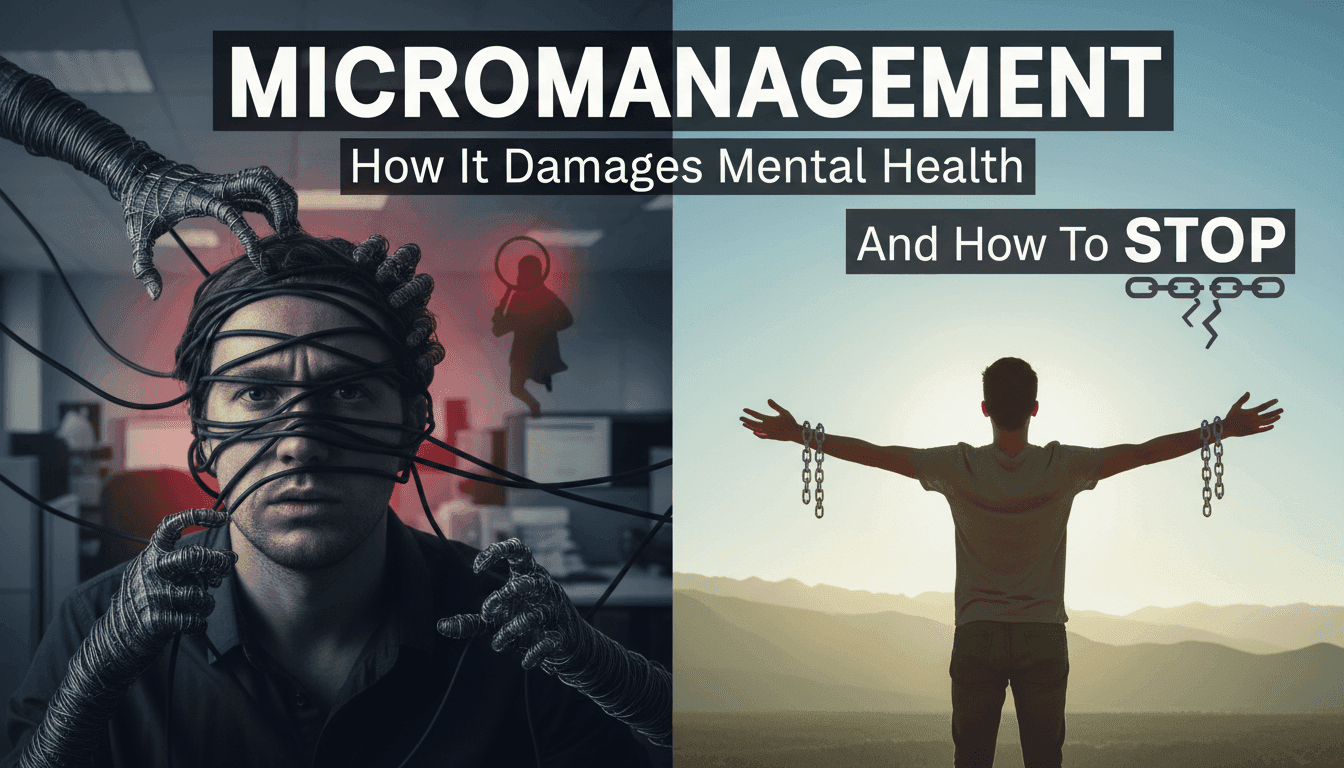
Table Of Contents
- What Is Micromanagement?
- The Psychological Cost: How Micromanagement Damages Mental Health
- Why Managers Micromanage (And Don't Always Know It)
- The Ripple Effect on Teams and Organisations
- How to Identify If You Are Being Micromanaged
- How Managers Can Stop Micromanaging
- Building a Culture of Autonomy and Trust
- How iGrowFit Supports Healthier Workplaces
Micromanagement: How It Damages Mental Health and How to Stop
It starts subtly. A manager asks to be copied on every email. They hover during team meetings, correct minor formatting decisions, or redo work that was already done well. For the employee on the receiving end, each small intrusion sends a quiet but unmistakable message: I don't trust you. Over time, that message accumulates into something far heavier — anxiety, disengagement, burnout, and a profound erosion of self-worth.
Micromanagement is one of the most commonly cited reasons employees quit their jobs, yet it remains one of the least openly discussed forms of workplace harm. Unlike overt bullying or discrimination, it operates in a grey zone — often unintentional, always corrosive. This article examines how micromanagement damages mental health at its core, why it happens, and — crucially — how both managers and organisations can break the cycle before it breaks their people.
What Is Micromanagement? {#what-is-micromanagement}
Micromanagement refers to a management style characterised by excessive control, close monitoring of employees' work, and a persistent focus on minor details rather than broader outcomes. A micromanager typically struggles to delegate meaningfully, insists on approving every decision regardless of scale, and prioritises how work is done over whether it achieves the intended result.
It is worth distinguishing between close support and micromanagement. A new employee benefits from structured guidance and frequent check-ins. A micromanaged employee, regardless of their experience or track record, finds themselves under constant scrutiny with little room for independent thought. The key differentiator is trust — or the lack of it. Micromanagement communicates, through repeated behaviour, that the employee's judgment cannot be relied upon.
While micromanagement is often associated with individual personality traits, organisational psychologists recognise it as a systemic issue that can be reinforced by company culture, unrealistic performance pressures, and a lack of leadership development support.
The Psychological Cost: How Micromanagement Damages Mental Health {#psychological-cost}
The mental health consequences of being micromanaged are well-documented and genuinely serious. When employees are subjected to relentless oversight, their psychological safety — the belief that they can take risks, share ideas, and make decisions without fear of punishment — is steadily dismantled.
Chronic stress and anxiety are among the most immediate effects. Knowing that every action is scrutinised activates the body's stress response repeatedly, keeping cortisol levels elevated and leaving employees in a state of low-grade hypervigilance. Over weeks and months, this physiological burden contributes to sleep disruption, physical fatigue, and difficulty concentrating.
Reduced self-efficacy is another significant consequence. Self-efficacy — a person's belief in their own capability — is a core pillar of psychological capital, which research consistently links to motivation, resilience, and performance. When a manager repeatedly overrides decisions or implies that an employee's output is inadequate, it chips away at this foundational belief. Employees begin to second-guess themselves, seek validation for even simple tasks, and lose the confidence that once made them effective.
Burnout is the long-term destination for many employees trapped in micromanaged environments. The combination of high effort, low autonomy, and a persistent sense of inadequacy creates the exact conditions that the World Health Organisation identifies as drivers of occupational burnout. Employees feel emotionally exhausted, increasingly detached from their work, and deeply cynical about their role and organisation.
Diminished sense of purpose rounds out the picture. When people are denied the opportunity to exercise judgment, grow through challenge, or contribute meaningfully, work loses its intrinsic value. They become transactional — showing up to fulfil obligations rather than to create something of worth. This shift is not laziness; it is a rational psychological response to an environment that has repeatedly signalled that their contributions do not matter.
Why Managers Micromanage (And Don't Always Know It) {#why-managers-micromanage}
Understanding why micromanagement happens is essential to stopping it. In most cases, micromanagers are not malicious. They are anxious. The behaviour is typically rooted in a set of deeply held fears and unexamined beliefs:
- Fear of failure or accountability. Managers who feel personally responsible for every outcome may over-control to ensure nothing goes wrong on their watch.
- Low trust in others' capabilities. This can stem from past experiences with underperforming teams or a general tendency toward perfectionism.
- Lack of confidence in their own leadership identity. Some managers, particularly those who were high-performing individual contributors, cling to task-level involvement because it is familiar territory.
- Organisational pressure. When senior leadership demands detailed reporting, rapid results, and visible control, managers may micromanage their teams as a trickle-down response to the pressure they themselves feel.
- Poor delegation skills. Many managers were never taught how to hand over work effectively, set expectations clearly, or trust a process without monitoring every step.
Crucially, many micromanagers do not recognise what they are doing. They describe themselves as detail-oriented, hands-on, or supportive. Without external feedback — from a coach, a 360-degree assessment, or an honest organisational culture — the pattern continues unchecked.
The Ripple Effect on Teams and Organisations {#ripple-effect}
The damage of micromanagement extends far beyond the individual employee. Teams develop collective learned helplessness, where initiative is suppressed because people have learned that independent action is rarely welcomed. Innovation dies quietly in these environments — not because employees lack ideas, but because they have stopped offering them.
Organisationally, the costs are measurable. High turnover is consistently linked to poor management practices, and replacing a single employee can cost between 50% and 200% of their annual salary when recruitment, onboarding, and lost productivity are factored in. Engagement surveys in micromanaged teams tend to show lower scores on autonomy, recognition, and trust — the very dimensions most strongly correlated with discretionary effort and retention.
For leadership pipelines, the harm is equally significant. When talented employees are never given the space to make decisions, develop judgment, or lead through ambiguity, organisations inadvertently stunt the growth of their future leaders. A culture of micromanagement produces compliant followers, not capable successors.
How to Identify If You Are Being Micromanaged {#identify-micromanagement}
Recognising micromanagement is not always straightforward, especially when it is framed as thoroughness or care. However, some consistent signs suggest your manager may be crossing the line:
- You are rarely allowed to complete tasks without mid-process check-ins or corrections.
- Decisions within your defined role are regularly redirected or overruled without explanation.
- You feel anxious when your manager is nearby, anticipating criticism rather than support.
- Your confidence in your own abilities has declined since joining this team or reporting to this manager.
- You find yourself seeking approval for decisions you know are within your competence.
- Creative thinking or problem-solving on your own initiative feels unwelcome or risky.
If several of these resonate, it may be worth seeking support — whether through a trusted HR contact, an employee assistance programme, or a professional counsellor who can help you process the experience and identify constructive next steps.
How Managers Can Stop Micromanaging {#how-to-stop}
Changing a micromanagement pattern requires deliberate self-awareness and a commitment to developing new leadership behaviours. It is not a quick fix, but the following approaches offer a meaningful starting point:
1. Name the pattern honestly. The first step is acknowledgment. Seeking feedback through a 360-degree assessment or candid conversations with trusted colleagues can surface blind spots that self-reflection alone may miss. Coaching is particularly effective here, as it creates a safe space to explore the beliefs and fears driving the behaviour.
2. Shift focus from activity to outcomes. Rather than monitoring how a task is completed, define what a successful outcome looks like and give employees the latitude to get there in their own way. This reframe reduces the urge to intervene and shifts accountability meaningfully to the team.
3. Practise structured delegation. Delegation is a skill, not a personality trait. Start by identifying low-risk tasks where you can deliberately step back, observe, and resist the impulse to correct. Over time, extend this to higher-stakes responsibilities as trust is built through demonstrated competence.
4. Address the underlying anxiety. For many managers, the root issue is not about control but about fear. Working with a coach or counsellor to understand what drives the anxiety can be transformative. Organisations that provide access to EAP services make this kind of support readily available and confidential.
5. Create feedback loops that do not depend on surveillance. Regular one-on-one meetings, clear KPIs, and project milestone check-ins provide visibility without constant oversight. When managers have structured touchpoints, the need to hover between them decreases significantly.
Building a Culture of Autonomy and Trust {#culture-of-autonomy}
Individual behaviour change is necessary, but insufficient on its own. Organisations serious about eliminating micromanagement need to look at the structures and norms that either encourage or discourage it.
Leadership development programmes that explicitly build coaching skills, emotional intelligence, and trust-based management practices are foundational. Psychological safety initiatives, which help teams feel secure enough to speak up, experiment, and even fail constructively, create the conditions where autonomy can genuinely thrive. Profiling and assessment tools that help managers understand their own behavioural tendencies — and the impact those tendencies have on their teams — provide the self-knowledge that is a prerequisite for change.
At the organisational level, it is also worth examining whether performance management systems inadvertently reward micromanaging behaviours. If managers are recognised primarily for short-term outputs and never held accountable for engagement, turnover, or team development, the incentive structure quietly perpetuates the problem.
At iGrowFit, this systems-level thinking is central to how we work with organisations. Through our ConPACT framework — spanning Consultancy, Profiling, Assessments, Coaching, and Training — we help businesses identify the root causes of dysfunctional management dynamics and build the human capital capabilities needed for sustainable, high-performance cultures.
How iGrowFit Supports Healthier Workplaces {#igrowfit-support}
Since 2009, iGrowFit has partnered with over 450 Fortune 500 companies, MNCs, and SMEs to address the kind of people challenges that sit at the intersection of performance and wellbeing. Micromanagement is one of the most common issues we encounter — and one of the most addressable when organisations are willing to invest in the right support.
Our multi-disciplinary team of psychologists, coaches, counsellors, and management consultants works with both individual leaders and organisational systems. For managers caught in micromanagement patterns, we offer executive coaching and leadership development interventions grounded in evidence-based psychology. For employees experiencing the mental health consequences of over-control, our EAP counselling services provide a confidential, professional space to process, recover, and regain confidence.
We also work at the cultural level, helping organisations assess their management practices, develop psychologically safe environments, and build the kind of leadership pipeline that sustains performance without sacrificing human wellbeing. Because at iGrowFit, we believe that helping people hit goals and finish tasks consistently is only possible when the humans doing that work are genuinely supported.
Final Thoughts
Micromanagement is rarely born of bad intentions, but its impact on mental health is real, measurable, and serious. Anxiety, eroded self-belief, burnout, and disengagement are not inevitable features of working life — they are signals that something in the management dynamic needs to change. The good news is that change is possible. With honest self-reflection, the right developmental support, and an organisational culture that values autonomy as much as accountability, the cycle of micromanagement can be broken.
If you are an employee struggling under the weight of over-control, know that what you are experiencing has a name — and there is support available. If you are a manager wondering whether your style may be causing harm, the fact that you are asking the question is already a meaningful first step. What matters now is what you do next.
Ready to Build a Healthier, Higher-Performing Workplace?
Whether you are dealing with micromanagement challenges as a leader or an employee, iGrowFit's team of psychologists, coaches, and EAP specialists is here to help. Reach out to us today for a confidential conversation about how we can support your organisation's wellbeing and performance goals.
Chat with Us on WhatsApp — our team is ready to help.