Social Anxiety at Work: How It Looks, Why It's Underdiagnosed, and How to Help
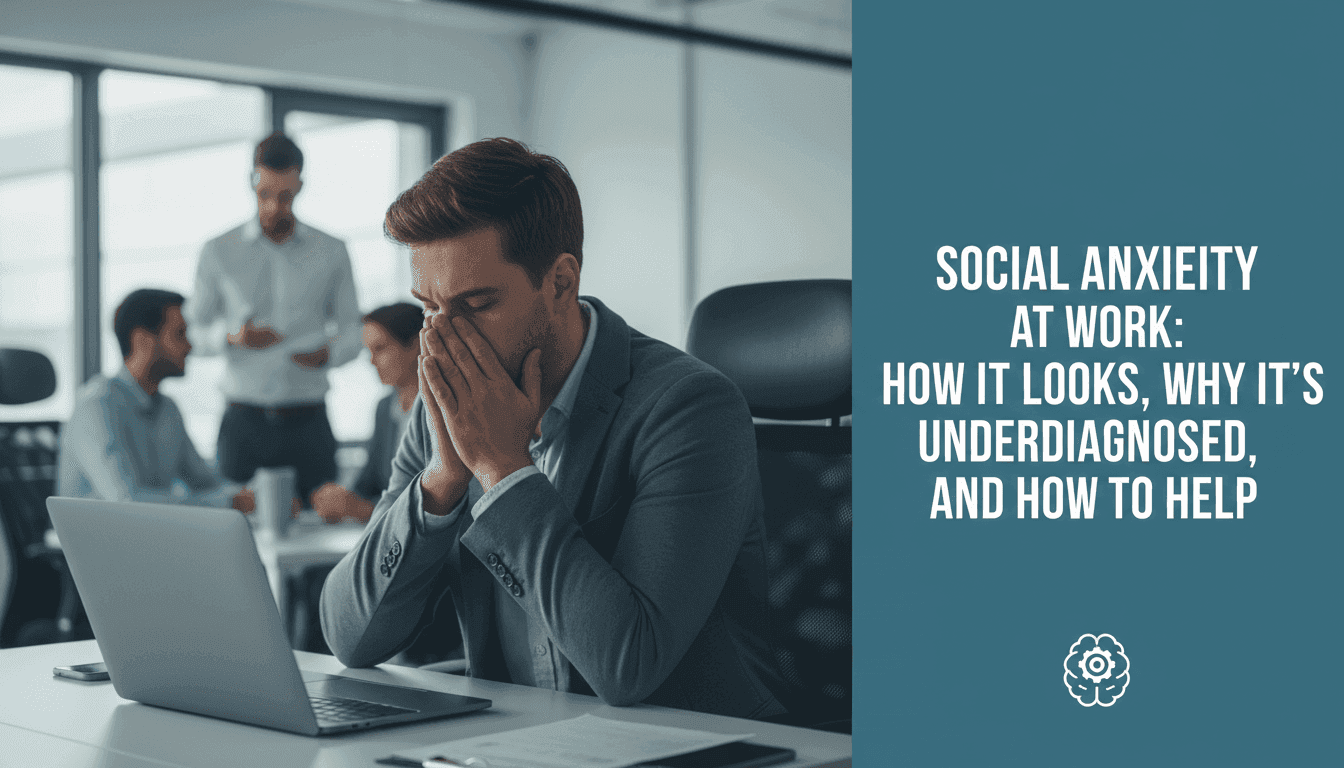
Table Of Contents
- What Social Anxiety at Work Actually Looks Like
- Why Social Anxiety Is So Frequently Underdiagnosed
- The Hidden Organizational Cost of Unaddressed Social Anxiety
- How Managers and HR Leaders Can Recognize the Signs
- Building a Workplace That Supports Socially Anxious Employees
- The Role of Employee Assistance Programs in Early Intervention
- Conclusion
Introduction
Imagine a high-performing analyst who consistently delivers excellent work but goes silent the moment a meeting begins. Or a talented new hire who avoids the lunch room, declines every team event, and responds to emails within minutes but never picks up the phone. From the outside, these employees might be labelled introverted, disengaged, or simply "difficult to manage." But for many of them, what is happening beneath the surface is something far more specific: social anxiety disorder, one of the most prevalent yet chronically underidentified mental health conditions in the modern workplace.
Social anxiety at work is not shyness. It is not a personality quirk or a preference for working alone. It is a recognized clinical condition that affects an estimated 12.1% of adults at some point in their lives, according to the National Comorbidity Survey — and the workplace, with its performance reviews, presentations, open-plan offices, and constant interpersonal demands, can be one of the most triggering environments imaginable for those who live with it.
This article explores what social anxiety genuinely looks like in a professional setting, why it so often slips through the cracks of workplace wellness initiatives, what it costs organizations when left unaddressed, and — most importantly — what HR leaders, managers, and business owners can do to build a more psychologically safe and supportive environment for every member of their team.
What Social Anxiety at Work Actually Looks Like {#what-it-looks-like}
Social anxiety disorder (SAD) is characterized by an intense, persistent fear of social situations where a person may be scrutinized, judged, or embarrassed by others. In a clinical context, this fear must be disproportionate to the actual threat, cause significant distress, and meaningfully interfere with daily functioning. In a workplace context, that interference can take many forms — and very few of them look the way most people expect.
Contrary to the popular image of someone visibly trembling before a crowd, many employees with social anxiety present in far subtler ways. A team member might consistently volunteer for solo projects to avoid collaborative settings. Another might prepare obsessively for meetings — rehearsing responses, anticipating questions — only to freeze or go completely quiet once in the room. Some employees avoid the camera in video calls, cite vague illnesses on days with high-stakes presentations, or send lengthy, meticulously crafted emails rather than making a simple two-minute phone call.
Common workplace manifestations of social anxiety include:
- Avoiding speaking up in group meetings, even when they have valuable insights to contribute
- Difficulty initiating or maintaining casual conversations with colleagues (particularly small talk)
- Intense discomfort when being observed while working, such as during desk reviews or walkthroughs
- Avoiding networking events, team lunches, or after-work social gatherings
- Over-preparation or procrastination driven by fear of judgment rather than poor time management
- Excessive apologizing or self-deprecation in professional communications
- Difficulty asserting boundaries, asking for help, or giving feedback to peers
- Physical symptoms during high-pressure social situations: blushing, sweating, trembling, or a racing heart
What makes this particularly challenging from a management perspective is that many employees with social anxiety are highly conscientious, detail-oriented, and deeply motivated to perform well. Their anxiety is often fueled by a strong desire to be competent and well-regarded — which means their struggles can be invisible precisely because they are working so hard to hide them.
Why Social Anxiety Is So Frequently Underdiagnosed {#why-underdiagnosed}
Despite being one of the most common anxiety disorders globally, social anxiety in the workplace remains stubbornly underdiagnosed. Several factors contribute to this gap, and understanding them is essential for any organization serious about employee wellbeing.
The stigma around seeking help remains significant. In many workplace cultures — particularly in competitive, high-performance environments — admitting to anxiety is perceived as weakness. Employees fear that disclosing a mental health struggle will affect their career progression, how their manager views them, or their professional reputation. This is especially true for social anxiety, where the act of seeking help (talking to HR, calling an EAP line, attending a counselling session) is itself a social act that can feel overwhelming.
Employees themselves often do not recognize what they are experiencing. Many adults with social anxiety have lived with it for so long that they simply believe they are "not a people person" or that they are "bad at networking." The condition is frequently misattributed to personality traits rather than recognized as a treatable clinical condition. Without accurate self-identification, self-referral to support services is unlikely.
Managers and HR professionals are rarely trained to spot it. Most workplace mental health training focuses on visible crisis indicators — burnout, depression, suicidal ideation — rather than the quieter, more chronic presentations of anxiety disorders. Social anxiety, by its very nature, tends to keep people off the radar. The employee who never speaks up in meetings generates far less concern than the one who breaks down in the hallway.
The diagnostic process is complicated by high comorbidity. Social anxiety frequently co-occurs with depression, generalized anxiety disorder, and substance use disorders. When an employee does reach out for support, their presenting concerns might focus on feeling low or burned out, with the underlying social anxiety never surfacing or being properly assessed. A multidisciplinary approach to psychological assessment — one that uses validated profiling tools and considers the full picture — is essential to accurate identification.
The Hidden Organizational Cost of Unaddressed Social Anxiety {#hidden-costs}
Organizations often discuss mental health in terms of absenteeism — the days employees are physically absent from work. But social anxiety's impact is more insidious, operating most powerfully through presenteeism: employees who show up physically but are unable to perform to their potential because of the psychological burden they are carrying.
Research consistently shows that anxiety disorders are among the leading causes of presenteeism-related productivity loss. An employee with unmanaged social anxiety might spend significant mental energy before every meeting anticipating judgment, during every meeting monitoring their own behavior and appearance, and after every meeting ruminating on perceived mistakes. This cognitive load is exhausting and leaves little capacity for creative thinking, strategic decision-making, or genuine collaboration.
Beyond individual productivity, the organizational costs compound across teams. When socially anxious employees hold back ideas in brainstorming sessions, decline leadership development opportunities, avoid cross-functional collaboration, or disengage from mentoring relationships, the organization loses access to their full contribution. Innovation suffers. Leadership pipelines thin out. Team cohesion weakens as quiet withdrawal is misread as indifference or lack of commitment.
There are also real retention costs. Employees who feel chronically stressed by their work environment — and who receive no support for that stress — are more likely to quietly disengage and eventually leave. Given that replacing a mid-level employee can cost anywhere from 50% to 200% of their annual salary, the business case for early psychological intervention is not just humane — it is financially rational.
How Managers and HR Leaders Can Recognize the Signs {#recognize-signs}
Recognizing social anxiety requires a shift in how managers interpret employee behavior. Behaviors that are often labeled as "attitude problems" or "lack of engagement" deserve a more nuanced read.
Watch for patterns, not isolated incidents. A single quiet meeting means nothing. A consistent pattern of avoidance, over-preparation, self-deprecation, and social withdrawal — particularly when it contrasts with strong independent performance — is worth gentle attention.
Create space for one-to-one conversations. Employees with social anxiety are significantly more likely to open up in a private, low-stakes setting than in a group environment. Regular, informal check-ins (not performance reviews) that focus on how an employee is experiencing their work — not just what they are producing — can open doors that would otherwise stay firmly closed.
Normalize the language of wellbeing. When leaders and managers speak openly about stress, mental health, and the value of support resources, they dramatically lower the psychological barrier to disclosure. This does not require personal oversharing; it requires consistent, matter-of-fact messaging that seeking support is a sign of self-awareness, not weakness.
Avoid inadvertent social pressure. Well-intentioned team-building activities, mandatory social events, or calls to "be more vocal in meetings" can feel acutely threatening to someone managing social anxiety. Managers can instead offer structured alternatives: written input before meetings, optional participation in social events, or small-group settings rather than large team forums.
Refer with care. When you suspect an employee may be struggling, the way you raise the conversation matters enormously. Frame it around observable behavior and genuine concern, not diagnosis or judgment. Pointing an employee toward available support — including a confidential Employee Assistance Program — should be done with warmth, without pressure, and with absolute assurance of confidentiality.
Building a Workplace That Supports Socially Anxious Employees {#building-support}
Individual manager sensitivity is essential, but sustainable support requires systemic change. Organizations that genuinely prioritize psychological wellbeing do not rely on heroic individual managers — they build it into their structures, cultures, and processes.
Psychological safety is the foundation. Research by Google's Project Aristotle and subsequent studies consistently shows that psychological safety — the belief that one will not be punished or humiliated for speaking up — is the single strongest predictor of team effectiveness. For employees with social anxiety, psychological safety is not a nice-to-have; it is a prerequisite for participation.
Flexible work arrangements can be genuinely therapeutic. The rise of hybrid and remote work has been quietly transformative for many employees with social anxiety. Removing the constant social pressure of an open-plan office can allow these employees to do their best work. Rather than viewing flexibility as a productivity risk, forward-thinking organizations see it as a structural accommodation that benefits psychological wellbeing.
Training managers in mental health literacy pays dividends. A manager who understands the difference between introversion and anxiety, who can recognize avoidance behaviors, and who knows how to have a supportive conversation without overstepping is an extraordinary organizational asset. Investing in manager capability through evidence-based training — covering topics like psychological capital, stress recognition, and compassionate communication — creates a ripple effect across entire teams.
Structured inclusion practices reduce anxiety triggers. Meeting agendas shared in advance, rotating speaking opportunities, anonymous idea submission tools, and written feedback options are not accommodations for "weak" employees. They are good management practices that reduce unnecessary social pressure and allow the full diversity of communication styles to contribute meaningfully.
At iGrowFit, we work with organizations to embed these practices systematically. Through our ConPACT framework — which integrates Consultancy, Profiling, Assessments, Coaching, and Training — we help businesses identify where psychological barriers exist across their workforce and co-design solutions that are practical, evidence-based, and aligned with their specific organizational culture.
The Role of Employee Assistance Programs in Early Intervention {#eap-role}
Employee Assistance Programs (EAPs) are among the most cost-effective tools available to organizations for addressing mental health concerns before they escalate. For social anxiety specifically, early intervention through short-term counselling, Cognitive Behavioral Therapy (CBT)-informed approaches, or coaching can be genuinely life-changing — reducing symptom severity, improving workplace functioning, and increasing an employee's overall quality of life.
However, EAP effectiveness depends heavily on accessibility and awareness. An EAP that employees do not know about, do not trust, or find too socially demanding to access (ironically, calling a hotline can itself be a barrier for someone with social anxiety) will sit unused while the people who need it most continue to struggle in silence.
The most effective EAP models are proactive, not reactive. Rather than waiting for employees to reach crisis point and self-refer, they integrate regular psychological wellbeing touchpoints into the employee experience: routine assessments during onboarding and annual reviews, psychoeducation sessions that destigmatize mental health conditions including social anxiety, and manager training that equips leaders to make warm, informed referrals.
At iGrowFit, our EAP services are designed precisely around this proactive philosophy. Drawing on our multidisciplinary team of psychologists, coaches, counselors, and organizational consultants, we work with businesses to create a culture where mental health support is not a last resort — it is an integrated part of how the organization takes care of its people. Our work spans individual coaching and clinical support through to organizational-level diagnostics and leadership development, ensuring that solutions address both the individual and the system around them.
Conclusion {#conclusion}
Social anxiety at work is not rare, and it is not invisible once you know what to look for. It sits in the quiet employee who never speaks up, the high achiever who turns down every promotion opportunity that involves public speaking, and the talented individual who logs off early every Friday to avoid the office social hour. It is deeply human, clinically significant, and — critically — highly treatable when identified and supported early.
For organizations, the opportunity is clear: move beyond reactive mental health policies and build workplaces that are structurally, culturally, and interpersonally equipped to support the full range of human experience — including the experience of anxiety. This is not about lowering performance expectations. It is about removing unnecessary psychological barriers so that every employee can bring their genuine capability to their work.
The organizations that will lead in the decade ahead are not simply those with the most talented people. They are the ones that create the conditions for those people to thrive — and that requires taking social anxiety, and mental health more broadly, seriously as a business priority.
Ready to Build a More Psychologically Supportive Workplace?
If you are an HR leader, manager, or business owner who wants to take meaningful action on employee mental health — including social anxiety — iGrowFit is here to help. Our evidence-based Employee Assistance Programs, organizational assessments, and leadership coaching solutions have supported over 75,000 employees across more than 450 companies since 2009.
Let's start a conversation about what your organization needs.
Chat with us on WhatsApp and one of our consultants will be in touch to explore how iGrowFit can support your team.