
Toxic Workplace Signs: 12 Red Flags & What HR Can Do About Them
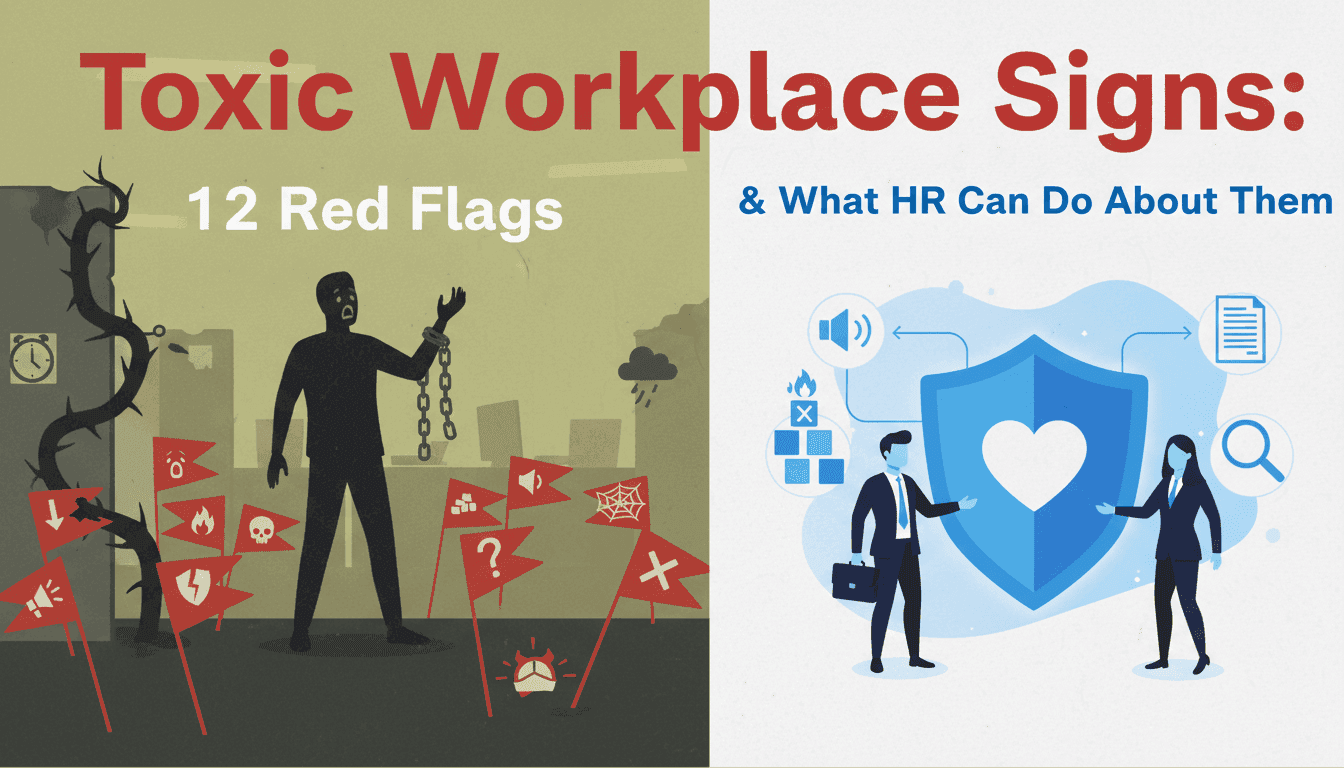
Table Of Contents
- What Makes a Workplace Toxic?
- Why Toxic Workplaces Are an HR Priority
- 12 Red Flags of a Toxic Workplace
- 1. High Employee Turnover
- 2. Poor or Absent Communication
- 3. Micromanagement Culture
- 4. Lack of Psychological Safety
- 5. Favoritism and Unfair Treatment
- 6. Chronic Overwork and Burnout
- 7. Bullying, Harassment, or Intimidation
- 8. Blame Culture with No Accountability
- 9. Suppressed Employee Voice
- 10. Lack of Recognition or Growth Opportunities
- 11. Cliques and Exclusionary Behavior
- 12. Leadership Modeling Bad Behavior
- What HR Can Do: Practical Steps to Address Toxicity
- When to Bring in External Support
- Conclusion
Toxic Workplace Signs: 12 Red Flags & What HR Can Do About Them
A toxic workplace rarely announces itself. It creeps in through patterns: the meeting where no one speaks up, the team member who quietly resigns after months of being overlooked, the manager whose feedback leaves people feeling smaller rather than stronger. By the time leadership notices something is wrong, the culture has often been damaged for far longer than anyone realized.
For HR professionals and business leaders, recognizing the signs of a toxic work environment early is one of the most critical responsibilities they carry. Left unaddressed, workplace toxicity doesn't just hurt morale. It drives up absenteeism, accelerates turnover, suppresses productivity, and creates legal and reputational risks that can take years to recover from. Research consistently shows that psychological safety and wellbeing are foundational to peak performance, and when those foundations crack, so does the business.
This article walks through 12 clear red flags that signal a toxic workplace, and more importantly, outlines what HR can practically do about each one. Whether you're seeing early warning signs or managing an entrenched cultural problem, the insights here are grounded in evidence-based people development principles that have helped organizations across industries build healthier, higher-performing teams.
What Makes a Workplace Toxic?
A toxic workplace is one where the prevailing culture, behaviors, or systems consistently undermine the psychological, emotional, or professional wellbeing of employees. It's not simply about having difficult days or demanding deadlines. Toxicity is characterized by patterns: repeated behaviors that are tolerated, normalized, or even rewarded, which ultimately make employees feel unsafe, undervalued, or unable to perform at their best.
Importantly, toxicity can exist at any level of an organization. It can stem from individual managers, team dynamics, structural policies, or leadership behavior at the top. Identifying where it originates is the first step toward addressing it effectively.
Why Toxic Workplaces Are an HR Priority
The business case for addressing workplace toxicity is clear and compelling. Studies from the Society for Human Resource Management (SHRM) have estimated that toxic workplace culture costs U.S. employers alone over $223 billion in employee turnover over a five-year period. Beyond direct financial costs, toxic environments suppress innovation, reduce discretionary effort, and erode the trust that high-performing teams depend on.
For HR, the challenge is twofold. First, you need the diagnostic tools to recognize toxicity when it's present. Second, you need the organizational authority and practical strategies to address it in ways that create lasting change rather than surface-level fixes. Both of these start with knowing what to look for.
12 Red Flags of a Toxic Workplace
1. High Employee Turnover
When talented people consistently leave an organization, especially within the first year or two of joining, it's rarely about the role itself. High voluntary turnover is one of the most reliable early indicators of a toxic workplace because people vote with their feet. If your exit interviews are surfacing themes around management style, lack of support, or feeling undervalued, those are signals that warrant serious attention rather than routine documentation.
2. Poor or Absent Communication
Healthy organizations are defined in part by how well information flows. In toxic workplaces, communication tends to be inconsistent, withheld, or weaponized. Employees are left guessing about decisions that affect them, important updates arrive late or not at all, and rumors fill the vacuum left by transparent leadership. When people can't trust the information they receive, anxiety and disengagement follow closely behind.
3. Micromanagement Culture
Managers who struggle to delegate, who check in excessively, or who override employees' decisions at every turn send a clear message: we don't trust you. Micromanagement stifles autonomy, kills motivation, and stunts professional development. It also tends to attract and retain a certain type of employee (one who waits to be told what to do) while pushing away the independent, high-initiative talent organizations most need.
4. Lack of Psychological Safety
Psychological safety, the ability to speak up, ask questions, disagree, and take risks without fear of punishment or humiliation, is widely recognized as a cornerstone of effective teams. When it's absent, employees self-censor, mistakes go unreported, and innovation dries up. A workplace where people fear the consequences of honesty is one where problems compound quietly beneath the surface until they become crises.
5. Favoritism and Unfair Treatment
When promotions, opportunities, or recognition are perceived to depend on personal relationships rather than merit, the impact on team morale is swift and lasting. Favoritism breeds resentment, discourages effort among those who feel overlooked, and signals to employees that the game is rigged. This is especially damaging when the favoritism intersects with demographic characteristics, creating potential discrimination concerns alongside the cultural harm.
6. Chronic Overwork and Burnout
Ambition and hard work are healthy. But when overwork becomes the baseline expectation rather than the exception, when people routinely skip breaks, stay late out of fear rather than passion, and feel guilty for taking leave, the organization is burning through its most valuable resource: human energy. Burnout is not a personal failure. It is an organizational signal that workloads, expectations, and recovery time are fundamentally out of balance.
7. Bullying, Harassment, or Intimidation
This red flag needs no subtlety. Any environment where employees are subjected to belittling, threats, public humiliation, sexual harassment, or persistent intimidation is not just toxic. It is potentially unlawful. The challenge for HR is that these behaviors are often minimized, denied, or excused with phrases like "that's just their management style." Robust reporting mechanisms, clear consequences, and consistent enforcement are non-negotiable here.
8. Blame Culture with No Accountability
In blame-driven workplaces, mistakes become ammunition rather than learning opportunities. People protect themselves by hiding errors, shifting responsibility, and avoiding any initiative that might go wrong. Paradoxically, this kind of culture often coexists with a lack of genuine accountability for those in power. Leaders who blame teams for failures while claiming credit for successes model exactly the behavior that makes toxicity self-perpetuating.
9. Suppressed Employee Voice
If employees don't raise concerns, it doesn't necessarily mean there aren't any. In many toxic workplaces, silence is learned behavior: people have tried speaking up before and experienced negative consequences for doing so. When suggestion boxes go unanswered, town halls are monologues, and dissenting opinions are dismissed or punished, the organization loses its most valuable feedback loop and most employees lose their sense of agency.
10. Lack of Recognition or Growth Opportunities
People need to feel that their contributions matter and that their career has a trajectory. When recognition is rare, inconsistent, or reserved only for visible wins, and when development opportunities are blocked or nonexistent, employees disengage. Quiet quitting, the phenomenon of employees doing the bare minimum while remaining technically employed, is often a symptom of this particular red flag rather than a character flaw in the individual.
11. Cliques and Exclusionary Behavior
Social dynamics in the workplace have real consequences for inclusion and belonging. When informal social groups form in ways that exclude colleagues, especially along lines of seniority, gender, ethnicity, or personality type, the result is a fragmented culture where some people feel like insiders and others feel perpetually marginal. Exclusion is a form of harm, and it has measurable effects on engagement, performance, and mental wellbeing.
12. Leadership Modeling Bad Behavior
Perhaps the most insidious red flag of all is when toxic behaviors come from the top. Leaders set the emotional and behavioral tone of an entire organization. When senior figures are seen dismissing people in meetings, playing politics, avoiding accountability, or behaving in ways that contradict stated values, it signals to everyone else that the rules don't really apply. Culture is always, in some sense, a reflection of leadership behavior.
What HR Can Do: Practical Steps to Address Toxicity
Recognizing the warning signs is the first step. Taking meaningful action is what separates organizations that recover and thrive from those that watch their culture quietly deteriorate. Here are the most effective levers HR has at its disposal.
Conduct honest organizational diagnostics. Before prescribing solutions, HR needs a clear picture of what's actually happening. This means going beyond annual engagement surveys to include pulse surveys, focus groups, confidential exit interviews, and psychometric profiling tools that surface the real state of the culture. Data gathered honestly, and acted upon consistently, builds the credibility HR needs to drive change.
Build psychological safety from the inside out. Creating environments where employees feel genuinely safe to speak up requires more than a policy statement. It requires manager training, role-modeling by leadership, and structural changes to how feedback is solicited and used. Programs that develop emotional intelligence and interpersonal skills at the team level have a compounding positive effect on the broader culture.
Establish clear behavioral standards with real consequences. Values without enforcement are just posters on a wall. HR must work with leadership to define the specific behaviors that are expected and those that will not be tolerated, and then apply those standards consistently regardless of seniority or performance metrics. Accountability that stops at the middle of the org chart is not accountability.
Invest in leadership development. Because so many toxic workplace signs originate from or are enabled by leadership behavior, developing better leaders is often the highest-leverage intervention available. Coaching programs, 360-degree feedback processes, and structured leadership development initiatives help managers and executives build the self-awareness and people skills that healthy cultures depend on.
Implement Employee Assistance Programs (EAPs). A robust EAP gives employees access to confidential counseling, mental health support, and coaching resources that help them navigate workplace stress and personal challenges before they escalate. Critically, EAPs also provide HR with aggregate data about the wellbeing trends in the organization, enabling more proactive and targeted interventions. Organizations like iGrowFit offer comprehensive EAP services designed to address the full spectrum of employee wellbeing needs, from individual psychological support to organization-wide culture transformation.
Create structured recognition programs. Recognition doesn't require large budgets. It requires consistency, sincerity, and visibility. Structured recognition frameworks, whether peer-to-peer, manager-driven, or milestone-based, reinforce the behaviors and contributions that matter and counteract the invisible cost of feeling overlooked.
When to Bring in External Support
Some cultural challenges are too deeply entrenched, or too politically complex, for internal HR teams to address alone. This is not a failure of HR. It's a recognition that certain interventions require the credibility, neutrality, and specialist expertise that external partners bring.
External organizational consultants and EAP providers can conduct impartial assessments, design and deliver targeted training, facilitate difficult conversations between leadership and teams, and provide the kind of evidence-based, bespoke solutions that align business performance goals with genuine human capital development. If you are seeing multiple red flags from this list, particularly those involving leadership behavior or systemic cultural dysfunction, seeking specialist support early is almost always more cost-effective than waiting for the situation to worsen.
Conclusion
A toxic workplace doesn't fix itself. Left unaddressed, the red flags outlined in this article compound over time, each one making the next harder to resolve. But organizations that take culture seriously, that invest in psychological safety, leadership development, and genuine employee wellbeing, don't just reduce toxicity. They build the foundation for sustained high performance, lower attrition, and workplaces where people genuinely want to show up and contribute.
HR has a critical role to play in this. Not as the department that manages complaints, but as a strategic partner that shapes the conditions in which people and businesses thrive together. Whether you're conducting your first culture audit or navigating a significant organizational challenge, the right frameworks, tools, and partners make all the difference.
Ready to address the signs of a toxic workplace in your organization?
At iGrowFit, we specialize in evidence-based Employee Assistance Programs and organizational wellbeing solutions that help businesses build healthier, higher-performing cultures. With over 15 years of experience and a multidisciplinary team of psychologists, coaches, and management consultants, we partner with organizations to create lasting, meaningful change.
Chat with us on WhatsApp to find out how we can support your organization today.