
Wellness Program Design: A 6-Phase Framework From Audit to Launch
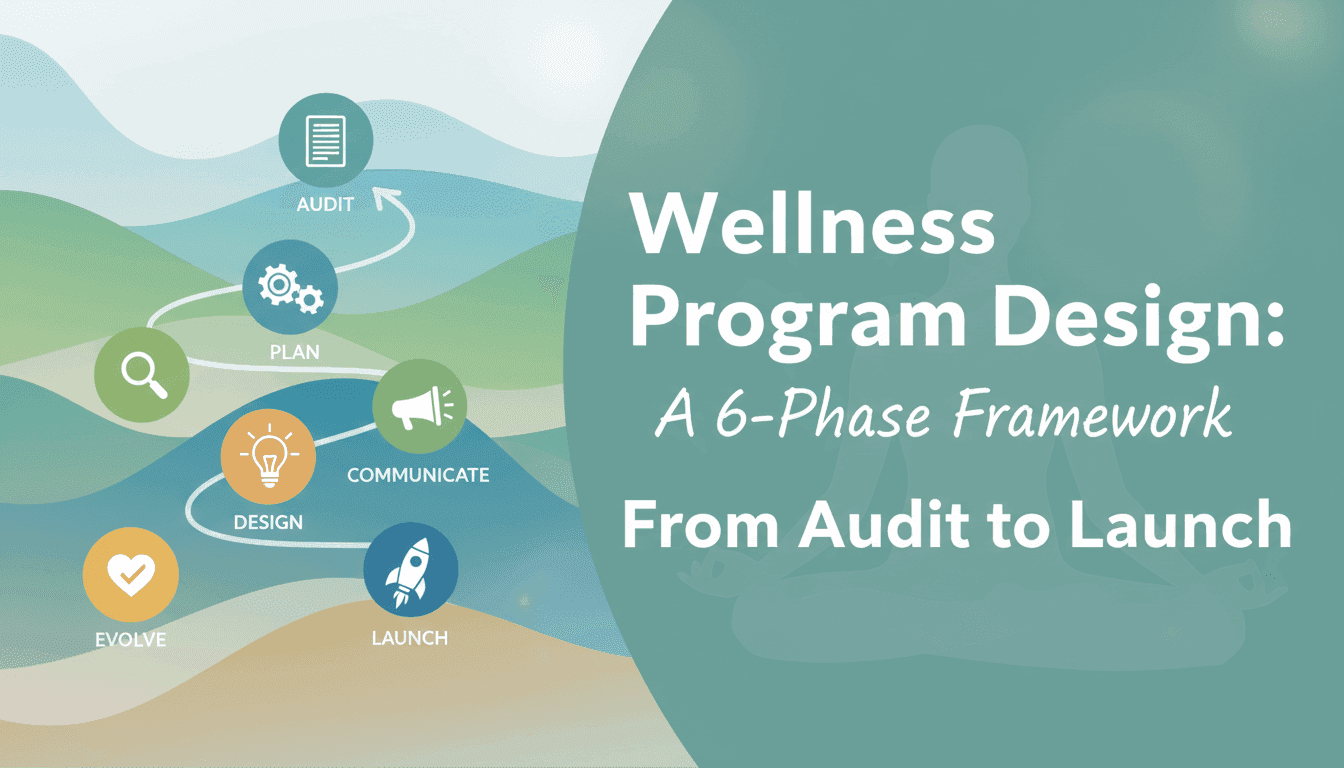
Table Of Contents
- Why Most Wellness Programs Fail Before They Start
- What Is Wellness Program Design?
- The Business Case: Why Getting the Design Right Matters
- The 6-Phase Wellness Program Design Framework
- The Role of Psychological Capital in Wellness Program Design
- Common Design Mistakes to Avoid
- Partner With Experts Who Have Done This Before
Wellness Program Design: A 6-Phase Framework From Audit to Launch
Most workplace wellness programs are launched with the best of intentions — and then quietly forgotten six months later. A motivational poster here, a step-counting challenge there, a webinar that only 12 people attended. Sound familiar? The problem is rarely effort or budget. It's design.
When a wellness program is built without a structured framework, it becomes a collection of disconnected activities rather than a coherent strategy. Employees disengage, leadership loses confidence in the ROI, and the HR team is left justifying spend with anecdotes instead of data. The companies that get this right — the ones whose employees genuinely thrive and whose organisations consistently hit their people performance goals — approach wellness program design as a deliberate, phased process.
This article walks you through a practical 6-phase framework for designing, building, and launching a workplace wellness program that delivers measurable outcomes. From the initial organisational audit to your full launch and beyond, each phase is grounded in evidence-based methodology and real-world implementation experience.
Why Most Wellness Programs Fail Before They Start {#why-most-wellness-programs-fail}
Before we get into the framework, it's worth understanding why so many wellness initiatives underperform. The answer is almost never a lack of care — it's a lack of structure. Organisations skip the assessment phase, assume they know what employees need, copy a competitor's program, or launch company-wide without piloting first. Each of these shortcuts produces the same outcome: low participation, low impact, and low trust.
Research consistently shows that well-designed programs deliver significant returns. According to a 2024 Wellhub study, 95% of companies that measure the ROI of their wellness programs report positive returns — and 91% of HR leaders say healthcare costs dropped after introducing wellness initiatives. The Global Wellness Institute has found that companies prioritising wellbeing report up to 20% higher productivity overall. These are not outlier results from exceptional companies. They are what happens when wellness programs are built correctly from the ground up.
The difference between a program that works and one that wastes budget comes down to one thing: intentional design.
What Is Wellness Program Design? {#what-is-wellness-program-design}
Wellness program design is the structured process of planning, building, and deploying a workplace well-being initiative that aligns with both organisational goals and employee needs. It goes well beyond choosing a vendor or scheduling a workshop. Effective design means understanding where your people are struggling, what your business needs to achieve, and which evidence-based interventions will close the gap between the two.
Modern wellness program design recognises that employee wellbeing is not just an individual concern — it is an organisational one. Work itself can be a source of stress, disengagement, and burnout. A program designed without examining the psychosocial conditions of the workplace will always be fighting an uphill battle. Conversely, a program designed to address both individual wellbeing and the systems and culture around people can shift the entire organisation.
This is the philosophy behind iGrowFit's approach — one shaped by more than 15 years working with over 450 Fortune 500 companies, MNCs, and SMEs across Asia. It is not enough to offer wellness resources. You need to design for lasting psychological and behavioural change.
The Business Case: Why Getting the Design Right Matters {#the-business-case}
Before any framework can gain traction internally, HR leaders and People & Culture teams need to make a compelling business case. The numbers support it unambiguously.
Employees with mental-health and well-being challenges are four times more likely to want to leave their organisations, according to McKinsey research. Replacing an employee can cost anywhere from 50 to 200% of their annual salary when recruiting, onboarding, and lost productivity are factored in. Presenteeism — employees who show up but are not fully functional — costs businesses an estimated $15,000 per hour of unproductive labour, according to McKinsey. And burnout, disengagement, and quiet quitting cost organisations billions each year in hidden performance drag.
On the other side of the ledger, a well-designed wellness program is a proven performance accelerator. Focusing on mental health alone yields a 4:1 ROI. Organisations that implement effective programs save an average of $462 per employee per year in healthcare claims. And when companies invest in employee well-being, employees are twice as likely to want to stay and three times more likely to recommend their workplace to others.
The investment case is clear. Now, here is how to design a program worthy of that investment.
The 6-Phase Wellness Program Design Framework {#the-6-phase-framework}
Phase 1: Organisational Audit {#phase-1-organisational-audit}
Every effective wellness program begins with honest, rigorous diagnosis. Skipping the assessment phase is one of the most common — and costly — mistakes organisations make. Before you can design anything, you need to understand the current state of your people's wellbeing, the conditions shaping it, and the gaps in your existing support infrastructure.
An organisational audit at this stage should cover three layers. First, quantitative data: examine your absenteeism trends, turnover rates, engagement survey scores, healthcare utilisation patterns, and any existing EAP usage data. These numbers tell you where the pain is concentrated. Second, qualitative insight: conduct structured employee pulse surveys, focus groups, and manager interviews to surface what data alone cannot capture — stress triggers, cultural dynamics, perceived barriers to wellbeing, and unmet needs. Third, environmental and psychosocial risk assessment: examine how the design of work itself (workloads, role clarity, autonomy, management practices, psychological safety) is contributing to or undermining employee wellbeing.
This three-layer audit produces a heat map of your organisation — showing you exactly where to focus your design energy and making it very difficult for leadership to dismiss the need for investment. At iGrowFit, this diagnostic stage is embedded in our ConPACT framework under Consultancy and Profiling, and it is where the most important design decisions get made.
Key audit outputs to capture:
- Current wellbeing baseline scores (per department, role level, and tenure)
- Top three psychosocial risk factors affecting your workforce
- Gap analysis between current offerings and identified employee needs
- Leadership readiness and cultural openness to wellbeing initiatives
Phase 2: Goal Setting and Stakeholder Alignment {#phase-2-goal-setting}
Audit data without direction is just noise. Phase 2 converts insights into intentions — and gets the right people aligned before a single initiative is designed. This phase is often underestimated, but it is where programs either gain momentum or die quietly in committee.
Start by translating your audit findings into specific, measurable wellness goals. Rather than vague aspirations like "improve employee wellbeing," define what success looks like in operational terms: reduce absenteeism by 15% over 12 months, increase EAP utilisation from 4% to 12%, improve manager-reported team engagement by a targeted number of points on your next survey cycle. Concrete goals create accountability and give you the measurement baseline you will need in Phase 6.
Equally critical is securing visible, genuine leadership buy-in. When senior leaders actively participate in wellness initiatives — not just endorse them via email — it signals to the entire organisation that wellbeing is a shared priority, not an HR initiative. Executive participation has been shown to drive employee engagement in wellness programs from 44% to as high as 80%. Identifying internal wellness champions across departments at this stage dramatically increases adoption later.
This phase should also produce a documented wellness strategy brief — a short, clear document that outlines your goals, target populations, measurement approach, and the business rationale for each decision. It protects the program's integrity as it moves through design and keeps all stakeholders on the same page.
Phase 3: Program Design and Customisation {#phase-3-program-design}
This is where the intelligence gathered in Phases 1 and 2 becomes a tangible program. Good wellness program design is built on one principle: it must be designed for your people, not borrowed from someone else's.
A comprehensive wellness program addresses the full spectrum of employee wellbeing — physical, mental, emotional, social, and financial health. Most organisations start with mental and physical wellbeing (the most acute needs) before expanding across dimensions. The design should define the specific interventions, activities, and resources that will address the priority needs identified in your audit. These might include coaching programs, resilience training, psychological profiling, leadership development workshops, peer support networks, flexible work policies, or access to professional counselling.
Critically, this is also the phase to build your incentive and participation architecture. Effective incentives are not simply prizes or gift cards — they are motivational structures that make engagement feel worthwhile and accessible. Consider participation-based recognition, purpose-driven reward options (such as charitable donations on behalf of employees), and manager-led team challenges that build social accountability without coercion. Voluntary participation with privacy protections built in is non-negotiable — it builds the trust that sustains long-term engagement.
Finally, define your measurement framework before launch. Determine which leading indicators (participation rates, survey scores, manager referral rates) and lagging indicators (absenteeism, turnover, healthcare utilisation) you will track. Building measurement infrastructure now prevents the all-too-common situation of running a program for a year and having no data to show for it.
Phase 4: Infrastructure and Communication Planning {#phase-4-infrastructure}
Even a brilliantly designed program will underperform if employees do not know it exists, do not understand it, or do not trust it. Phase 4 is about building the operational backbone and communication strategy that will carry the program into your organisation.
Infrastructure decisions at this stage include: selecting any platforms or tools that will house your program, establishing the governance structure (who owns what, who reports what, and to whom), ensuring appropriate data privacy policies are in place, and confirming that your program complies with relevant employment and health data regulations. Smaller organisations often run effective programs using existing internal tools — the infrastructure does not need to be complex to be effective.
Your communication plan should be developed with the same rigour as the program itself. Map out how you will introduce the program to employees, what the key messages are for each audience (individual contributors, managers, senior leaders), and how you will sustain ongoing communication beyond the initial launch. The most effective communication positions wellness not as a benefit to be consumed, but as an organisational value being brought to life. Managers need specific briefing — they are your most important channel for normalising participation and reducing stigma.
Phase 5: Pilot Launch and Iteration {#phase-5-pilot-launch}
Before going organisation-wide, launch your program with a contained pilot group — ideally one department or team of 20 to 50 people. A well-designed three-month pilot produces more actionable learning than six months of additional planning ever could. It reveals what resonates, what falls flat, where the communication is unclear, and where the design assumptions were wrong.
During the pilot, measure actively and continuously. Track participation trends week by week, collect qualitative feedback from participants and their managers, monitor your leading indicators, and document everything that surprises you. Run a mid-point check-in at four to six weeks — not just a formal survey, but genuine conversations that surface barriers early enough to address them before full launch.
Iterate quickly and without ego. If a particular element is not gaining traction, modify it. If an unexpected need surfaces, build for it. The pilot phase is your most valuable design tool — treat it as ongoing research, not a rehearsal. Organisations that skip pilots and launch company-wide immediately tend to lock in design errors at scale, making course correction far more disruptive.
Phase 6: Full Launch, Measurement, and Continuous Improvement {#phase-6-full-launch}
With pilot learnings integrated, you are ready for full organisational launch. But launch is not the finish line — it is the starting gate for the real work of building a sustained wellbeing culture.
In the first 90 days post-launch, focus on visibility, accessibility, and early wins. Celebrate participation milestones, share anonymised data on engagement, and ensure leadership continues to model the behaviours the program is designed to encourage. Make it easy for employees to engage — reduce friction wherever possible.
At the six-month mark, conduct your first substantive program review. Compare your leading and lagging indicators against the baselines established in Phase 2. What has shifted? What has not? Where are participation gaps concentrated? Use this data to refine underperforming elements and double down on what is working. Incorporate wellbeing metrics into your formal management review cycle at this stage — when wellbeing data sits alongside financial and operational performance data, it signals definitively that it matters.
The goal of Phase 6 is to transition the program from a project into a permanent organisational capability. This is the moment wellness stops being something HR runs and becomes something the whole organisation owns. Annual benchmarking, regular pulse surveys, and an iterative design mindset ensure the program evolves with your workforce rather than becoming static and irrelevant over time.
The Role of Psychological Capital in Wellness Program Design {#psycap-role}
Most wellness programs focus on reducing what is wrong — stress, burnout, absenteeism. At iGrowFit, we believe the most durable programs also invest in building what is right: the positive psychological resources that enable people to perform, adapt, and thrive over the long term.
This is the principle behind Psychological Capital, or PsyCap — a concept rooted in positive psychology and encompassing four core dimensions: Hope (the ability to find pathways to goals), Efficacy (confidence in one's capacity to succeed), Resilience (the ability to bounce back from setbacks), and Optimism (a constructive expectation of future outcomes). Together, these are known as the HERO model.
A meta-analysis of 51 independent samples found a strong, significant positive relationship between PsyCap and desirable employee outcomes — including job satisfaction, organisational commitment, citizenship behaviour, and objective performance — while also showing a negative relationship with stress, anxiety, and turnover intentions. Structured interventions designed to build PsyCap have been shown to produce meaningful, measurable improvements in employee performance and wellbeing over time.
When PsyCap development is embedded into your wellness program design — through coaching, targeted training, leadership modelling, and evidence-based profiling — you are not just managing employee health. You are building the psychological infrastructure that sustains peak performance. This is the distinction between a wellness program that reduces illness and one that actively develops people.
Common Design Mistakes to Avoid {#common-mistakes}
Even experienced HR teams fall into predictable traps when designing wellness programs. Being aware of these pitfalls before you start is one of the most valuable things you can do:
- Designing for the average employee. Your workforce is not homogeneous. A program built around the assumed needs of a generic employee will resonate with a narrow slice of your people. Segment your design — by role type, life stage, stress profile, or department — and build in flexibility.
- Launching without baseline data. Without a pre-program measurement baseline, you cannot demonstrate impact. Even a simple set of initial survey scores, absenteeism rates, and engagement figures gives you the evidence base you need later.
- Treating participation as the end goal. High participation rates feel like a win, but they are a leading indicator, not an outcome. Design your program to move the needle on the metrics that matter to your business — productivity, retention, performance — not just attendance at lunch-and-learns.
- Underinvesting in manager capability. Managers are the single biggest environmental factor in employee wellbeing. A program that equips individual employees but leaves managers without skills, tools, or role modelling expectations will quickly hit a ceiling.
- Letting the program go static. Employee needs evolve, business pressures shift, and what worked in year one may not work in year three. Build in structured review cycles and the organisational agility to update your program design regularly.
Partner With Experts Who Have Done This Before {#partner-with-experts}
Designing a wellness program that genuinely moves the needle on human performance is both an art and a science. It requires diagnostic rigour, design creativity, change management skill, and ongoing measurement discipline. For most organisations — whether large multinationals or fast-growing SMEs — the most efficient path to getting this right is working with partners who have already navigated the complexity.
Since 2009, iGrowFit has helped over 450 organisations design and implement bespoke wellness programs grounded in evidence-based psychology and real-world organisational experience. Our ConPACT framework (Consultancy, Profiling, Assessments, Coaching, and Training) maps directly onto each phase of the design process described in this article — ensuring that every decision is data-driven, every intervention is purposeful, and every program is built to last.
Wellness program design is not a one-time project. It is a commitment to your people that compounds in value over time. Done well, it builds the psychological capital, the cultural trust, and the human capability that allows your organisation to hit its goals, finish what it starts, and sustain peak performance through whatever comes next.
Ready to design a wellness program that actually works?
Speak directly with the iGrowFit team and find out how our evidence-based framework can be tailored to your organisation's unique needs.