Workplace Counselling: Models, Costs & How to Launch In-House Sessions
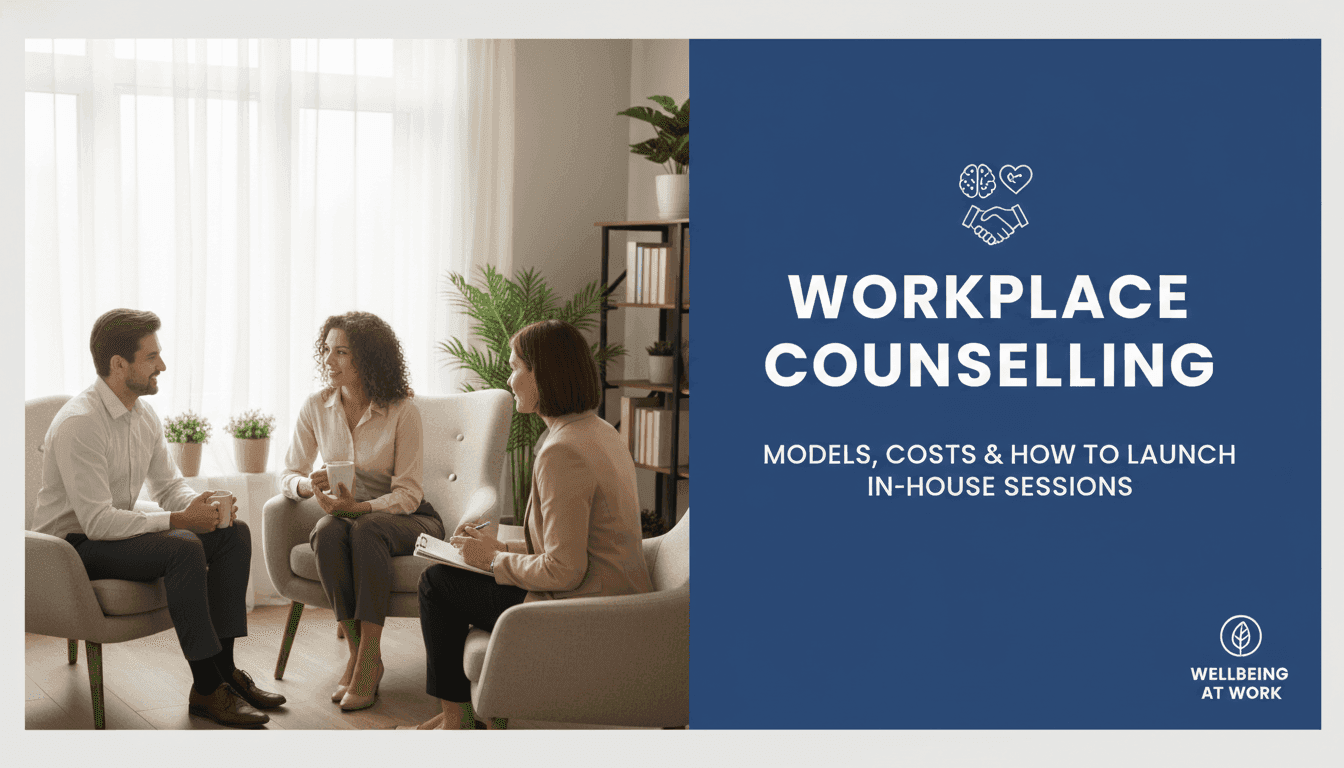
Table Of Contents
- What Is Workplace Counselling?
- Why Workplace Counselling Matters More Than Ever
- Common Workplace Counselling Models
- Understanding the Real Costs
- How to Launch In-House Workplace Counselling Sessions
- Key Challenges to Anticipate
- How iGrowFit Supports Your Workplace Counselling Journey
- Final Thoughts
Workplace Counselling: Models, Costs & How to Launch In-House Sessions
Workplace stress, burnout, and unresolved personal challenges are quietly costing organisations more than most leaders realise. Research consistently shows that poor mental health at work contributes to absenteeism, reduced productivity, higher turnover, and even safety incidents. Yet for many businesses, the idea of offering professional counselling support feels either too complex or too expensive to act on. The good news is that it doesn't have to be either.
Workplace counselling — when structured thoughtfully — is one of the highest-return investments a company can make in its people. Whether you are an HR professional building a business case for leadership, an L&D manager exploring employee wellbeing programmes, or a business owner who wants to do right by your team, this guide breaks down everything you need to know: the main counselling models available, what in-house and outsourced sessions actually cost, and a practical step-by-step roadmap to get a programme running inside your organisation.
What Is Workplace Counselling? {#what-is-workplace-counselling}
Workplace counselling is a professional support service that provides employees with a confidential space to explore personal, emotional, and work-related difficulties with a qualified counsellor or psychologist. It sits within the broader category of Employee Assistance Programmes (EAPs) and is distinct from performance management, coaching, or mentoring — though it often works alongside all three.
The goal is not to "fix" employees, but to equip them with tools, perspectives, and coping strategies that allow them to function more effectively at work and in life. Topics addressed in workplace counselling sessions commonly include stress and anxiety, relationship difficulties, grief and loss, financial worry, trauma, substance use, and work-related conflicts. Because the support is confidential and professionally delivered, employees are far more likely to engage honestly than they would be with a line manager or internal HR contact.
For organisations, the value extends beyond individual wellbeing. When people feel psychologically supported, they are more engaged, more resilient, and more able to contribute at their full capacity — which directly feeds into the kind of consistent performance that drives business results.
Why Workplace Counselling Matters More Than Ever {#why-it-matters}
The post-pandemic era has permanently shifted expectations around mental health at work. Employees today are more willing to speak openly about psychological struggles, and they are also more likely to leave an employer that does not take their wellbeing seriously. In competitive talent markets across Southeast Asia and globally, a credible, well-communicated wellbeing programme is increasingly a recruitment and retention differentiator.
Beyond the talent angle, the business case is compelling on its own. Studies from organisations like the World Health Organization estimate that for every USD 1 invested in mental health support at work, there is a return of USD 4 in improved health and productivity. Absenteeism and presenteeism — the phenomenon of employees showing up but functioning at reduced capacity — are two of the most measurable drains on any organisation's output. Workplace counselling directly addresses both.
Companies that have partnered with iGrowFit to implement structured EAP and counselling programmes consistently report improvements not just in wellbeing metrics, but in team cohesion, leadership effectiveness, and overall performance outcomes. The connection between psychological capital and peak performance is not theoretical — it is measurable and replicable.
Common Workplace Counselling Models {#counselling-models}
Not all workplace counselling programmes are structured the same way. Choosing the right model depends on your organisation's size, culture, budget, and the nature of the challenges your workforce is navigating. Here are the primary models used in organisational settings:
1. Employee Assistance Programme (EAP) Model
The EAP model is the most widely adopted framework globally. Under this structure, organisations contract with an external provider to give employees access to a set number of confidential counselling sessions per year, typically between three and eight sessions per employee. Employees can self-refer, which protects their privacy and removes the stigma barrier. EAPs often extend to employees' immediate family members and may include access to financial advice, legal guidance, and online wellbeing resources alongside clinical counselling.
This model suits organisations that want a low-barrier, scalable solution without building internal clinical capacity. The outsourced structure means that specialist expertise is always available, and providers manage compliance, clinical governance, and counsellor quality on the organisation's behalf.
2. In-House Counselling Model
Larger organisations sometimes employ one or more counsellors or psychologists directly as part of their HR or Occupational Health function. This model offers greater control over the programme design and allows counsellors to develop a nuanced understanding of the organisation's culture and common stressors. However, it requires significant investment in hiring, supervision, professional development, and clinical governance infrastructure to maintain ethical standards.
A critical consideration here is maintaining genuine confidentiality. Employees must trust that what they share in sessions will not reach their line manager or HR business partner. Clear policies and structural separation between counselling and HR decision-making are essential.
3. Hybrid or Blended Model
Many organisations find that a hybrid approach delivers the best outcomes. This typically combines an outsourced EAP for baseline access and short-term counselling needs with in-house psychological support — such as a resident wellbeing champion, coach, or counsellor — for ongoing, proactive engagement. The blended model allows organisations to maintain personal relationships with their workforce while drawing on external clinical expertise for complex cases.
4. Structured Short-Term Counselling (STSC)
This model is grounded in evidence-based therapeutic frameworks such as Cognitive Behavioural Therapy (CBT) and Solution-Focused Brief Therapy (SFBT). Sessions are time-limited (usually four to six sessions) and goal-directed, making them practical for a work context where the aim is to restore functional wellbeing rather than conduct deep long-term therapy. STSC is often the clinical backbone within EAP models.
5. Group and Psychoeducational Formats
Beyond individual sessions, many organisations benefit from group support formats — such as stress management workshops, resilience programmes, and psychological safety workshops. These formats are cost-effective, reach more employees at once, and reduce stigma by normalising conversations about mental health. They work best as a complement to, rather than a replacement for, individual counselling access.
Understanding the Real Costs {#understanding-costs}
One of the most common reasons organisations delay implementing workplace counselling is uncertainty about cost. The reality is that the range is broad, and the right approach for your organisation depends on factors including workforce size, desired utilisation rate, delivery mode, and level of clinical expertise required.
EAP contract costs for outsourced programmes are typically structured on a per-employee-per-year (PEPY) basis. In the Asia-Pacific region, this can range from SGD 50 to SGD 200 per employee per year depending on the scope of services included. Larger organisations generally negotiate better per-unit rates, and programmes that include digital access, wellbeing resources, and manager support tend to sit at the higher end.
In-house counsellor salaries represent the primary cost driver if you choose to build internal capacity. A qualified counsellor or registered psychologist in Singapore typically commands an annual salary between SGD 50,000 and SGD 90,000 or more depending on experience and specialisation. Add to this the costs of clinical supervision (a professional requirement for practising counsellors), professional development, and programme administration.
Session-based pricing is relevant for organisations that want to pilot counselling without a full commitment. Individual sessions with a qualified workplace counsellor or organisational psychologist typically range from SGD 120 to SGD 300 per session in Singapore, depending on the practitioner's credentials and the nature of the support.
The cost of inaction, however, is often far greater. When you account for the expense of replacing a single mid-level employee (estimated at 50 to 200 percent of their annual salary when recruitment, onboarding, and lost productivity are factored in), even a modest reduction in turnover driven by better wellbeing support delivers measurable ROI. Presenteeism costs are harder to quantify but are consistently identified as two to three times more expensive than absenteeism in well-documented workforce studies.
How to Launch In-House Workplace Counselling Sessions {#how-to-launch}
Launching a credible in-house programme requires more than booking a room and finding a counsellor. Here is a practical, phased roadmap:
1. Conduct a Needs Assessment Before designing anything, understand what your workforce actually needs. Use anonymous surveys, focus groups, exit interview data, and absenteeism records to identify the most prevalent challenges. This evidence not only shapes the programme but also forms the foundation of your business case for leadership approval and budget.
2. Define the Programme Model and Scope Based on your needs assessment, determine which counselling model is the best fit — whether that is a fully outsourced EAP, an in-house hire, a hybrid structure, or a short-term structured programme. Define the number of sessions employees can access, whether the programme extends to family members, what issues are in scope, and how referrals will work.
3. Establish Governance and Confidentiality Protocols This step is non-negotiable. Employees will not use a counselling service they do not trust. Document and communicate clearly how session content is protected, what the limits of confidentiality are (typically around risk of serious harm), and how aggregate, anonymised data may be reported to the organisation for programme evaluation. Engage HR, legal, and clinical leads in designing these protocols.
4. Select and Vet Your Counsellors Whether hiring internally or contracting externally, ensure that all counsellors hold recognised professional qualifications, are registered with a relevant professional body (such as the Singapore Association for Counselling or the Singapore Psychological Society), and receive regular clinical supervision. Credentials, specialisation in workplace issues, and cultural competency are all important screening criteria.
5. Design the Access and Referral Pathway Make it easy for employees to self-refer without going through their manager or HR. Consider a dedicated confidential phone line, an email address, or a digital booking platform. Establish a clear, documented process for manager-facilitated referrals in cases where a manager is concerned about an employee's wellbeing, ensuring this pathway does not compromise confidentiality.
6. Train Managers as First Responders Your counselling programme will be significantly more effective if line managers know how to recognise signs of distress, have language to start supportive conversations, and know how to signpost employees toward help without overstepping. A half-day manager mental health awareness training, delivered as part of launch activities, dramatically improves programme uptake and creates a more psychologically safe team environment.
7. Launch with a Communication Campaign Programme utilisation is directly linked to awareness. Develop an internal communications plan that includes leadership endorsement (senior visible buy-in reduces stigma), clear messaging about confidentiality, multiple touchpoints across channels (email, intranet, team meetings), and regular reminders throughout the year — not just at launch.
8. Monitor, Evaluate, and Iterate Set measurable objectives before launch — such as target utilisation rates, employee satisfaction scores, or reductions in stress-related absence — and build in quarterly review cycles. Use anonymised counsellor reports, employee feedback surveys, and HR data to assess impact and refine the programme continuously.
Key Challenges to Anticipate {#key-challenges}
Even well-designed workplace counselling programmes encounter obstacles. Being aware of common pitfalls helps you design around them from the start.
Stigma and uptake barriers remain the most significant challenge. Employees in many cultures, particularly across Asia, may feel that seeking counselling reflects weakness or could affect how they are perceived professionally. Sustained leadership visibility, peer champion networks, and normalising wellbeing conversations in everyday team interactions all help shift this over time.
Manager gatekeeping can inadvertently restrict access when managers are not properly briefed. Some managers discourage employees from taking up counselling because they fear it signals a performance problem or reflects poorly on their team. Embedding manager training into your launch plan addresses this directly.
Programme fatigue occurs when organisations launch a wellbeing initiative without sustaining engagement. Counselling support should be positioned as a permanent, valued benefit — not a temporary response to a crisis. Annual re-communication, integration into onboarding, and inclusion in your employer brand all help embed it as business as usual.
How iGrowFit Supports Your Workplace Counselling Journey {#igrowfit-support}
iGrowFit brings together a multi-disciplinary team of psychologists, counsellors, coaches, and management consultants who have supported over 450 Fortune 500 companies, MNCs, and SMEs across more than 700 consultancy projects since 2009. Their work has directly impacted more than 75,000 employees through evidence-based approaches rooted in developing psychological capital for peak performance.
Under the ConPACT framework — spanning Consultancy, Profiling, Assessments, Coaching, and Training — iGrowFit offers bespoke organisational solutions that connect business goals with human capital development. Whether you are starting from scratch with a needs assessment, looking to design a custom EAP structure, or seeking to embed counselling within a broader leadership and wellbeing strategy, the team brings the clinical depth and commercial understanding to make it work.
As a partner with Singapore's Health Promotion Board for national-level psychological wellbeing initiatives, iGrowFit is recognised not just as a service provider, but as a genuine thought leader and advocate for happiness at work, family, and life.
Final Thoughts {#final-thoughts}
Workplace counselling is no longer a nice-to-have. In an era where psychological safety, employee wellbeing, and peak performance are increasingly understood as interconnected, organisations that invest in credible, well-governed counselling support are building a measurable competitive advantage. The model you choose matters less than the commitment behind it — employees can tell the difference between a programme designed around genuine care and one deployed for optics.
Start with a clear understanding of your workforce's needs, choose a model that fits your organisational context, protect confidentiality with real structural rigour, and invest in manager capability alongside direct employee support. Done well, workplace counselling does not just help individuals through difficult periods — it builds the collective psychological resilience that allows teams to hit goals and finish tasks, consistently.
Ready to build a workplace counselling programme that actually works?
iGrowFit's team of organisational psychologists, counsellors, and EAP specialists can help you design, launch, and sustain a bespoke programme aligned to your business goals and workforce needs.
💬 Chat with us on WhatsApp — our team is ready to help you take the first step.