Workplace Fairness Act Singapore: Mental Health Implications for HR Professionals
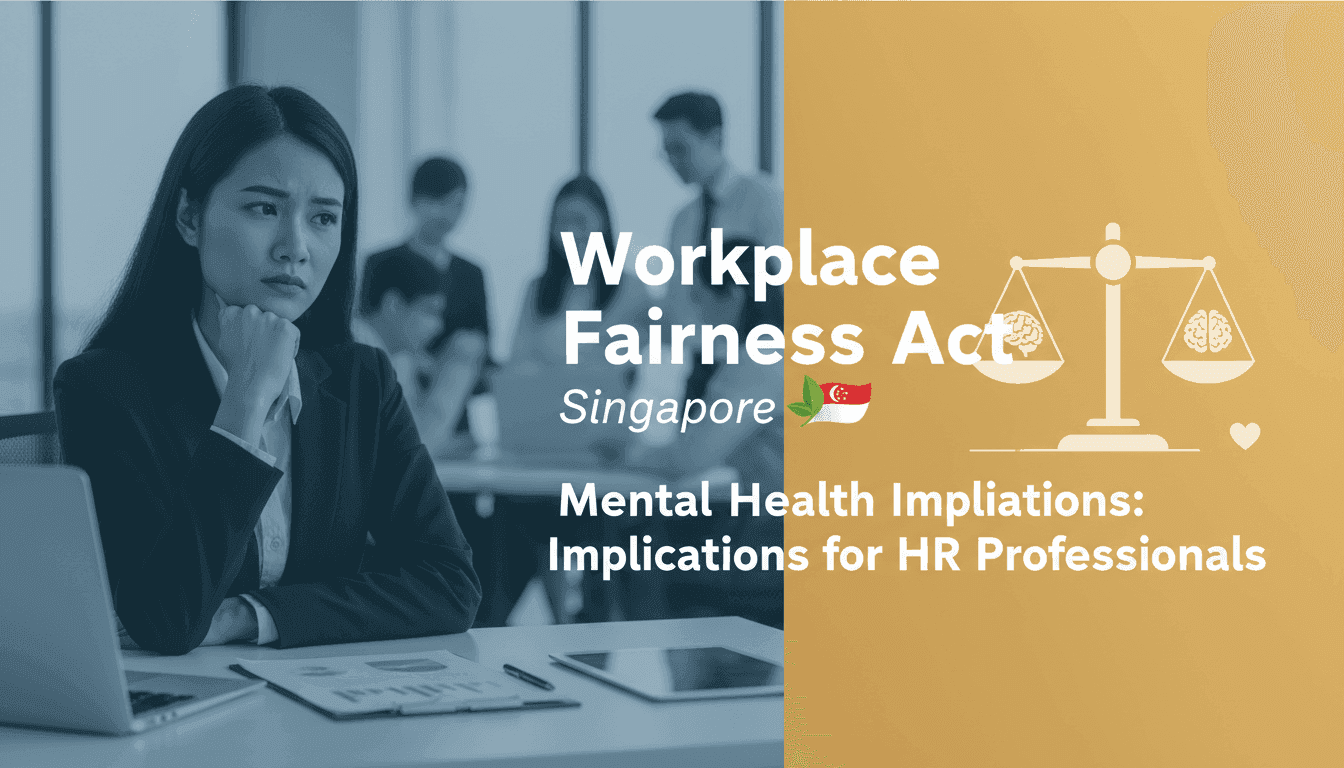
Table Of Contents
- Why the Workplace Fairness Act Changes Everything for HR
- Singapore's Mental Health Reality: What the Data Is Telling HR
- What the WFA Actually Requires: A Mental Health Lens
- The Hidden Cost of Getting This Wrong
- From Compliance to Psychological Capital: A Better Framework
- What HR Must Build Before Enforcement Arrives
- The Role of an EAP in WFA Readiness
- Building a Speak-Up Culture That Actually Works
- How iGrowFit Helps HR Lead the Change
- Conclusion: Compliance Is the Floor, Not the Ceiling
Singapore's HR Moment of Reckoning
For years, Singapore's HR community has championed mental health awareness with sincerity — running wellness weeks, distributing helpline numbers, and onboarding Employee Assistance Programs (EAPs) with the best of intentions. Yet burnout rates have barely shifted. Despite ongoing efforts, 61% of employees reported feeling burnt out in 2024, compared to 62% in 2022 — a figure that speaks to stagnation, not progress. The initiatives existed, but the underlying conditions that drive psychological distress remained largely unaddressed.
Now, the rules have changed. The Workplace Fairness Act, passed in 2025, turns principles that previously existed under the Tripartite Guidelines on Fair Employment Practices into binding legal obligations. For HR professionals, this isn't simply a policy update to file away. It is a structural shift in what workplace mental health support means — and what it costs to get it wrong. The Act was passed by Parliament on 8 January 2025 and is intended to take effect in 2026 or 2027, with one of its most significant shifts being the explicit inclusion of mental health as a protected characteristic.
This article is written specifically for HR practitioners navigating this transition. It covers what the Workplace Fairness Act requires, what the burnout data is signalling, and — critically — how the smartest HR teams are using this moment not just to comply, but to build genuinely healthier, higher-performing organisations from the inside out.
Why the Workplace Fairness Act Changes Everything for HR {#why-wfa-changes-everything}
In Singapore's employment landscape, the shift brought by the Workplace Fairness Act (WFA) is seismic precisely because it converts aspiration into obligation. What was once a set of voluntary best practices under the Tripartite Guidelines on Fair Employment Practices is now a binding legal framework that prohibits discrimination across the entire employment lifecycle — from recruitment and hiring through to performance evaluation, promotion, and dismissal. For HR professionals, this reorients the entire people function.
In 2025, Parliament passed two Bills that together form the WFA, making it Singapore's first law rendering workplace discrimination legally enforceable — enabling employees to take employers to a tribunal, or for larger claims, to the High Court, over discriminatory hiring decisions, biased promotions, or retaliatory dismissals. This is not theoretical. The precedent has been set, the machinery is being assembled, and HR teams now sit at the front line of compliance accountability.
Organisations must be able to demonstrate that employment decisions are objective, consistent, and properly documented, meaning HR processes, policies, and records will increasingly form part of the organisation's compliance evidence base. For HR professionals, this means the informal culture of "we handle things discreetly" is no longer adequate. Documentation, process, and psychological safety are now institutionally required — not merely recommended.
Singapore's Mental Health Reality: What the Data Is Telling HR {#mental-health-reality}
Understanding why the WFA's mental health provisions matter requires sitting honestly with the data. About a third of Singapore's workforce who participated in a voluntary online assessment reported experiencing work-related stress or burnout in 2024, according to data from the Ministry of Manpower and partner organisations. Separately, a survey of 1,018 employees in Singapore found minimal improvement in burnout levels — 61% in 2024 versus 62% in 2022 — underscoring that employers have not done enough to manage employee burnout over the past two years.
The generational dimension makes this more urgent. Gen Z reports the highest burnout rates at 68%, followed by 65% of Millennials, 54% of Gen X, and 36% of Baby Boomers. Since Gen Z and Millennials now represent the majority of most Singapore workforces, HR professionals managing talent pipelines, retention strategies, and succession planning cannot afford to treat these figures as someone else's problem.
Perhaps the most overlooked data point is the state of HR professionals themselves. According to Milieu's 2023 report focused on HR professionals in Singapore, at least 75% experience burnout and only 32% of respondents believe their company truly values mental health. This creates a structural paradox: the very function expected to champion employee wellbeing is itself operating under significant psychological strain. Any credible mental health strategy must account for this reality — because HR practitioners cannot pour from an empty cup.
What the WFA Actually Requires: A Mental Health Lens {#what-wfa-requires}
For HR teams, the most important thing to understand about the WFA is what "mental health condition" actually covers in legal terms. Under the Act, mental health conditions refer to any mental disorder diagnosed by a registered medical practitioner, and these protected characteristics account for more than 95% of discrimination complaints received by the Ministry of Manpower and TAFEP. This is a broad definition — and it means HR cannot limit its thinking to only severe or visible conditions. Depression, anxiety, and burnout-related disorders all fall within scope.
Practically speaking, the WFA prohibits adverse employment decisions at every stage. This includes choosing not to hire someone, giving a poor performance appraisal, denying a promotion or training opportunity, or dismissing an employee because they have a protected characteristic — including a mental health condition. HR teams must audit their processes across hiring, performance management, and exit procedures through this lens.
One of the most operationally significant requirements is the mandatory grievance framework. The WFA mandates a written grievance handling process that must be communicated to all employees — and this is a legal requirement, not optional. Furthermore, parties cannot contract out of the Act: any term in an employment contract that excludes or limits its operation, or prevents anyone from raising a grievance under it, is void. HR policies and employment contracts that contain such clauses must be reviewed and revised before enforcement begins.
What HR must prohibit under the WFA (mental health dimension):
- Rejecting job applicants because of a disclosed mental health diagnosis
- Excluding employees with mental health conditions from training or promotion opportunities
- Making working conditions unreasonably difficult for employees with mental health conditions
- Sharing an employee's mental health information without consent
- Retaliating against employees who raise mental health-related grievances
- Using job advertisement language that implicitly screens out candidates with mental health conditions
The penalties for non-compliance are substantial. The Act introduces mandatory grievance handling procedures, anti-retaliation protections, and a new dispute resolution framework through the Employment Claims Tribunal, with claims reaching up to SGD 250,000.
The Hidden Cost of Getting This Wrong {#hidden-cost}
Beyond the legal penalties, the business case for getting mental health right is compelling on its own terms. A study conducted by Duke-NUS and the Institute of Mental Health found that the total productivity loss attributable to anxiety and depression in Singapore is estimated at approximately S$15.7 billion a year. This figure encompasses both absenteeism and presenteeism — the more insidious of the two, where employees show up physically but are cognitively and emotionally depleted.
Research shows that accessing support through EAP providers reduces sick leave by 33%, lost time by 40%, and work-related stress by 65%. The inverse is equally instructive: organisations without adequate support structures absorb these costs invisibly, embedded in reduced output, higher turnover, and declining team performance. Financial returns from investing in employee wellbeing are well-documented, with studies consistently demonstrating that organisations achieve $3 to $6 in return for every dollar invested in EAP services.
For HR professionals making the internal business case to leadership, these figures are the foundation. Mental health support is not a welfare expenditure — it is an investment with a demonstrable, measurable return that directly protects the organisation's most critical resource: its people.
From Compliance to Psychological Capital: A Better Framework {#psychological-capital}
Here is where many organisations will make their most consequential mistake. The WFA creates a compliance floor — a minimum threshold of acceptable behaviour. But organisations that treat it as a ceiling will spend the next several years managing grievances reactively, updating policies grudgingly, and wondering why their engagement scores haven't moved.
The more powerful frame is psychological capital: the internal resources that allow employees to navigate challenge, maintain performance under pressure, and sustain wellbeing over time. Psychological capital encompasses four dimensions — hope, efficacy, resilience, and optimism — and it is precisely what evidence-based EAP and people-development programmes are designed to build.
The WFA is, in effect, legislating a minimum standard of psychological safety. When the law says an employer cannot punish someone for raising a grievance, it is saying that speak-up culture is no longer a leadership preference — it is an employer obligation. HR professionals who understand this distinction will move beyond box-ticking toward genuine culture transformation.
This reflects a growing recognition that workplace mental health support needs to be multi-layered. Mental health support is not a one-size-fits-all solution: some individuals require clinical intervention, while others benefit from practical workplace adjustments or supportive management. For HR teams, this means building tiered support ecosystems — from organisational policy and culture at the top, through manager capability in the middle, to individual clinical and coaching support at the base.
What HR Must Build Before Enforcement Arrives {#what-hr-must-build}
With enforcement expected between 2026 and 2027, the window for preparation is real but not unlimited. The Workplace Fairness Act represents a significant shift from voluntary guidelines to statutory obligations. The five protected characteristic groups are broad, the penalties for non-compliance are material, and the burden of proof in dispute resolution effectively requires employers to have documented evidence of fair decision-making at every stage of the employment lifecycle.
HR professionals need to think in three layers of action:
Layer 1: Compliance Infrastructure (Immediate Priority)
The foundation is getting the legal basics right. This includes drafting or revising written grievance handling procedures that explicitly cover mental health discrimination, auditing all job advertisements and hiring templates for language that could imply bias against candidates with mental health conditions, and reviewing employment contracts for clauses that may be voided under the WFA. Organisations must be able to demonstrate that employment decisions are objective, consistent, and properly documented — and HR processes and records will increasingly form part of the compliance evidence base. Every performance appraisal, every promotion decision, every redundancy process needs a documented rationale that stands independent of protected characteristics.
Layer 2: Manager Capability (Three to Six Months)
Line managers are simultaneously the greatest risk and the greatest asset in any mental health strategy. They are often the first to notice when a team member is struggling — and the first to inadvertently say something discriminatory when they try to help without adequate training. Investing in structured mental health training for people managers covers recognising early signs of psychological distress, having supportive and legally sound conversations, understanding what workplace adjustments are reasonable and appropriate, and knowing when to refer to professional support. This training also reduces the 90% supervisor time drain that occurs when people issues escalate without early intervention.
Layer 3: Cultural Embedding (Ongoing)
Policy and training are necessary but insufficient. A large proportion of employees report that they do not have access to essential wellness services, including mental health support initiatives — and this gap in support contributes directly to the persistence of high burnout levels. Sustained culture change requires leadership role modelling, visible senior commitment to mental health, and systematic reduction of the root causes of burnout — unrealistic workload expectations, always-on communication cultures, and insufficient psychological safety at the team level.
The Role of an EAP in WFA Readiness {#role-of-eap}
A well-designed Employee Assistance Programme is no longer optional in Singapore's new legislative landscape — it is a foundational component of any WFA-ready HR strategy. Employee Assistance Programmes are work-based programmes that offer free and confidential assessments, short-term counselling, referrals, and follow-up services to employees who have personal or work-related problems, with the goal of helping employees resolve these issues so that they can remain productive and effective at work.
For WFA readiness specifically, an EAP serves three critical functions. First, it provides the confidential support channel that employees need to seek help without fear of disclosure or professional consequence — directly addressing the legal requirement not to share an employee's mental health information without consent. Second, it gives HR a structured, defensible process for supporting employees who disclose mental health conditions, reducing the risk of unintentional discrimination through inconsistent management responses. Third, it generates utilisation data that allows HR to identify systemic stress points across the organisation and intervene at the programme level, not just the individual level.
In Singapore, EAPs are becoming essential as more companies begin to recognise the connection between employee wellness and workplace performance. The most effective programmes go beyond counselling to integrate coaching, psychological profiling, organisational assessment, and leadership development — creating an interconnected system that strengthens the organisation's psychological capital from multiple angles simultaneously. iGrowFit's EAP is built precisely on this multi-disciplinary model, combining the clinical depth of psychology with the strategic lens of management consulting.
Building a Speak-Up Culture That Actually Works {#speak-up-culture}
One of the most frequently cited barriers to effective mental health support in Singapore workplaces is stigma. Employees often know support exists but fear that using it will flag them as a liability, affect performance reviews, or change how colleagues perceive them. This is not an irrational fear — it reflects real cultural dynamics that HR professionals need to actively counter, not dismiss.
The WFA's anti-retaliation provisions create the legal backbone of a speak-up culture, but the cultural architecture must be built deliberately. For some individuals, simply knowing that they can have a difficult period without fear of negative consequences can make a meaningful difference. Creating this psychological safety at the team and organisational level requires consistent, visible signals from leadership — not a one-time wellness campaign, but an ongoing demonstration that mental health is treated with the same seriousness as physical health.
Practical speak-up culture builders include trained Mental Health Champions or Ambassadors at the peer level, normalised language around stress and emotional wellbeing in team meetings and check-ins, senior leaders who share their own experiences with vulnerability and without career consequence, and a grievance process that employees genuinely trust to be confidential and fair. The WFA mandates the last of these; the others are what make the first one credible.
How iGrowFit Helps HR Lead the Change {#how-igrowfit-helps}
Building a WFA-compliant, psychologically resilient organisation is not a task HR teams can complete in isolation. It requires a partner with the depth to work at every level of the system — from individual employee support to leadership development to organisational culture transformation.
iGrowFit is Singapore's comprehensive Employee Assistance Programme provider operating under the iGROW umbrella, bringing together a multi-disciplinary team of management consultants, psychologists, coaches, counsellors, and researchers. Since 2009, iGrowFit has worked with over 450 Fortune 500 companies, MNCs, and SMEs, completing more than 700 consultancy projects and directly impacting over 75,000 employees through evidence-based solutions.
What distinguishes iGrowFit's approach is the ConPACT framework — Consultancy, Profiling, Assessments, Coaching, and Training — which delivers bespoke organisational solutions that align business goals with human capital development. Rather than offering standalone wellness programmes or generic EAP hotlines, iGrowFit builds the psychological capital infrastructure that enables people to perform at their best, sustain that performance, and navigate challenge with genuine resilience. This is exactly the kind of multi-layered, evidence-based support the WFA's mental health provisions are designed to encourage.
iGrowFit also partners with Singapore's Health Promotion Board on national-level psychological wellbeing initiatives, bringing institutional credibility and public health alignment to every engagement. For HR professionals seeking a partner who understands both the compliance landscape and the human reality behind it, this depth of expertise is the difference between a wellness programme and a genuine people development strategy.
Compliance Is the Floor, Not the Ceiling {#conclusion}
The Workplace Fairness Act represents Singapore's clearest signal yet that employee mental health is not a discretionary benefit — it is a right, and the organisations that fail to protect it will face real consequences. For HR professionals, the immediate priority is clear: build the grievance handling infrastructure, audit discriminatory language from all employment-related communications, and train managers to navigate mental health conversations with both legal awareness and genuine empathy.
But the most transformative opportunity lies beyond compliance. Employers who treat the WFA as a compliance exercise — minimum documentation, reactive grievance handling — will face unnecessary risk. Those who use it as a catalyst to build genuine psychological safety, robust EAP access, and a culture where people can do their best work without fear will find that wellbeing and performance reinforce each other. That is not idealism — it is the evidence-based reality that decades of people-development research consistently confirms.
The organisations that will thrive in Singapore's evolving workplace landscape are those whose HR functions lead the change proactively — not waiting for a complaint to arrive, but building the environments where people grow, contribute, and genuinely want to stay.
Ready to Build a Psychologically Resilient, WFA-Ready Workplace?
Navigating the Workplace Fairness Act's mental health obligations while building a genuinely supportive workplace culture requires the right expertise and the right partner. iGrowFit's multi-disciplinary EAP team has supported over 75,000 employees across 450+ organisations with evidence-based solutions designed to develop psychological capital at every level of your business.
From compliance-ready grievance frameworks to manager mental health training, psychological profiling, and holistic EAP support — we help HR teams lead with confidence.
Chat with our team on WhatsApp to discuss how iGrowFit can help your organisation meet its WFA obligations and build a workplace where people consistently hit goals and finish tasks at their best.