Workplace Wellness Software: Key Features, Top Vendors & Buyer's Checklist
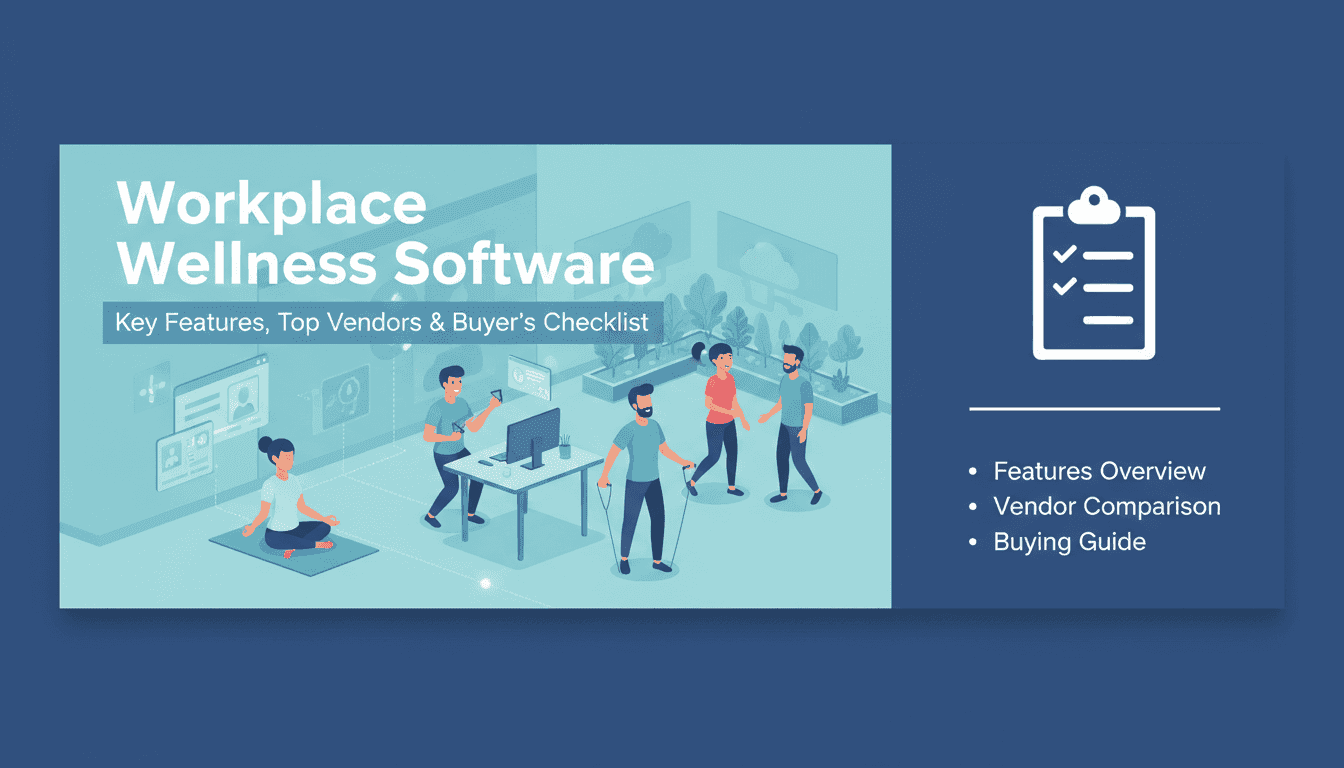
Table Of Contents
- What Is Workplace Wellness Software?
- Why Your Organisation Needs It Now
- Core Features to Look For
- The EAP Advantage: Why Human-Led Support Still Matters
- Leading Workplace Wellness Software Vendors
- Buyer's Checklist: 10 Questions Before You Sign
- How to Evaluate Vendors Like a Pro
- Understanding Pricing Models
- Making the Right Choice for Your Organisation
Is Your Wellness Technology Actually Working?
Most organisations that invest in workplace wellness software report the same frustration: the platform looks impressive during the demo, engagement peaks in week one, and then participation quietly flatlines. The software exists — but the culture of wellbeing does not.
This gap between technology and genuine human transformation is exactly what separates good wellness software from great wellness strategy. The right platform can automate health challenges, track biometric data, and surface engagement metrics. But without a framework that develops psychological capital — the resilience, optimism, efficacy, and hope that drive peak performance — the data remains just that: data.
This guide is written for HR leaders, People & Culture managers, and business decision-makers who want to go beyond purchasing software and actually build healthier, higher-performing workforces. We cover everything from core platform features and leading vendors to a practical buyer's checklist grounded in evidence-based wellbeing practice.
What Is Workplace Wellness Software? {#what-is-it}
Workplace wellness software refers to digital platforms and tools that help organisations plan, deliver, manage, and measure employee wellbeing programmes. These systems can encompass health risk assessments, activity challenges, mental health resources, coaching, incentive management, and analytics — all accessible through a single employee-facing portal.
The terminology across the market is broad. You may encounter terms like wellness platforms, well-being portals, health engagement platforms, or population health management solutions. While the labels differ, the underlying purpose is consistent: to make it easier for organisations to support workforce health at scale, and for employees to engage with that support in their daily lives.
It is worth distinguishing between a wellness app and a wellness platform. A wellness app typically serves one function — a meditation tool, a step counter, or a sleep tracker. A wellness platform acts as a central hub, integrating multiple programmes, third-party apps, and data sources behind a single login. For organisations running comprehensive wellbeing strategies, a platform approach is almost always more effective.
Workplace wellness software also varies significantly in depth. Some solutions focus exclusively on physical health challenges, while others extend into mental health support, financial wellbeing, coaching, and even EAP (Employee Assistance Programme) integration. Understanding this spectrum before you begin evaluating vendors will save considerable time.
Why Your Organisation Needs It Now {#why-now}
The business case for investing in employee wellbeing has never been stronger — or more urgent. According to Gallup's 2024 State of the Global Workplace report, low employee engagement costs the global economy an estimated $8.9 trillion in lost productivity. Meanwhile, research consistently shows that mental health challenges in the workplace directly reduce focus, decision-making quality, and collaborative performance.
In high-pressure business environments across Asia-Pacific, burnout rates are climbing. Studies indicate that 61% of workers in Singapore alone experience burnout from excessive workloads and poor work-life balance — a figure that underscores how acute the wellbeing gap has become. The organisations responding proactively are seeing measurable returns: companies with well-structured wellness programmes report lower turnover rates of around 9%, compared to 15% for those without any programmes.
Beyond cost reduction, the strategic argument for wellness investment is about human capital development. Employees with higher levels of psychological capital — characterised by resilience, optimism, self-efficacy, and a sense of hope — consistently outperform peers across measures of engagement, productivity, and leadership capability. When wellness software becomes the delivery vehicle for evidence-based psychological wellbeing initiatives, it stops being a HR tool and starts being a competitive advantage.
The financial logic is compelling too. Harvard research has found that medical costs fall by approximately $3.27 for every $1.00 invested in wellness programmes, while EAP-supported organisations consistently report meaningful reductions in absenteeism and healthcare expenditure. Focusing specifically on mental health yields an even stronger return, with some studies identifying a 4:1 ROI for businesses that invest in this area deliberately.
Core Features to Look For {#core-features}
Not all wellness platforms are equal. As you evaluate options, the following core features should guide your thinking.
Health Risk Assessments and Biometrics
A strong wellness platform should make it easy to deliver structured health assessments that give employees personalised insights into their wellbeing. These assessments can cover physical indicators such as blood pressure, BMI, and cholesterol, alongside lifestyle factors including sleep quality, nutrition, and physical activity levels. Critically, they should also include psychological dimensions — stress levels, resilience, presenteeism, and emotional wellbeing — because physical health data alone does not capture workforce performance risk.
The real value of health assessments comes from what happens next. Platforms that translate individual results into actionable recommendations — and aggregate anonymised data into workforce-level dashboards — give HR leaders the intelligence they need to design targeted interventions rather than one-size-fits-all programmes.
Wellness Challenges and Gamification
Wellness challenges are among the most effective tools for sparking behaviour change at scale. They run typically over two to six weeks, use points, leaderboards, and milestones to sustain motivation, and can be structured as individual, buddy, team, or organisation-wide competitions. The best platforms allow administrators to build custom challenges from scratch — ensuring each initiative reflects company culture rather than a generic template.
Beyond challenges themselves, engagement mechanics matter enormously. Platforms should offer gamification elements like badges and achievement levels, social community features for peer motivation, push notifications across email and mobile, and progress-tracking dashboards that give employees a clear sense of forward momentum.
Mental Health and Coaching Tools
Mental health support has moved from a peripheral benefit to a central expectation among today's workforce. Modern wellness platforms should provide access to self-guided mental health programmes, resilience-building resources, and ideally, direct access to certified coaches or counsellors. Coaching tools should support scheduling, session notes, progress tracking, and secure communication — whether delivered in-person, by video, or asynchronously.
For organisations that want to move beyond reactive support and build proactive psychological resilience, platforms that integrate evidence-based frameworks (such as positive psychology or cognitive behavioural approaches) are significantly more effective than those that offer generic content libraries.
Incentive and Rewards Management
Behaviour change is rarely sustained by willpower alone. Incentive programmes — when well-structured — bridge the gap between intention and action. Effective platforms allow administrators to award points for any health-related activity, from completing a health assessment to logging exercise or attending a coaching session. Points should be redeemable through integrated third-party fulfilment partners, giving employees meaningful choice over their rewards.
The goal is to move employees from extrinsic motivation (rewards) toward intrinsic motivation (genuine habit change) over time. Platforms that support this arc — through progressive milestones, personalised nudges, and increasingly complex behavioural goals — generate far better long-term engagement than those that treat incentives as a one-off sign-up mechanic.
Reporting, Analytics, and ROI Tracking
Any wellness investment needs to be defensible to leadership. Platforms should offer robust, customisable reporting across participation rates, engagement trends, health outcomes, absenteeism data, and programme ROI. The best systems allow HR teams to segment reports by department, geography, or demographic — enabling targeted programme adjustments rather than blanket responses.
Leaders should look for platforms that differentiate between ROI (return on investment, expressed financially) and VOI (value on investment, which captures broader outcomes like culture improvement, talent retention, and presenteeism reduction). Both lenses are important for building an internal business case.
Third-Party Integrations and Security
A wellness platform that cannot connect to your existing HR infrastructure will create more administrative work, not less. Prioritise platforms that offer native integration with your HRIS (such as Workday, SAP SuccessFactors, or BambooHR), wearable devices like Fitbit, Apple Health, and Garmin, and where relevant, EAP systems and insurer claims data.
Security is non-negotiable. Given the sensitivity of personal health data, platforms should implement multi-factor authentication, role-based access controls, independent data storage per client, and compliance with applicable data privacy legislation in your jurisdiction. For organisations operating across borders, this includes verifying the platform's data localisation and cross-border transfer practices.
The EAP Advantage: Why Human-Led Support Still Matters {#eap-advantage}
There is an important distinction between wellness software and wellness strategy — and it becomes most visible when an employee is struggling. Technology can surface a stress alert. It can suggest a breathing exercise or recommend an article on resilience. But it cannot replace the guided conversation with a trained psychologist, the confidential coaching session that reframes a leadership challenge, or the structured counselling that addresses a mental health crisis before it becomes a prolonged absence.
Employee Assistance Programmes (EAPs) were designed to fill this human gap. A well-integrated EAP provides employees with confidential access to qualified professionals — counsellors, psychologists, coaches, and financial advisers — who can address the personal, work-related, and psychological challenges that software alone cannot resolve. Research indicates that organisations with a well-utilised EAP see measurable returns through reduced absenteeism, lower healthcare costs, and improved productivity, with some studies showing EAPs generate approximately $3 in return for every dollar spent.
The most sophisticated modern wellness strategies combine technology platforms with EAP-grade human support. The platform handles scale, accessibility, and data. The EAP handles depth, confidentiality, and clinical quality. When both are well-integrated, organisations achieve something neither can deliver independently: a wellness ecosystem that meets employees at every point on the wellbeing spectrum — from prevention and performance optimisation all the way through to crisis support and recovery.
For organisations in Singapore and across Asia-Pacific, iGrowFit's EAP services offer this integrated model — combining evidence-based psychological capital development, coaching, profiling, and training through the ConPACT framework, with partnerships like Singapore's Health Promotion Board to deliver national-level wellbeing initiatives.
Leading Workplace Wellness Software Vendors {#vendors}
The global wellness software market is growing rapidly, with projections suggesting the employee wellness software segment will climb from approximately $0.79 billion in 2026 toward $1.5 billion by 2035. The vendor landscape is broad and competitive. Below is an overview of established platforms organisations commonly evaluate.
Personify Health is one of the most comprehensive platforms available, serving employers, health plans, and health systems. It combines personalised health and wellbeing solutions with healthcare navigation and care management in a single ecosystem — making it well-suited to large enterprises that need both engagement and clinical depth.
Wellable takes a holistic approach to wellness, integrating eight dimensions of wellbeing — physical, mental, emotional, social, occupational, intellectual, financial, and environmental — into one configurable platform. Its customisable challenge structures, data-driven insights, and recognition tools make it a strong choice for organisations that want breadth alongside measurable engagement.
WellRight is a highly configurable platform with over 400 wellness activities spanning physical, emotional, financial, social, and purpose dimensions. Notably, it includes health coaching from certified professionals as part of the core platform rather than as a paid add-on — and supports full white-labelling for health plans and benefit brokers.
Woliba is built around health data management, aggregating biometric data, wellness activity tracking, and health risk assessments into a single dashboard. It supports multi-language use and complex enterprise reporting, making it a practical choice for distributed or global workforces.
Wellness360 is a whole-person platform that leans heavily into engagement mechanics — challenges, assessments, surveys, rewards, and recognition — across physical, mental, financial, and social pillars. It suits organisations that want one system covering the full spectrum of employee wellbeing with strong participation tools built in.
Microsoft Viva Insights takes a different angle, focusing on work-habit data and productivity patterns to promote healthier work-life balance. For organisations already invested in the Microsoft 365 ecosystem, it provides a lower-friction entry point to workforce wellbeing intelligence.
It is worth noting that technology vendors and wellbeing service providers serve complementary but different purposes. A software platform delivers the infrastructure; a specialist EAP provider like iGrowFit delivers the evidence-based human capital development that transforms data into lasting behaviour change.
Buyer's Checklist: 10 Questions Before You Sign {#buyers-checklist}
Before committing budget to any wellness platform, work through this checklist with your internal project team.
-
Does the platform support the full wellbeing spectrum? Physical health challenges are easy. Mental health, financial wellbeing, and psychological resilience are harder. Confirm the platform covers all dimensions relevant to your workforce, not just the most visible ones.
-
How does it handle mental health and psychological support? Look for dedicated mental health modules, access to professional coaching or counselling, and clear pathways from self-help content to clinical-grade support. Ask whether the platform integrates with your EAP provider.
-
What does the engagement data actually look like? Ask vendors for real client engagement rates — not sign-up numbers, but sustained participation over three, six, and twelve months. A platform that nobody uses after week four delivers zero ROI.
-
Can it be configured to your culture, not just your logo? White-labelling is table stakes. More important is whether challenge structures, content, assessment tools, and communication templates can be genuinely customised to your industry, workforce demographics, and organisational values.
-
What are the integration requirements and limitations? Confirm API availability, HRIS compatibility, wearable device support, and what integrations come included versus what triggers additional development costs. Hidden integration fees can significantly change the total cost of ownership.
-
How is employee data protected and who owns it? Request the vendor's data security documentation. Confirm multi-factor authentication, data encryption standards, role-based access controls, and compliance with privacy legislation applicable to your operating jurisdiction.
-
What does the pricing model actually cover? Clarify whether pricing is per eligible employee per month (PEPM), per eligible per year (PEPY), or per active participant. Ask what is included in the base licence and what is charged additionally — particularly for implementation, training, integrations, and ongoing technical support.
-
What implementation support is provided? Ask whether implementation is self-guided or vendor-led. Confirm which resources the vendor assigns, what the expected timeline to go-live is, and what ongoing support looks like post-launch. A poorly managed implementation is one of the most common reasons wellness platforms fail.
-
Does the platform provide actionable reporting for leadership? Confirm that dashboards can be segmented by team, department, or geography. Ask whether reporting covers both ROI (financial metrics) and VOI (broader value indicators like culture, retention, and presenteeism), and how frequently reports can be generated.
-
What does the vendor's client retention rate look like? A vendor who retains clients year over year is a vendor whose platform actually delivers. Ask for references from clients with a workforce profile similar to yours, and speak to them directly before signing.
How to Evaluate Vendors Like a Pro {#evaluate-vendors}
Approaching vendor evaluation with discipline will protect your budget and your stakeholders' confidence. The process does not need to be complicated, but it does need to be structured.
Begin by defining your internal success criteria before you speak to a single vendor. What specific workforce outcomes are you trying to improve — absenteeism rates, engagement scores, healthcare costs, leadership bench strength, or psychological resilience? With clear success metrics established, every vendor conversation becomes more focused and every demo more informative.
Next, request tailored demos rather than standard walkthroughs. Provide vendors with a specific use case based on your workforce — for example, a distributed team across multiple locations, or a manufacturing environment with deskless workers — and ask them to demonstrate how their platform handles it. Generic demos are rarely useful; scenario-based demonstrations reveal capability gaps quickly.
When evaluating multiple vendors simultaneously, use a consistent scoring framework. Assess each platform across the same dimensions — core feature coverage, mental health depth, engagement mechanics, reporting quality, integration flexibility, security standards, implementation support, and pricing transparency. This discipline prevents recency bias and makes internal stakeholder discussions far more productive.
Always conduct reference checks with clients who resemble your organisation in size, industry, or workforce composition. The questions that matter most are not about features — they are about implementation experience, ongoing vendor responsiveness, and whether engagement rates have been sustained over time.
Understanding Pricing Models {#pricing}
Workplace wellness software pricing varies considerably across vendors, and the apparent per-user cost rarely reflects the true investment required. Understanding the full cost structure before you negotiate will prevent unpleasant surprises after the contract is signed.
Typical corporate wellness software pricing ranges from approximately $2 to $10 per employee per month, or $24 to $100 per employee annually — with comprehensive platforms featuring mobile access, coaching integration, and advanced analytics sitting toward the higher end of this range. However, additional costs frequently arise from implementation fees, custom integrations, training, and ongoing support charges that are not always included in the headline licensing rate.
The three most common licensing structures are PEPM (Per Eligible Per Month), which charges for every employee eligible to access the platform regardless of whether they actually use it; PEPY (Per Eligible Per Year), which applies the same logic on an annual basis; and PPPY (Per Participant Per Year), which charges only for employees who actively access the system. The right model depends on your expected participation rates — PPPY pricing can be advantageous for programmes with high voluntary engagement, while PEPM suits organisations running mandatory wellness activities.
Always ask vendors about minimum annual licensing fees, which apply when your participant numbers fall below a threshold, as well as software upgrade policies. A vendor who charges extra for new feature releases every year is effectively building in an unbudgeted cost escalation. Strong vendors release regular updates as part of the licence and can demonstrate a track record of continuous platform improvement.
Making the Right Choice for Your Organisation {#making-right-choice}
Selecting workplace wellness software is ultimately a decision about how seriously your organisation takes its people. The technology is the enabler; the strategy, the culture, and the quality of human support are what determine whether that technology delivers lasting results.
The most effective wellness investments share a common characteristic: they combine accessible, scalable technology with evidence-based human capital development. The platform provides reach; the psychological expertise provides depth. Together, they create the conditions in which people can genuinely hit goals, finish tasks, and perform sustainably at their best.
For organisations seeking not just a software vendor but a strategic wellbeing partner — one that brings psychologists, coaches, counsellors, and evidence-based frameworks to complement your technology investment — iGrowFit offers a holistic EAP and human capital development model that has supported over 450 Fortune 500 companies, MNCs, and SMEs across 700+ consultancy projects, impacting more than 75,000 employees since 2009.
Start with Strategy, Not Software
Workplace wellness software is a powerful tool — but it is only as effective as the strategy behind it. The organisations achieving the strongest wellbeing outcomes are not those with the most feature-rich platforms. They are the ones that have aligned their technology choice with a clear understanding of what their people actually need, built leadership support for wellbeing as a cultural priority, and ensured that human-grade support — coaching, counselling, and psychological capital development — sits alongside the digital tools they deploy.
Use this guide and the buyer's checklist as your starting point. Evaluate vendors with discipline, ask the hard questions about engagement sustainability and data security, and never lose sight of the fundamental goal: a workforce that is not just healthier on paper, but genuinely equipped to perform, grow, and thrive.
Ready to Build a Healthier, Higher-Performing Workforce?
If you are evaluating your employee wellbeing strategy and want guidance from a team of psychologists, coaches, and wellbeing specialists with over 15 years of evidence-based practice — we would love to help.
Chat with the iGrowFit team on WhatsApp to discuss how our EAP services, ConPACT framework, and bespoke organisational solutions can complement your wellness technology investment and deliver real, measurable impact for your people.