World Mental Health Day at Work: 25 Activities Beyond a Lunch-and-Learn
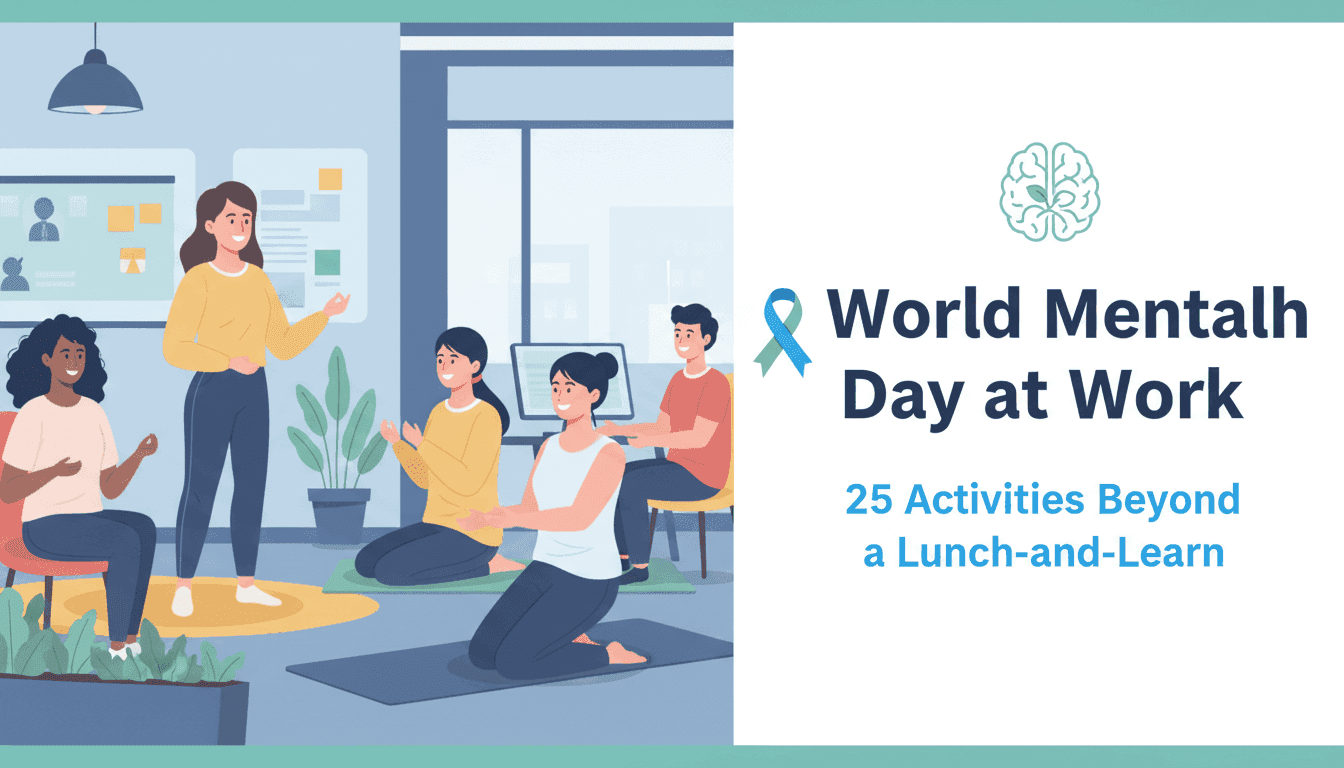
Table Of Contents
- Why One Day — and One Event — Is Never Enough
- Category 1: Spark Awareness and Reduce Stigma
- Category 2: Build Skills That Stick
- Category 3: Foster Human Connection
- Category 4: Structural and Systemic Actions
- Category 5: Make It Last Beyond October 10
- How to Choose the Right Mix for Your Organisation
- Final Thought: From Awareness to Action
Every October 10, inboxes fill up with wellness reminders, green ribbons appear on lanyards, and someone books a caterer for a midday mental health session. The lunch-and-learn has its place. But if your organisation's World Mental Health Day programming starts and ends there, you are likely missing the point — and the people who need it most.
World Mental Health Day has been observed since 1992, and its power lies not in the date itself but in what organisations choose to do with it. The World Health Organization has consistently called on employers to move beyond awareness and into systemic action. For HR leaders, people managers, and wellbeing champions, that means designing experiences that open conversations, build real skills, and signal to employees that mental health is not a one-day campaign — it is a year-round commitment.
At iGrowFit, we have spent more than 15 years helping organisations across Asia develop the psychological capital of their people — the hope, efficacy, resilience, and optimism that drives peak performance and genuine wellbeing. What we have learned is that the most impactful World Mental Health Day programmes do not just raise awareness. They build capacity.
This guide gives you 25 practical, evidence-informed activities — organised by purpose and impact level — so you can design a World Mental Health Day (and the weeks around it) that employees will actually feel.
Why One Day — and One Event — Is Never Enough {#why-one-day}
Before diving into the activities, it helps to understand what you are working against. Workplace mental health challenges are not a niche concern. According to the World Health Organization, with 60% of the global population in work, the workplace has become one of the most consequential environments for mental health — for better or worse. Unhealthy conditions, including stigma, discrimination, and chronic stress, pose significant risks to employee wellbeing and productivity. Meanwhile, research consistently shows that focusing on mental health yields a strong return: for every $1 spent on treating common mental health concerns, the WHO estimates a $4 return in improved health and productivity.
The challenge is that a single event — however well-intentioned — rarely moves the needle on stigma, skills, or culture. What does move the needle is a layered approach: activities that build awareness, activities that develop skills, activities that create community, and structural changes that signal genuine commitment. The 25 activities below are organised exactly this way.
Category 1: Spark Awareness and Reduce Stigma {#category-1}
These activities work best on or immediately around October 10. Their goal is to open the conversation and normalise talking about mental health at work.
1. Mental Health Trivia Challenge
Organise a team trivia session using tools like Kahoot or Mentimeter, with questions covering stress, resilience, burnout, anxiety, and common myths. Keep teams small (4–6 people) to encourage discussion over competition. The real value is not in the answers — it is in the conversations that follow each question. Debrief with a facilitator who can connect the facts to real workplace scenarios.
2. Mental Health Myth-Busters Wall
Print large myth vs. fact cards and post them throughout common areas — pantries, lift lobbies, meeting room walls. Pair each myth with a brief evidence-based explanation and a simple tip. Update the wall weekly throughout October to maintain momentum beyond the single day. Employees who would never attend a formal session often absorb this information passively.
3. Silent Support System
Introduce a simple, non-verbal daily check-in using colour-coded stickers or desk cards (for example: green for doing well, yellow for managing, orange for stretched). This removes the pressure of having to say "I'm fine" when you're not. Importantly, follow this up — pair it with a trained manager who knows how to gently follow through when someone signals they need support.
4. "In My Own Words" Story Board
Invite employees to anonymously share a one-sentence experience with workplace stress, burnout, or a moment when they found support. Display these on a physical or digital board on October 10. Hearing peers' words — not expert statistics — is often what breaks down stigma most effectively. Keep participation voluntary and moderated.
5. Green Ribbon Pledge Campaign
Distribute green ribbons (the international symbol for mental health awareness) alongside pledge cards where employees commit to one specific action — whether that is checking in on a colleague, taking lunch away from their desk, or trying a breathing technique. A pledge tied to a specific behaviour is far more effective than a pledge tied to vague "support." Display completed pledge cards as a collective commitment.
6. "Did You Know?" Digital Campaign
Post one evidence-based mental health statistic each workday in the two weeks leading up to October 10 — on your company intranet, Slack, or Teams. Keep each post brief and include a practical takeaway. Pair with a question that invites employee responses to drive engagement and surface what topics matter most to your team.
Category 2: Build Skills That Stick {#category-2}
Awareness without skills is incomplete. These activities give employees something practical to carry with them after October 10 is over.
7. Resilience-Building Workshop
Facilitated by a psychologist or trained consultant, this workshop introduces the four components of psychological capital — hope, efficacy, resilience, and optimism — and gives employees concrete strategies for strengthening each. Evidence across more than 50,000 employees shows that PsyCap predicts job satisfaction, organisational commitment, and job performance. Unlike generic stress management content, a PsyCap-based workshop teaches employees that these qualities are developable, not fixed. iGrowFit designs and delivers this kind of evidence-based session as part of its consultancy and training offering.
8. Mental Health First Aid Training
Equip a cohort of volunteers with the skills to recognise early signs of distress, respond appropriately, and guide colleagues toward professional support. Mental health first aiders are not therapists — but they are informed, compassionate first points of contact. Trained managers and first aiders can effectively support their teams and foster a healthier, more supportive work environment. Run an initial cohort on World Mental Health Day and schedule a refresher every six months.
9. Mindful Communication Workshop
Poor communication is one of the leading drivers of workplace stress. This workshop covers active listening, empathic language, and how to have honest conversations about workload and boundaries. Role-play exercises are particularly effective here — they allow participants to practice difficult conversations (like asking for help or addressing a struggling colleague) in a safe environment before they face them in real life.
10. Stress Inoculation Bootcamp
A half-day intensive that combines education and practice. Participants learn the physiological basis of stress responses, then work through practical techniques including box breathing, cognitive reframing, and body-based grounding exercises. Unlike a one-off workshop, structure this with a brief 10-minute follow-up session three weeks later so participants can share what worked and troubleshoot what did not.
11. Boundary-Setting Masterclass
This session addresses one of the most requested topics in modern workplaces: how to set healthy boundaries without damaging professional relationships. Cover the difference between assertiveness and aggression, how to say no to unreasonable demands, and how to communicate workload limits to managers. Include real-world scenarios drawn from your industry for maximum relevance.
12. Breathwork and Regulation Micro-Sessions
Offer three or four 15-minute guided breathwork sessions throughout the day on October 10 — before the morning stand-up, at midday, and before close of business. Research published in Scientific Reports found that breathwork interventions have a statistically significant effect on self-reported stress. Micro-sessions lower the participation barrier and serve employees who cannot commit to a full workshop. Record and share them for remote or hybrid staff.
13. Positive Psychology Workshop
Introduce the science of flourishing — covering gratitude practices, strengths identification, and the role of meaning in work — through an interactive session led by a certified positive psychology practitioner. Include a personal strengths assessment so participants leave with concrete insight into what energises them at work. Follow up with a short team debrief the following week.
Category 3: Foster Human Connection {#category-3}
Loneliness and disconnection are among the most underreported mental health risks in the workplace. These activities prioritise belonging.
14. Walk and Talk Sessions
Organise structured walking groups during lunch breaks on October 10. Assign optional conversation prompts related to mental health — or let conversations flow naturally. Physical movement reduces cortisol, and side-by-side walking (rather than face-to-face) tends to make difficult conversations feel less confrontational. This is one of the simplest, lowest-cost, highest-impact activities on this list.
15. Collaborative Wellbeing Mural
Set up a large canvas or whiteboard in a shared space and invite employees to contribute drawings, words, or messages representing what mental health means to them. Display the finished mural prominently. The act of creating something together is itself therapeutic — it builds a sense of shared identity and collective care that outlasts the day.
16. Peer Support Circle
Facilitated by an internal champion or external professional, a peer support circle brings together a small group of employees to share experiences and strategies around a common theme — managing pressure, navigating change, returning from leave. Participation should always be voluntary and the format should prioritise listening over advice-giving. These circles are particularly powerful for new managers, parents returning from parental leave, and employees in high-pressure roles.
17. "Meet the Human" Conversations
Pair employees across departments for a structured 30-minute conversation — using guided questions that invite them to share not just their work roles but something about what sustains them outside of work. This is especially valuable in larger organisations where employees in the same building may never interact. Connection is a core determinant of psychological safety, and psychological safety is what makes it possible for people to speak up about mental health concerns.
18. Gratitude Board (Physical and Digital)
Create a communal space — physical or on a platform like Miro or your intranet — where employees can post notes of appreciation for colleagues. Seed it on October 10 by having leadership post the first entries. Gratitude practices are well-supported by research as a means of improving mood and reducing stress. The social dimension of a shared board amplifies the individual benefit.
19. Random Acts of Kindness Day
Dedicate October 10 as a company-wide day of small deliberate kindness — with prompts such as leaving an encouraging note for a colleague, buying someone their morning coffee, or simply saying "how are you, really?" Share examples of what happened across the organisation at the end of the day. The aggregate effect of small kindnesses is a measurably more positive team climate.
Category 4: Structural and Systemic Actions {#category-4}
Activities are most meaningful when they are supported by policies and structural commitments. These actions signal that October 10 is not a performance — it is a reflection of how the organisation genuinely operates.
20. Manager Mental Health Briefing
Before October 10, run a dedicated 60-minute briefing for all people managers. Cover: how to recognise signs of distress in their teams, how to have supportive conversations without overstepping professional boundaries, and what formal support resources are available through your EAP. Managers trained in mental health awareness are one of the most cost-effective investments an organisation can make. They are the first line of support — and the first point of failure when that support is absent.
21. Anonymous Wellbeing Pulse Survey
Launch a brief, anonymous survey on or just before October 10 to baseline how employees currently feel about their mental health, workload, and the level of support available to them. Share the aggregated results transparently with the organisation and commit to three specific actions based on what you learn. The survey itself sends a message: we want to know, and we intend to act. Follow up with results within four weeks.
22. EAP Awareness Drive
Research consistently shows that EAP utilisation rates remain low — often because employees simply do not know what is available to them, or they associate the programme with crisis rather than proactive support. Use World Mental Health Day to run an active, personal communication campaign: short videos from leadership encouraging use, clear explanations of what the EAP covers, and testimonials (anonymised) from employees who have benefited. An EAP that is not used is not a benefit — it is a line item. iGrowFit offers EAP solutions specifically designed to drive meaningful utilisation through a multi-disciplinary team of psychologists, coaches, and counselors.
23. Policy Review and Announcement
Use October 10 as the moment to announce or reaffirm a specific mental health policy commitment — whether that is flexible working hours, clear after-hours communication norms, mental health leave provisions, or workload review processes. Employees are acutely attuned to the gap between wellness messaging and working conditions. Closing even one part of that gap on World Mental Health Day is worth more than any activity on this list.
Category 5: Make It Last Beyond October 10 {#category-5}
The risk of any awareness day is the cliff edge — intense focus on October 10, then silence. These activities are designed to sustain momentum.
24. Monthly Mindfulness Mondays
Establish a recurring 20-minute guided mindfulness or reflection session at the start of every Monday — beginning on October 10 and continuing monthly. The cumulative effect of regular, brief mindfulness practice is significantly greater than a single event. Rotate facilitators (internal champions, external coaches, trained employees) to keep the format fresh and distribute ownership of wellbeing culture across the organisation.
25. 12-Month Wellbeing Calendar
On October 10, launch a structured wellbeing calendar for the following 12 months. Include key mental health awareness dates, monthly themes, planned activities, and check-in moments. Share it with all employees and build it into team planning cycles. A calendar signals intentionality — that mental health is embedded in how the organisation operates, not bolted on as an afterthought.
How to Choose the Right Mix for Your Organisation {#how-to-choose}
Not every activity will be right for every organisation. The most effective World Mental Health Day programmes are designed with context in mind: the size of your team, your existing culture, the seniority and openness of your leadership, and the specific stressors your employees are facing.
A useful starting framework is to aim for at least one activity from each of the five categories above. This ensures you are building awareness, developing skills, creating connection, taking structural action, and planning for continuity — not just checking the October 10 box.
For organisations new to workplace mental health programming, start with the Silent Support System (#3), the Manager Briefing (#20), and the EAP Awareness Drive (#22). These three actions create a foundation of awareness, accountability, and access before you build anything more elaborate.
For organisations with an established wellbeing culture, the higher-leverage investments are the Resilience-Building Workshop (#7), the Wellbeing Pulse Survey (#21), and the 12-Month Wellbeing Calendar (#25). These deepen existing commitment and move the programme from event-based to systemic.
For remote or hybrid teams, prioritise the Digital Campaign (#6), Breathwork Micro-Sessions (#12), Guided Virtual Peer Circles (#16), and the Gratitude Board on a shared digital platform (#18). Physical distance does not have to mean disconnection — but it does require intentional design.
Regardless of where you start, the most important principle is consistency. The data is clear: organisations that invest systematically in employee wellbeing see meaningful returns in productivity, retention, and engagement. And the employees who work within them experience something that cannot be measured in ROI alone — the sense that they genuinely matter.
Final Thought: From Awareness to Action {#final-thought}
World Mental Health Day is not a destination. It is a starting point — or, for organisations already on the journey, a useful moment to recalibrate and recommit. The activities in this guide are not meant to be exhaustive. They are meant to be chosen thoughtfully, implemented with care, and followed through with consistency.
The organisations that get this right are not necessarily those with the largest wellbeing budgets. They are the ones where leaders talk openly about mental health, where managers are equipped to support their people, and where employees trust that asking for help will not cost them professionally. That kind of culture is built activity by activity, conversation by conversation, over time.
If you are planning your World Mental Health Day programme and would like guidance on which activities will have the highest impact for your specific organisation — or if you want to explore how a structured EAP can extend what you do on October 10 into genuine, year-round psychological capital development — the iGrowFit team is here to help.
Ready to go beyond awareness and build a workplace where mental health genuinely thrives?
iGrowFit has partnered with over 450 organisations — from MNCs to SMEs — to design evidence-based wellbeing programmes that deliver lasting impact. Whether you need a single World Mental Health Day workshop or a full-year EAP solution, our multi-disciplinary team of psychologists, coaches, and consultants will work with you to build something that fits your people and your goals.
👉 Chat with us on WhatsApp to speak with a wellbeing consultant today.